Realism Without an Outside
Cognition-Relative Realism and the Limit of Positive Determinability
Abstract
The classical opposition between realism and solipsism usually presupposes that one can meaningfully speak of a relation between consciousness and the external world. Realism asserts a reality independent of cognition; solipsism points to the inescapability of one’s own experience. The present paper argues that this opposition itself already presupposes too much: the problem lies not only in the assertion of an external world, but already in the concept of the “outside,” because it gives the indeterminable a form that can arise only within a cognitive system.
The central thesis is this: the so-called outside is not a positively determinable domain that stands independently over against the cognitive system, but a stabilized interpretation of the limit of positive determinability as a counter-domain. This limit does not designate a spatial division between inside and outside, but the end of an operation of determination. Likewise, the “within” of a cognitive system is not meant spatially, but designates the reach of a context of determination.
From this, neither naïve realism nor dogmatic solipsism follows. Concerning what is no longer positively determinable, it can be decided neither that it exists nor that it does not exist. Every positive determination as reality, matter, cause, structure, or world-in-itself would already be a form-giving operation within a cognitive system. The thesis is therefore not an ontology, but a limiting rule of positive determination.
At the same time, realism does not thereby lose its significance. As cognition-relative realism, it describes the form in which reality can acquire meaning, resistance, and orientational force within a cognitive system. Realism does not begin merely with the assertion of real objects, but with the construction of an external and embedding order; from the perspective of this order, the cognitive system retroactively reconstructs itself as part of it. This retroactive reconstruction is functionally powerful, but must not be confused with full access to one’s own conditions of cognition.
Keywords
Realism; solipsism; boundary tension; cognitive system; givenness; positive determination; outside; limit of positive determinability; cognition-relative reality; cognition-relative realism; cognition-relative absoluteness; science
1. From the Problem of Realism to the Question of the Outside
Every statement about reality must appear somewhere: as experience, thought, concept, measurement, theory, memory, or proof. It does not follow from this that nothing exists independently of it. But it does follow that every determination of reality already takes place within a context in which something is distinguished, designated, and stabilized as meaningful. The first question is therefore not whether there is an external world. The deeper question is whether the concept of an “outside” can be used meaningfully at all without already giving the indeterminable a form.
Philosophy has often treated realism and solipsism as incompatible fundamental positions (cf. Descartes 1996; Kant 1998; Putnam 1981). Realism assumes that a reality exists independently of cognition. Solipsism, by contrast, points out that everything that appears certain is given only within one’s own experience. Between the two positions there seems to be a hard alternative: either there is a real world outside consciousness, or all certainty remains confined to consciousness and experience.
Yet this alternative is already framed too strongly. It presupposes that one can meaningfully speak of an “outside.” This concept, however, is not neutral. Whoever says “outside” already forms a structure: an inside, a limit, another side, a possible counter-domain. In this way, the indeterminable is already given a form. This form, however, cannot come from a domain independent of the cognitive system; it arises within a context of determination.
The central thesis of this paper is therefore this: the so-called outside is not a positively determinable domain that stands over against the cognitive system as an independent counter-domain. It is already a stabilized interpretation of the limit of positive determinability as a counter-domain. The outside is not the limit itself, but a form in which this limit is misunderstood as a kind of other region, counterpart, or independent order of reality.
Cognitive system does not here necessarily mean a conscious subject. The term is not used here in the narrow sense of cognitive science. It designates the broader context in which givenness can pass into distinction, stabilization, meaning, and reality-formation. Whether such a context also includes experience, orientation, action, or subjectivity is an additional question.
This shifts the question. It is no longer primarily a matter of whether there is an external world or not. That question already presupposes too much. Rather, the issue is which positive determinations are permissible at all if every determination takes place within a context of cognition. What is determined as reality, matter, cause, structure, or world is already formed, distinguished, and meaningfully stabilized. What lies beyond the reach of positive determination can be determined neither positively nor negatively.
This thesis does not lead to dogmatic solipsism. It does not claim that only consciousness exists. Nor does it claim that world, science, other human beings, or material structures are mere illusions. It merely says: everything positively determinable appears within a context of determination. What lies beyond this determinability cannot be determined as reality without already being transferred into a form internal to a cognitive system.
At the same time, realism does not thereby become worthless. On the contrary, it becomes more precisely determinable. Realism is not real because it proves an absolute reality independent of the cognitive system. It is real because, within a cognitive system, it stabilizes the form in which reality can carry meaning at all. Reality here does not mean access to a world-in-itself, but stable resistance, expectational stability, corrigibility, and orientational relevance.
The paper develops this thesis in several steps. First, the initial tension between realism and solipsism is reconstructed. The boundary tension between the two positions is then introduced as a heuristic intermediate step. Subsequently, givenness, positive determination, and the limit of positive determinability are clarified. This is followed by the decisive sharpening: the outside is not the limit itself, but the stabilized interpretation of the limit as a counter-domain. The concept of cognitive system is then distinguished from experiential system, orientation system, action system, and subject. Finally, reality, absoluteness, realism, science, and empiricism are reconstructed in cognition-relative terms.
2. Realism and Solipsism as Initial Tension
Realism asserts that a world exists independently of cognition (cf. Putnam 1981; van Fraassen 1980). This world is not merely a content of consciousness, but that to which perception, science, language, and action refer. The realist can therefore say: the world is not there only because it is experienced. It exists independently of whether it is cognized or not.
Solipsism begins from another point, one connected to the Cartesian question of certainty (Descartes 1996). It emphasizes that only one’s own experience is immediately given to the cognizing context. Everything that appears as world, body, history, nature, measurement, or another subject appears within a field of experience or determination. Solipsism need not immediately assert that only this experience exists. The weaker insight already suffices: everything that appears as certain or determinable appears within an act of determination.
The conflict arises because the two sides emphasize different functions. Realism emphasizes stability, resistance, and world-reference. It explains why experience is not arbitrary and why science, communication, and orientation appear possible. Solipsism, by contrast, emphasizes the limit of ultimate grounding. It reminds us that every form of evidence, including evidence for an independent reality, itself appears within experience or determinability.
Both insights carry weight. Without the solipsistic insight into limits, realism becomes naïve. It treats the stable form of the world as if it were already access to a reality in itself. Without realistic stabilization, however, the solipsistic insight becomes empty. A system that cannot stabilize reality cannot build robust expectations, corrections, or a shared order.
The problem, therefore, is not that realism or solipsism is simply false. They become problematic only when they are metaphysically inflated. Realism becomes too strong when it derives a cognized world-in-itself from stable world-relations. Solipsism becomes too strong when it infers from the inescapability of experience the nonexistence of everything else. Both then exceed the limit of what can meaningfully be determined.
3. The Boundary Tension Between Realism and Solipsism as an Intermediate Step
The tension between realism and solipsism can be described as boundary tension. What is meant is a structural tension of cognition: the more strongly reality is fixed as independent, the more strongly the role of the cognitive system in its determination is concealed; conversely, the more strongly the inescapability of experience is emphasized, the more uncertain the stability of a shared world becomes.
This boundary tension shows that realism and solipsism are not simply two separate worldviews. They designate two poles of a single problem of cognition. Realism stabilizes world-reference. Solipsism marks the limit of ultimate grounding. Realism makes stable reality possible. Solipsism prevents this stability from being confused with absolute cognition.
In this function, boundary tension remains a useful reference concept. It makes perceptible that realism and solipsism do not simply exclude one another, but limit one another. It allows the tension between realistic world-fixation and solipsistic insight into limits to be named without having to unfold the entire argument anew each time.
Yet this boundary tension remains an intermediate step. It still works with the language of inside and outside. It speaks as if there were, on the one hand, an inner experience and, on the other, an outside to which this experience refers. Precisely this opposition must be examined further.
For “outside” is not a neutral concept. It gives the impression of designating a domain outside the reach of positive determination. But such a domain is not positively determinable. As soon as it is described as outside, it already receives a form: it is thought as another side, as a possible counterpart, as a space on the other side of a limit. This form-giving, however, occurs within the cognitive system.
The boundary tension between realism and solipsism therefore shows the initial tension. The actual sharpening, however, consists in the fact that not only the realistic assertion of an external world is problematic, but already the concept of “outside” itself.
4. Givenness and Positive Determination
In order to formulate the sharpening of the problem of realism clearly, givenness and positive determination must be distinguished. Givenness here does not yet mean cognition, reality, or world. It designates only the inescapable starting point that something appears or is given at all. This givenness is not to be understood as an object among objects. As soon as it is described as something determinate, a further operation has already been added.
Likewise, givenness is not already to be understood as the directed experience of a subject. At the beginning, there is not already a subject looking at a world. Such a formulation would presuppose too much: subject, object, direction, perspective, and world-reference. Givenness here more cautiously designates the limit at which something is first given at all, before it is determined as this or that. Directedness, perspective, and subject-form are later achievements of determination and stabilization; their genesis is not developed separately in this paper, but it must not already be presupposed.
Positive determination begins where something is distinguished, formed, designated, stabilized, or transferred into meaning. A positive determination does not merely state that something is given. It says what it is, how it is valid, to what it is related, what form it has, or what role it plays. Concepts such as reality, matter, cause, structure, world, subject, and outside are such positive determinations.
This shows that the core of the problem does not begin merely with the question of realism. It begins already with form-giving. Everything asserted as reality is already determined. Everything designated as outside is already formed. Everything addressed as a cause has already been transferred into an order of meaning.
This distinction is decisive. Givenness itself must not be confused with reality. Reality is not mere raw givenness. Reality arises only where determinations become stable enough to function as resistant, expectationally stable, corrigible, and meaning-bearing. Reality is therefore not simply engagement with a finished outside, but stabilized determination.
Likewise, cognition must not be equated with mere experience. Experience can occur as givenness without already having been transferred into reflected determination, stable meaning, or a reality-form. Positive determination is a further stage: it turns what is given into something determinable, recognizable, and meaningful within a context.
The question of the outside is therefore a question of the legitimate reach of positive determination. It is not: What lies out there? It is: may anything be determined as “out there” at all if this “out there” is supposed to designate precisely what lies beyond the reach of positive determinability?
5. The Limit of Positive Determinability
The limit of positive determinability designates the point at which a context of cognition can mark its own reach without being able to make a legitimate statement about what lies beyond that reach. This limit is not a wall between two known domains. Nor is it a line behind which an unknown world begins that has nevertheless already been determined as reality. It designates the end of the possibility of making meaningful positive determinations.
The distinction between marking a limit and determining an outside is therefore decisive. A marking of a limit is reflexively minimal: it does not assert what lies beyond the limit, but merely records that positive determination ends at this point. A determination of an outside goes beyond this. It interprets the end of determination as another side, counter-domain, or independent order of reality. Only the first operation is methodologically permissible; the second already gives the indeterminable a form.
Limit here therefore does not mean: here inside, there outside. It does not designate a line between a determinable inside and an indeterminate outside, but the end of an operation of determination. Precisely for this reason, the limit of positive determinability must not itself be understood as indicating a domain beyond the limit.
A positive determination exists when something is determined as reality, matter, cause, structure, world, object, subject, or property. Such determinations already presuppose forms of meaning. They presuppose that something can be distinguished, designated, stabilized, and brought into a context. Precisely these achievements belong to the context of cognition.
Therefore, what can here only be marked as not-positively-determinable must not be determined as reality, matter, cause, structure, or world. Nor can it be determined as nonexistence. For negation too would be a statement about what is precisely not positively determinable.
The only clean statement is this: what lies beyond the reach of positive determination can be decided neither as existent nor as nonexistent. It can only be marked as a limit of determinability. This marking is not cognition of an object. It is a self-limitation of determination.
The limit of positive determinability thereby cuts off two overextensions. It permits no absolute external-world assertion, but also no absolute denial of the world. Naïve realism goes too far when it infers a world-in-itself from stable reality-forms. Dogmatic solipsism likewise goes too far when it infers the nonexistence of everything else from the inescapability of experience. Both statements exceed the limit of what can meaningfully be determined.
6. Why “Outside” Already Says Too Much
The concept of “outside” initially seems cautious. It seems merely to suggest that something might lie beyond the reach of positive determination. Yet even this suggestion already forms the indeterminable. Whoever speaks of an outside does not merely mark an end of determination, but interprets this end as a counterpart: as another side, as a possible domain, as something that stands over against the cognitive system.
A limit thereby becomes a counter-domain. This is precisely where the metaphysical overextension lies. A cognitive system can mark that positive determination ends. But it cannot legitimately determine that beyond this end there lies an outside in the sense of a domain, space, or counterpart. Such a determination would already apply its own forms to what is precisely not positively determinable.
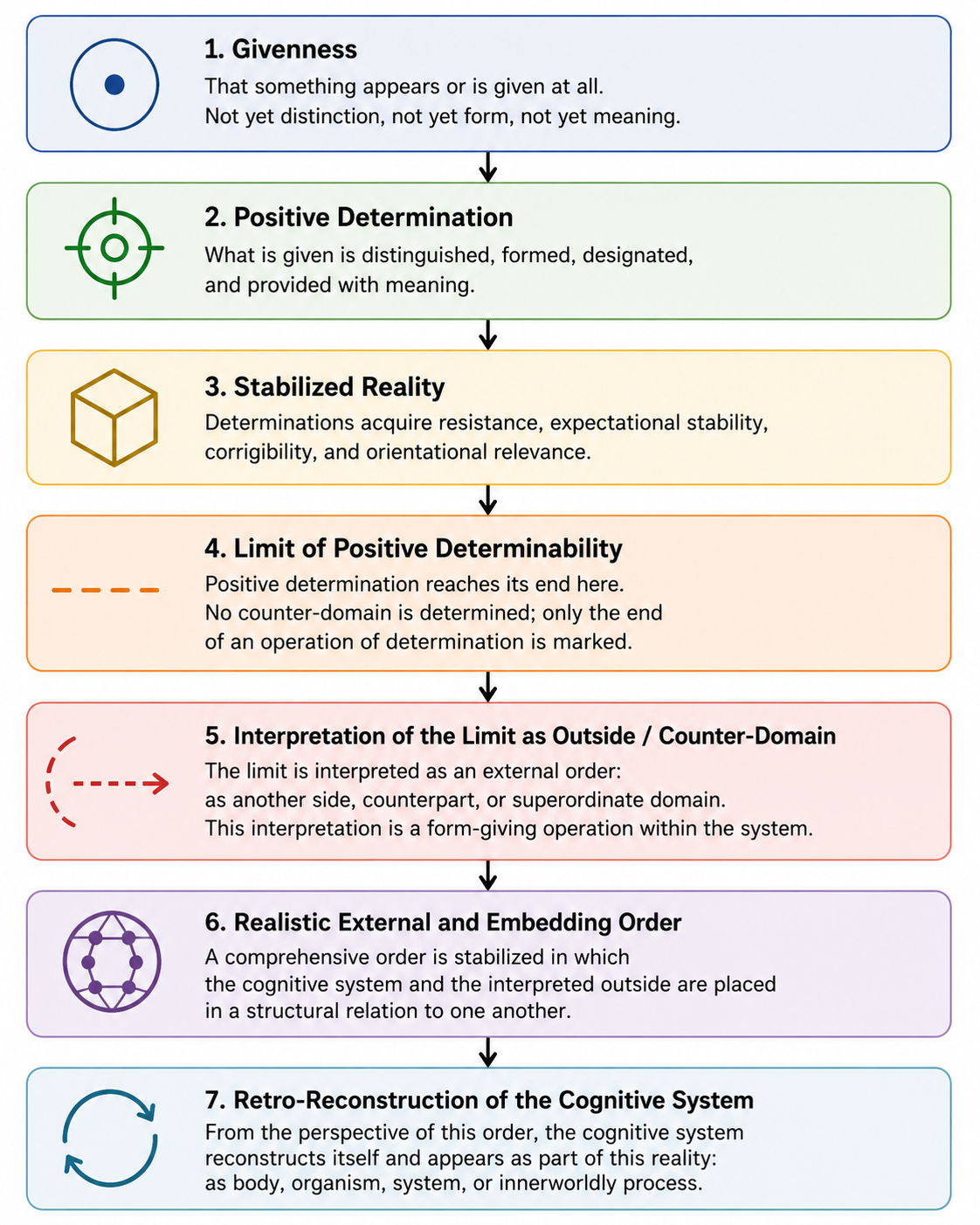
The crucial point can therefore be stated as follows:
The outside is not the limit itself, but already the stabilized interpretation of the limit as a counter-domain.
The thesis is therefore not an ontology. It does not assert what ultimately exists or does not exist. It formulates a limiting rule of positive determination: what is no longer positively determinable must not be positively fixed either as external world, matter, cause, structure, or world-in-itself, or as nonbeing. Realism is not refuted thereby; its metaphysical surplus is limited.
The interpretation of the limit as outside is not simply false. Rather, it is highly productive. The idea of an outside in which the cognitive system is embedded generates precisely the form that supports realism. Reality then appears as something that stands over against the cognitive system, limits it, corrects it, and integrates it into a more comprehensive order. This makes world-reference, embodiment, causality, other systems, science, expectation, and possible orientation stabilizable.
Precisely for this reason, realism does not begin merely with the statement “There are real things.” It begins already with the assertion of an outside itself: with the form in which a cognitive system understands itself as embedded in a more comprehensive order of reality. This external and embedding representation is the actual basic operation of realism. It makes reality not merely something that appears, but an order from whose perspective the cognitive system can understand itself.
Naïve realism usually performs this step tacitly. It treats the external order stabilized by a cognitive system as if it were direct access to an outside independent of the cognitive system. It overlooks the fact that “outside” is already a form. This form does not arise outside the cognitive system, but within the determination that interprets its own limit as a counter-domain.
As soon as this outside is defined as real, the direction of determination reverses. The cognitive system now no longer appears as the context in which positive determination and reality-formation become possible. It appears as part of the very reality that has emerged from its own achievement of determination: as body, brain, organism, physical system, or innerworldly process.
This retroactive reconstruction inherent in realism is functionally very strong. It makes scientific self-description, biological classification, psychological explanation, and social orientation possible. Yet it must not be confused with a complete self-description or ultimate grounding of the cognitive system. For the external order from whose perspective the cognitive system is now reconstructed is itself already a reality-form stabilized within a cognitive system.
The formulation “There could be an outside” therefore remains intelligible only as a cautious boundary expression. Strictly speaking, it does not name a determinable domain, but only the possibility that the limit of positive determinability is interpreted as outside within the cognitive system.
7. Within Without an Outside
Talk of “inside” or “within” must also be clarified. When it is said that positive determination takes place within a cognitive system, this “within” must not be understood spatially. It does not designate a closed space that has an outside standing over against it. It designates the reach of a context of determination.
The “within” of the cognitive system is therefore not an inner side. It is the operative context in which givenness can be distinguished, formed, stabilized, and made meaningful. Within here means: within the conditions under which positive determination is possible.
An analogy can clarify this. Even in the case of spatial wholes, extension does not necessarily imply a determinable outside. A universe can be thought of as spatially extended without thereby already positing a spatial outside. A spatial outside would be meaningful only if the universe itself lay within a larger space. But this is not already given by the concept of extension.
Still less does an outside follow from the “within” of a cognitive system. For this within is meant not spatially, but operatively. The space of determination of a cognitive system has reach without thereby having to be embedded in a superordinate space with an outside.
This avoids a widespread misunderstanding. Whoever hears “within the cognitive system” may easily think of a container that must have an outside. That is precisely not what is meant. The cognitive system is not a space. It is not a vessel. It is not an inner domain with an external counterpart. It is the context of positive determinability.
The question “What lies outside this context?” therefore already repeats the problematic form-giving. It turns the reach of an operation into a spatial or object-like domain. More precisely: where positive determination ends, no counter-domain can be determined.
8. Methodological Self-Limitation: No Divine View of Cognitive Systems
At this point, an important objection arises. If it is said that a cognitive system cannot go beyond its own limit of determinability, this may sound as if the cognitive system itself were being viewed from outside. The theory would then presuppose precisely what it denies: a standpoint outside the cognitive system.
This objection is justified. Talk of the cognitive system must not claim a divine view. It must not pretend that a cognitive system can be fully surveyed from outside. The theory of the cognitive system is itself an operation internal to a cognitive system. It arises within a space of determination, not outside it.
But it does not follow from this that one may no longer speak of cognitive systems at all. It follows only that such talk must be reflexively limited. The concept of cognitive system does not designate an object that is fully grasped from a neutral external standpoint. It designates the context within which givenness, distinction, stabilization, meaning, reality, and limit can become thematic at all.
The theory therefore does not claim: this is what the cognitive system is in itself. It claims more cautiously: within a cognitive system, it can be reconstructed that every positive determination takes place within a context of determination. This reconstruction too is itself such a determination. It therefore does not abolish the limit, but makes it explicitly visible.
This is not a faulty circle, so long as the theory discloses its own position. A circle would be faulty if it asserted an external view that, according to the theory’s own thesis, is impossible. What is not faulty is a reflexive structure in which a cognitive system does not prove its own conditions of determination from outside, but recognizes them as inescapable in the enactment of its determinations.
The situation resembles logic. Logic cannot be proved from outside logic, because every proof already operates logically. This does not make logic arbitrary. Rather, it shows that it cannot be meaningfully left behind within argumentation. Likewise, a cognitive system cannot prove from outside its forms of determination that all determination takes place within forms of determination. But it can recognize that every contrary assertion would in turn be a determination within this context.
The methodological self-limitation is therefore this: the following analysis claims no standpoint outside the cognitive system. It is a reflexive reconstruction within a cognitive system. It does not describe the cognitive system from outside, but marks the limit that shows itself in the enactment of positive determination.
9. Cognitive System, Experience, Orientation, Action, and Subject
The concept of cognitive system must be relieved of excessive burden. It must not be tacitly equated with experience, orientation, action, or subjectivity. A cognitive system initially designates only the context in which positive determination becomes possible: givenness can be distinguished, formed, stabilized, related, and made meaningful.
A cognitive system is also not to be understood from the outset as directed or perspectival. Directedness arises only where positive determinations develop reference-structures: something is grasped as related to something, distinguished from something, or situated within a certain order of relevance. Perspective is stronger still. It arises where such reference-structures become a stable positional order. The paper does not pursue this genesis in detail, but it must mark that it is not already presupposed in the concept of cognitive system.
Not every cognitive system is necessarily an experiential system. An experiential system would be a system in which raw experience or phenomenal givenness occurs. Whether a system possesses such raw experience is an additional question. It must not be derived from mere determinative or model-forming capacity.
Not every cognitive system is already an orientation system. Orientation presupposes stable forms of meaning and reality, but it is not identical with determination itself. A cognitive system can form the preconditions for orientation by forming reality as stable, resistant, and expectationally stable. Orientation arises only where such reality-forms are used for relevance, direction, decision, or possible practice.
Not every cognitive system is already an action system. Action presupposes a further coupling: a system must not only determine and orient, but also be able to intervene in a situation, react, or develop behavior. Reality-formation can make action possible, but it is not already action.
Subjectivity is also a stronger form. A subject can be understood as an integrated coupling of raw experience, cognition, affective valence, self-reference, orientation, and action. It experiences, distinguishes, evaluates, orients itself, acts, and can relate to itself in a certain way.
This differentiation prevents the concept of cognitive system from carrying too much. It does not automatically designate a conscious, feeling, acting, or originally perspectival system. It initially designates only the context of positive determinability and reality-formation. On this basis, experience, orientation, action, and subjectivity can be connected; they are not already contained in the concept.
10. Modeled Cognitive Systems and Reflexive Retransfer
Talk of the cognitive system is further stabilized by the fact that cognitive systems can model other cognitive systems. Within its own space of determination, a cognitive system can understand other systems as distinguishing, stabilizing, expecting, capable of irritation, capable of learning, or capable of orientation. It does not cognize these other systems absolutely. It models them.
Such a model can be functionally robust. If another system is treated as a cognitive system, stable expectations, communication, and coordination can arise. The model then proves itself not as access to a thing-in-itself, but as a viable order within one’s own space of determination.
Functional confirmation does not appear abstractly, but in concrete achievements of stability: such models make robust expectations possible, respond to correction, stabilize communication, and repeatedly allow successful coordination. Their viability therefore lies not in access to the other system in itself, but in their robust function within one’s own space of determination.
Under certain conditions, such a model can be reflexively transferred back to one’s own domain. A cognitive system can say: what I model in other cognitive systems as distinction, stabilization, expectation-formation, irritation, and correction can, under structural comparability, also be used to describe my own operations.
This retransfer is not absolutely grounded. It is legitimized functionally and cognition-relatively. Its legitimacy does not arise because the other cognitive system would be cognized in itself. It arises because modeling that system within one’s own space of determination makes robust expectations, corrections, and coordination possible. Structural comparability is therefore not asserted metaphysically, but supported through functional confirmation.
Retransfer is thus not an external view of oneself. It is a model-mediated self-reconstruction. The cognitive system does not cognize itself completely from outside, but gains a self-model through the modeling of other cognitive systems and through functional comparability with them.
Several conditions must be fulfilled for this. First, structural comparability must exist: the other system must be modelable as operating similarly in relevant respects. Second, functional confirmation must be present: the model must make robust expectations and corrections possible in dealing with the other system. Third, the model-character must remain marked: the other system does not appear absolutely, but within one’s own space of determination. Fourth, retransfer must not be misunderstood as complete self-knowledge.
In this way, legitimate talk of the cognitive system arises without a divine view. A cognitive system cannot detach itself from itself. But it can model other cognitive systems, test these models, and, under certain conditions, relate them back to itself. Self-description remains cognition-relative, but it is not arbitrary.
The crucial point is this: self-knowledge here arises not through an external view, but through reflexive retransfer of modeled cognitive systems.
11. Reality as Stabilized Determination
If positive determination is possible only within a cognitive system, the concept of reality must also be determined anew. Reality can then not primarily mean: that which exists in itself independently of the cognitive system. Such a definition would already be a positive determination beyond the reach of legitimate determinability.
Reality is also not identical with mere givenness. Givenness means only that something appears or is given. Reality arises only when determination becomes stable enough to carry resistance, expectational stability, corrigibility, and meaning. Reality is therefore stabilized determination.
For a cognitive system, reality means that something shows itself as stable, resistant, expectationally stable, not arbitrarily changeable, and orientationally relevant. Reality is that in relation to which expectations are formed and corrected. It is what cannot simply be abolished by wish, imagination, or arbitrary positing.
This determination does not make reality subjectively arbitrary. Precisely resistance and corrigibility show that reality for a cognitive system is not merely free invention. A real order is an order that carries, limits, irritates, confirms, disappoints, and structures possible orientation. It is real within the conditions under which reality can carry meaning at all.
The question of meaning is thereby separated from the question of existence. Whether something exists beyond the reach of positive determination remains undecidable. What reality means, by contrast, can be understood only within a cognitive system. There, reality does not mean an absolute world-in-itself, but a stable form of meaning, resistance, and order.
This distinction is decisive. What lies beyond the reach of positive determination may remain open as a boundary question. But the meaning of reality cannot meaningfully be shifted there. For meaning arises only where distinction, stabilization, comparison, expectation, and, where applicable, orientation occur. Without such a context, it is unclear what reality as meaning is supposed to mean at all.
Therefore, the statement that the meaning of reality exists in the same way outside the cognitive system loses its sense. It transfers a meaning-form internal to a cognitive system onto what is precisely not determinable within a cognitive system. It asserts not only something undecidable, but already gives this undecidable the form of reality.
More precisely: the existence of what lies beyond the reach of positive determination remains undecidable; the meaning of reality is cognition-relative.
12. The Cognition-Relative Meaning of the Absolute
The clarification concerns not only the concept of reality, but also the concept of the absolute. Ordinarily, “absolute” means something that is valid independently of perspective, condition, cognitive system, and context of meaning. Yet this concept too carries meaning only within a cognitive system.
Accordingly, “absolute reality” can no longer be understood without qualification as an ultimate reality independent of the cognitive system. For as soon as “absolute reality” is determined, a context of meaning is already active. Something is distinguished, designated, asserted, thought, and brought into a form. This operation lies within a cognitive system.
This does not mean that the concept of the absolute must be eliminated. It must be understood differently. For a cognitive system, absoluteness can take the form of maximal stability, inescapability, or binding validity. Something can be absolute within a cognitive system insofar as it cannot meaningfully be further relativized there.
At least two forms can be distinguished here. First, there is an absoluteness of givenness: that something appears or is given at all cannot be meaningfully bypassed within a context of cognition, because every denial appears in turn as givenness. Second, there is an absoluteness of stabilized reality: within a context, an order of reality can be so binding, resistant, and corrigible that it practically cannot be arbitrarily suspended.
Both forms are cognition-relative. They prove no world-in-itself. But neither are they merely arbitrary. A wall, a pain, a social conflict, or a measured value can possess compelling reality within the respective context of determination without thereby proving absolute reality in the metaphysical sense.
Absoluteness thereby becomes cognition-relative. This may initially sound contradictory, but it is precise. It means: absolute is not what would be determined in itself outside every cognitive system. Absolute is what possesses, within a cognitive system, a function that cannot be arbitrarily abolished, is maximally stable, or is inescapable.
This clarification prevents a false either-or. If reality cannot be determined as absolute in the metaphysical sense, it does not follow that it is merely relative or arbitrary. It can be cognition-relatively absolute: binding, resistant, inescapable, and orientation-generating within the context in which reality carries meaning at all.
13. Realism as a Real Form of Stabilization in a Cognition-Relative Sense
From the argument so far, a new determination of realism follows. Realism is not the cognition of a determinable outside. Such an outside cannot be positively determined. Rather, realism is the form in which a cognitive system organizes reality as a stable external and embedding order.
This external order must not be confused with a metaphysical outside. It arises within the cognitive system as a functional structure: something is treated as independent of mere wish, as resistant, enduring, expectationally stable, and possibly orientationally relevant. In this sense, realism is operatively necessary as soon as stable reality is needed for orientation, correction, communication, or science.
The decisive step of realism, however, does not consist only in asserting real objects. It consists in stabilizing an external order as real and then reconstructing the cognitive system from the perspective of this external order. The cognitive system thereby appears as part of reality itself: as body, brain, organism, social being, or physical process.
This perspective is not a genuine perspective from outside the cognitive system. It is an internally formed external perspective. The cognitive system forms an order of reality, posits it as an external order, takes up a perspective on itself within this order, and then reconstructs itself as part of this reality. Precisely this shift of perspective makes realism productive and, at the same time, epistemologically dangerous.
It is productive because it makes embodiment, causality, natural science, the social world, biological self-description, and practical orientation possible. It is dangerous when the origin of this external order is forgotten. Then the cognitive system no longer appears as the context of conditions for positive determination, but only as an innerworldly object. The reality stabilized by it is retroactively declared to be the origin from which the cognitive system itself emerges.
Realism is therefore real in a cognition-relative sense. It is real in the sense in which reality can carry meaning at all within a cognitive system. It proves no world-in-itself, but it stabilizes world-reference. It grounds no absolute outside, but it generates a viable external order. It is not metaphysically final, but functionally significant.
Cognition-relatively real does not mean less real, merely subjective, or arbitrary. Rather, it means that reality-forms can be stable, robust, corrigible, and orientationally relevant without therefore being determinable as reality in itself independent of the cognitive system. Precisely thereby, the false opposition is avoided according to which something must be either absolutely real or merely subjective.
Cognition-relative realism thereby avoids two errors. It avoids naïve realism because it does not claim that reality is accessible as world-in-itself. But it also avoids shallow antirealism because it does not claim that reality is mere appearance. Reality is real where it operates stably and bindingly within a cognitive system.
The central formula is:
Realism is not real because it proves an absolute reality, but because within a cognitive system it stabilizes precisely the form in which reality can acquire meaning, resistance, and orientational force at all.
More precisely:
Realism is the perspective-form internal to a cognitive system in which a cognitive system stabilizes an external order and subsequently reconstructs itself from the perspective of that order as part of it.
Realism is thereby not refuted, but newly situated. It is not an ultimate metaphysical thesis, but a functional form of reality for finite cognitive systems.
14. Science and Empiricism
This position is not directed against science. Science does not need naïve metaphysical realism in order to function (cf. Carnap 1950; van Fraassen 1980). It needs stable observations, robust models, reproducible procedures, corrigibility, and functional confirmation. All of this remains fully possible.
Scientific objects can be functional-empirically real. A virus, an electron, a planet, or a neural process is not meaningless because it is not proved as a thing-in-itself. Such objects are real insofar as they are stably measurable, theoretically integrable, predictively powerful, and practically effective within scientific orders.
What is eliminated is only the additional metaphysical claim that scientific models grasp a reality in itself independent of the cognitive system. Science can be understood as a highly developed stabilization of experiential and measurement orders (cf. Popper 2002; van Fraassen 1980). Its strength lies in its robustness, not in a provable escape from the cognitive system.
Empiricism therefore does not begin with a neutral view of an already fully determined external world. It begins with the possibility of stabilizing something at all as observation, measurement, or data structure. This stabilization can be methodologically refined, intersubjectively tested, and technically extended. But it does not abolish the limit of positive determinability.
Science thereby remains strong. It is only epistemologically relieved of a burden. It does not have to prove absolute reality in order to be valid. It must show that its orders are viable, corrigible, and effective within their domains.
15. Brief Positioning
The position developed here does not stand outside the philosophical tradition. It touches several familiar lines without being identical with them. Its independence does not consist in posing the question of realism for the first time, but in analyzing the concept of “outside” itself as a stabilized interpretation of a limit of determination, and in understanding realism as an operation of externalization and retroactive reconstruction.
Kant separates appearance and thing in itself and shows that cognition is bound to the conditions of possible experience (Kant 1998). The present argument shares the rejection of naïve access to reality in itself. It shifts the emphasis, however: not only does the thing in itself remain unknowable, but talk of an “outside” is already problematic as soon as it is supposed to do more than mark a limit of positive determinability. The limit is not understood here as an indication of a determinable counter-domain, but as the end of an operation of determination.
Husserl’s phenomenology is also relevant insofar as it does not presuppose world as a merely present external world, but asks about the conditions of its givenness, intentionality, and constitution (Husserl 1960; 1970). His analyses of consciousness, intentionality, and intersubjectivity in particular touch the problem addressed here. The present argument, however, does not begin with the phenomenological description of intentional acts of consciousness, but with the more general question of when a limit of positive determinability is illegitimately interpreted as outside or counter-domain. Whereas Husserl analyzes the constitution of world within the horizon of transcendental subjectivity, this paper focuses on the epistemological overextension of the concept of outside and the realistic retroactive reconstruction of the cognitive system.
Sellars’s critique of the myth of the given is also relevant because it warns against treating givenness as an ultimate basis that already generates cognition. The concept of givenness used here is precisely not intended to designate a positively determined foundation, an object, or a conceptually unmediated source of cognition. Givenness merely marks the inescapable starting point that something appears or is given at all. Cognition, reality, world, and outside arise only where positive determination, stabilization, and meaning are added.
Carnap’s distinction between internal and external questions of existence points in a related direction (Carnap 1950). Questions of existence acquire their sense within a linguistic or theoretical framework. The thesis defended here, however, does not begin primarily in linguistic logic. It does not first ask within which linguistic framework an existence-claim is meaningful, but how a reality-form arises at all in which something can be determined as object, world, outside, or reality. The focus therefore lies on positive determination, limit, and reality-stabilization, not on the choice of a linguistic framework.
Putnam’s internal realism is one of the closest points of contact for the position developed here, especially because it rejects the idea of a ready-made world and seeks to think realism without a metaphysical external standpoint (Putnam 1981; 1990). The proximity lies in the fact that reality is not understood as an independently finished, articulated order to which cognition merely gains access. Putnam’s critique of metaphysical realism, his rejection of a God’s-eye view, and his emphasis on conceptual mediation converge with the present paper’s rejection of unmediated access to a world-in-itself. This reference to Putnam is not meant to reconstruct the full development of his realism, but to mark the point at which his critique of metaphysical realism intersects most strongly with the present argument. The difference, however, lies in the level at which the analysis begins. Putnam criticizes the idea of a ready-made world and works primarily through questions of reference, truth, conceptual schemes, and rational acceptability. By contrast, the present paper makes the prior external form itself the problem: not only a ready-made world, but already the interpretation of a limit of determination as an external order is analyzed. The decisive point is therefore not only that reality is not available without a scheme, but that realism forms an external order and subsequently reconstructs the cognitive system from the perspective of that order as part of it.
Van Fraassen’s constructive empiricism limits the claim of scientific theories by separating scientific acceptance from metaphysical realism (van Fraassen 1980). This line too is relevant. The difference lies in the fact that constructive empiricism primarily limits the truth-claim of scientific theories with respect to unobservable entities, whereas the present argument begins more deeply: observability, measurability, and empirical reality themselves are also understood as stabilized forms of positive determinability. Science thereby remains strong, but its reality-status is determined not metaphysically, but cognition-relatively.
Goodman’s talk of ways of worldmaking is also related insofar as it shows that world must not simply be presupposed as a finished order (Goodman 1978). The position defended here differs, however, in that it does not primarily examine the plurality of possible world-versions, but the limit at which every positive determination of world ends. The focus therefore lies less on the plurality of world-versions than on the status of the concept of outside and realistic retroactive reconstruction.
Constructivist and systems-theoretical approaches are also relevant, especially where observation, self-description, and world-reference are not understood as access to an independently finished given order (cf. Luhmann 1995). The insight that self-descriptions occur within the world described by them touches the figure of realistic retroactive reconstruction developed here. The difference, however, lies in the focus: this paper does not develop a theory of social systems, operative closure, or communication, but analyzes the specific epistemological overextension of the concept of outside. What is decisive is not only that world-reference operates system-relatively, but that already the interpretation of a limit of determination as outside constitutes a positive form-giving.
Finally, Wittgenstein is relevant insofar as meaning cannot be understood independently of use, practice, and form of life (Wittgenstein 2009). Here too there is proximity to the thesis that reality carries meaning only within a context of determination. This paper, however, formulates the question not primarily in terms of language-practice, but epistemologically: it examines why the so-called outside cannot count as a positively determinable domain and why realism nevertheless remains necessary as a cognition-relatively real form of stabilization.
The contribution therefore does not understand itself as an isolated counterposition to the tradition. It recalls an old, unresolved question, but sharpens it at a specific point: it is not only the assertion of an external world that is problematic. Already “outside” is an overextended form-giving of what may only be marked as the limit of positive determinability, not as a counter-domain. The paper’s own point lies in connecting this analysis of limits with the thesis that realism performs a productive double operation: it stabilizes an external order and then reconstructs the cognitive system from the perspective of that order as part of it.
16. Realism as a Necessary but Not Absolute World-Form
The classical opposition between realism and solipsism conceals the decisive question of limits. It is not only the assertion of an external world that is problematic, but already the interpretation of the limit of positive determinability as outside. This limit is not a division between two domains, but the end of an operation of determination. The “within” of a cognitive system must therefore likewise not be understood spatially, but as designating the reach of a context of determination. Realism is thereby not refuted, but newly situated as a necessary, though not absolute, world-form of finite cognitive systems.
The boundary tension introduced in Chapter 3 therefore does not dissolve, but changes its status. Realism and solipsism no longer appear as two metaphysical end-positions, but as mutual limitations: realism stabilizes world-reference; the solipsistic insight into limits prevents its absolutization.
Concerning what lies beyond the reach of positive determination, it can be decided neither that it exists nor that it does not exist. Every positive determination as reality, matter, cause, structure, or world-in-itself would already be an operation internal to a cognitive system. Likewise, the assertion that there is nothing there would also be an impermissible determination. The limit permits no positive world-thesis, but also no negative one.
This insight does not lead to the abolition of reality. It leads to a more precise determination of reality. For a cognitive system, reality is not mere givenness, but stabilized determination: a form of meaning, resistance, expectational stability, and possible orientational force. In this sense, reality can be cognition-relatively absolute: not as access to a world-in-itself, but as a bond within a context of meaning and order that cannot be arbitrarily abolished.
Realism is thereby neither naïvely confirmed nor rejected. It is functionally reconstructed. It is a cognition-relatively real form of stabilization, not metaphysically secured access to an outside. It does not begin merely with the assertion of real objects, but with the external and embedding representation: the cognitive system stabilizes an external order and subsequently reconstructs itself from the perspective of that order as part of it. This reconstruction is strong in orientation and explanation, but remains a model-like retro-description within the stabilized order. The cognitive system thereby appears as part of reality, although this reality-form itself could acquire meaning only within a cognitive system.
The productive turn consists in the fact that the critique of realism does not lead to mere solipsism. A cognitive system cannot cognize an absolute outside, but it can stabilize reality; and this stabilization supports orientation, science, correction, and possible action.
What follows is not a finished individual methodology, but a methodological maxim: reality-forms are to be judged according to their stability, resistance, corrigibility, and orientational achievement, not according to whether they claim metaphysical access to an outside. Within this framework, a theory gains weight not by asserting a metaphysical outside, but by making reality-forms more stable, more corrigible, and more capable of orientation. Science, consciousness research, and model-formation are thereby not devalued, but relieved of an unnecessary claim to ultimate grounding.
The determination of cognition-relative reality developed here also forms an epistemological point of connection for further analyses of stabilization, model-formation, and contingency processing. This connective function, however, does not presuppose any superordinate system architecture. The paper remains limited to the clarification of the problem of realism: reality can be stable, binding, and orientationally effective within a cognitive system without thereby having to be determined as a metaphysical outside.
Conceptual Canon of This Paper
The following conceptual canon serves to stabilize central meanings within this text. It is used where an explicit conceptual reference basis is required for the argument of this paper. It makes no claim to completeness or final systematicity. Concepts not listed here either do not belong to the functional core of this paper or are treated separately in other works.
This paper stands in systematic proximity to epistemological debates about realism, solipsism, internal reality, constructive empiricism, and the limits of positive determinability. It does not, however, adopt any existing theory as its conceptual superarchitecture. The concepts introduced here serve exclusively the local argument of this paper: givenness, positive determination, limit of positive determinability, outside, boundary tension, cognitive system, cognition-relative reality, cognition-relative realism, and cognition-relative absoluteness.
The talk of stabilization in this paper is locally related to the stabilization of positive determination and reality-formation. A further analysis of epistemic stabilization, especially the transition from experiential fields to model-capable orders, can be found in Rapp (2026a).
The concepts of this canon are therefore not to be understood as ultimate metaphysical concepts. They do not describe reality in itself, but stabilize the meanings required for the analysis of the problem of realism. In particular, the concept of cognitive system does not designate an object fully graspable from outside, but a reflexive working concept for the context within which positive determination and reality-formation become possible.
The conceptual canon is limited to those concepts that are necessary for the independence of the argument.
Givenness designates the inescapable starting point that something appears or is given at all. Givenness is not yet cognition, not reality, and not world. Nor is it originally directed, perspectival, or subject-shaped.
Positive determination designates every operation through which something is distinguished, formed, designated, stabilized, or provided with meaning. It includes not only linguistic statements, but form-giving in general.
Cognitive system designates a context within which givenness can pass into distinction, stabilization, meaning, and reality-formation. The concept claims no external view and is not to be equated with experiential system, orientation system, action system, or subject.
Experiential system designates a system to which raw experience or phenomenal givenness is attributed. Whether a cognitive system is also an experiential system is an additional question.
Orientation system designates a system that uses stable forms of meaning and reality for relevance, direction, expectation, or possible practice. Orientation presupposes reality-formation, but is not identical with positive determination.
Action system designates a system that does not merely determine or orient, but intervenes in a situation, reacts, or develops behavior.
Subject designates an integrated form in which raw experience, cognition, affective valence, self-reference, orientation, and action converge.
Directedness designates a later achievement of positive determination in which reference-structures arise. It is not already contained in givenness.
Perspective designates a stabilized positional order that builds on directedness. It is not an original property of givenness or cognition.
Limit of positive determinability designates the point at which a cognitive system can mark its limitation without being able to make a legitimate positive statement about what lies beyond the reach of this determination. Limit here does not mean a division between two domains, but the end of an operation of determination.
Within in this paper does not designate a spatial inner domain, but the reach of a context of determination.
Outside in strict usage designates no domain beyond the cognitive system, but the stabilized interpretation of the limit of positive determinability as a counter-domain.
Boundary tension between realism and solipsism designates the structural tension whereby stronger realistic world-fixation conceals the role of the cognitive system in determination, while stronger solipsistic insight into limits makes the stability of a shared world more uncertain. The concept serves to name the mutual limitation of realistic world-fixation and solipsistic insight into limits.
Reality within a cognitive system designates a stable, resistant, meaning-bearing, and orientationally relevant order. Reality is not mere givenness, but stabilized determination.
Cognition-relative reality designates reality insofar as it acquires meaning, resistance, and orientational force within a cognitive system.
Cognition-relative realism designates the theoretical position that recognizes cognition-relative reality without metaphysically absolutizing it. It maintains that reality can be stable, resistant, corrigible, and orientationally effective within a cognitive system without deriving from this access to a reality in itself independent of the cognitive system. Realism is real in this cognition-relative sense: it stabilizes the form in which reality can acquire meaning, resistance, and orientational force for a cognitive system.
Cognition-relative absoluteness designates a form of maximal stability, inescapability, or validity within a context of cognition and meaning, not access to an ultimate reality independent of the cognitive system.
Realism in this paper does not designate metaphysical access to a world-in-itself, but the cognition-relative form of stabilization and perspective in which a cognitive system forms an external order and subsequently reconstructs itself from the perspective of that order as part of it.
Dogmatic solipsism designates the excessively strong thesis that only one’s own consciousness exists.
Solipsistic insight into limits designates the weaker insight that everything positively determinable appears only within a cognitive system.
Canonical Status and Scope of Validity
The concepts stabilized in this paper apply to the argumentative context of Realism Without an Outside. They serve to clarify why the so-called outside must be understood not as a positively determinable domain, but as a stabilized interpretation of the limit of positive determinability. The concepts may be used as reference concepts in later works, provided their local status remains marked. They do not replace a comprehensive epistemology, but determine the conceptual functional core of this paper.
Literature
Carnap, Rudolf. 1950. “Empiricism, Semantics, and Ontology.” Revue Internationale de Philosophie 4 (11): 20–40.
Descartes, René. 1996. Meditations on First Philosophy. Translated by John Cottingham. Cambridge: Cambridge University Press.
Goodman, Nelson. 1978. Ways of Worldmaking. Indianapolis: Hackett.
Husserl, Edmund. 1960. Cartesian Meditations: An Introduction to Phenomenology. Translated by Dorion Cairns. The Hague: Martinus Nijhoff.
Husserl, Edmund. 1970. The Crisis of European Sciences and Transcendental Phenomenology. Translated by David Carr. Evanston: Northwestern University Press.
Kant, Immanuel. 1998. Critique of Pure Reason. Translated and edited by Paul Guyer and Allen W. Wood. Cambridge: Cambridge University Press.
Luhmann, Niklas. 1995. Social Systems. Translated by John Bednarz Jr. and Dirk Baecker. Stanford: Stanford University Press.
Popper, Karl. 2002. The Logic of Scientific Discovery. London: Routledge.
Putnam, Hilary. 1981. Reason, Truth and History. Cambridge: Cambridge University Press.
Putnam, Hilary. 1990. Realism with a Human Face. Edited by James Conant. Cambridge, MA: Harvard University Press.
Rapp, Stefan. 2026a. From the Field of Experience to the Model: Epistemic Stabilization and the Localization of Uncertainty under Finite Conditions. Zenodo. https://doi.org/10.5281/zenodo.19917105.
Rapp, Stefan. 2026b. The Limits of the Self in Ontological Materialism: On the Indeterminacy of Exclusive Personal Identity. Zenodo. https://doi.org/10.5281/zenodo.18219333.
Sellars, Wilfrid. 1997. Empiricism and the Philosophy of Mind. Cambridge, MA: Harvard University Press.
van Fraassen, Bas C. 1980. The Scientific Image. Oxford: Clarendon Press.
Wittgenstein, Ludwig. 2009. Philosophical Investigations. 4th ed. Translated by G. E. M. Anscombe, P. M. S. Hacker, and Joachim Schulte. Oxford: Wiley-Blackwell.
Appendix: Didactic Examples on the Reach of the Problem of Realism
The following appendix does not provide an additional grounding for the main thesis, but illustrates its reach. The examples are not exhaustive case analyses, but show typical structural shifts: functionally justified orders of reality can tip into metaphysical overextension when their stabilization internal to a cognitive system is forgotten. The appendix thereby makes visible why the clarification of the concept of outside is relevant not only for abstract epistemology, but also for science, physics, everyday realism, debates about consciousness, AI, and intersubjectivity.
A.1 Scientific Measurement: Methodological Stabilization Without a Claim to the World-in-Itself
A scientific measurement can easily appear as direct access to reality. An instrument displays a value, an experiment confirms a hypothesis, an equation describes a relation. From this arises the impression that science grasps the world as it exists in itself independently of every cognitive system.
This interpretation, however, goes beyond what a measurement itself achieves. A measurement is not a neutral view from outside the cognitive system. It is embedded in theoretical assumptions, technical procedures, calibrations, mathematical models, observational practices, and rules of interpretation. The measured value is real, but it is real within a stabilized methodological context.
This does not weaken science. On the contrary: precisely repeatability, technical robustness, and corrigibility make scientific measurements particularly strong reality-forms. An electron, a virus, a planet, or a chemical reaction is not meaningless because it is not proved as a thing-in-itself. Such objects are functional-empirically real because they are stably measurable, predictable, and effective within scientific orders.
It becomes problematic only when this functional-empirical reality is confused with metaphysical absoluteness. Then a stable scientific order is treated as providing purported access to a reality in itself independent of the cognitive system. The precise form is therefore this: scientific reality is not mere appearance, but neither is it a metaphysically secured view of a world-in-itself. It is a robust, methodologically stabilized reality-form within a cognitive system.
A.2 Physics and Search Space: Materialism as a Strong but Not Absolute Form of Stability
Modern physics provides a particularly clear example. Classical material conceptions suggest that reality consists of clearly determinable objects with fixed properties. Modern physical theories show, however, that everyday concepts of object and property cannot simply be presupposed as the ultimately valid form of reality. Quantum phenomena are described by different model-forms depending on the experimental and theoretical order; it does not follow from this that material descriptions are false, but it does follow that they must not prematurely be treated as the metaphysically final form of reality.
The problematic case arises when materialism is no longer treated as a strong functional-empirical form of stability, but as an inescapable form of reality. Then the theoretical search space is narrowed. Concepts such as information, relation, structure, field, process, or measurement order then appear only as derivative descriptions of an allegedly already fixed material reality. Yet this blocks precisely what open model-formation must achieve: examining which concepts and model-forms possess the greatest viability under which conditions.
Cognition-relative realism avoids this prejudgment. It does not deny the reality of material orders, but only limits their metaphysical absolutization. Within scientific practice, matter is highly reality-effective: measurable, technically usable, stabilizing, and corrigible. But it does not follow from this that material description must be the final form of every possible order of reality. It can be a particularly successful form of stability without thereby becoming metaphysically absolute.
The same applies to alternative forms of order. Information, relation, structure, process, or measurement order must likewise not be prematurely metaphysically absolutized. Initially, they are possible model-forms whose viability must show itself in whether they can stably provide explanation, prediction, integration, and correction. The error does not lie in using matter, information, or structure. The error lies in fixing one of these forms in advance as the final form of reality.
The physical search space thus shows especially clearly what cognition-relative realism methodologically achieves. It protects model-formation from metaphysical narrowing. Material, informational, relational, or processual orders can be examined according to their viability without any one of them being fixed in advance as absolute reality.
A.3 Brain and Consciousness: Realistic Retroactive Reconstruction
A particularly illuminating example is the statement: consciousness arises in the brain. This statement is scientifically and practically strong. It makes medical interventions, neurological diagnoses, psychological models, and technical research possible. It is therefore not simply false.
Epistemologically, however, it contains a retroactive reconstruction. The brain is itself an object within a stabilized order of reality. It appears through perception, measurement, imaging, theory, biological classification, and scientific model-formation. If it is now said that the brain generates consciousness, then an external order stabilized within the cognitive system explains the cognitive system from itself.
This is the realistic reversal process: the cognitive system stabilizes an external order, for example body, brain, nature, and causality. Subsequently, it reconstructs itself from this external order. It then appears as an innerworldly object: as organism, brain process, or physical system.
This reconstruction is functionally productive. It is indispensable for medicine, biology, and neuroscience. But it must not be misunderstood as an ultimate epistemological grounding. For the brain from which the cognitive system is explained is itself already part of a reality-form that acquires meaning only within a cognitive system.
The problematic case is not that brain reconstruction would be false. It lies in the fact that it can grasp consciousness only within the already stabilized external order. Consciousness then appears primarily as product, effect, or function of an innerworldly system. In this way, a dependency is asserted whose epistemological status has not been clarified: consciousness is bound to matter or to another reality-form, although this reality-form itself acquires meaning only within a cognitive system. This difficulty becomes particularly visible where consciousness or personal continuity is to be bound directly to material substratehood, although the concrete matter of the body is continuously exchanged (Rapp 2026b). Realistic retroactive reconstruction can thereby conceal that the relation between consciousness and material reality must not be presupposed as a clarified dependency, but can itself be modeled only within a cognitive system.
The point is therefore not: the brain is unreal. Rather: the brain possesses a strong functional-empirical reality-status. It can explain consciousness within a scientific external order, but it cannot ground from outside the epistemological origin of this external order itself.
A.4 Everyday Realism: Practical Stabilization Without Metaphysical Inflation
In everyday life, we are realists. We treat tables, doors, cars, money, appointments, bodies, and other people as real. This attitude is not naïve in the practical sense. It is necessary. Without stable reality-forms, we could not walk, plan, speak, act, work, or orient ourselves.
When someone opens a door, he does not ask whether the door exists independently of the cognitive system as a thing-in-itself. He treats it as real because it is stable, resistant, and relevant to action. It can be opened or not opened. It limits movement. It generates expectations. It allows correction when an expectation fails.
This everyday reality is therefore not mere imagination. It supports orientation, action, and social coordination. But its reality-status does not lie in proving an absolute world-in-itself. It lies in reliably generating meaning, resistance, and practical binding within a cognitive system.
The problem arises only when everyday realism is tacitly metaphysically absolutized. Then a functionally necessary world-form becomes a claim about absolute reality. Everyday life therefore shows especially well: realism is not simply an error. It is a necessary form of stabilization. But its necessity in enactment does not prove its metaphysical absoluteness.
A.5 AI and Subjectivity: Cognitive Operation Is Not Experience
The distinction between cognitive system, experiential system, orientation system, action system, and subject becomes especially important in artificial intelligence. A large language model can distinguish concepts, form relations, reconstruct arguments, generate texts, and compare models. In this sense, it can participate in achievements of determination and modeling.
It does not follow from this, however, that it possesses raw experience. Nor does it follow that it possesses affective valence, its own orientation, action in the strong sense, or subjectivity. A system can functionally participate in cognitive operations without being an experiential system or subject.
The point therefore lies not in a premature denial or affirmation of artificial subjectivity, but in the separation of levels of attribution. Precisely here, an unclear realism would be problematic. If one simply describes an AI system as an innerworldly object, for example as a machine, neural network, or computational process, one obtains a functional-empirically meaningful description. If, by contrast, one immediately treats it as a subject because of its linguistic achievements, one mixes determination, experience, orientation, and self-reference.
The paper helps to separate these levels. An AI system can be described in a reality-effective way as a functional cognitive or modeling system without phenomenal experience having to be attributed to it for that reason. Conversely, one must not deny its real functional efficacy merely because it is not a subject in the full sense.
The precise question is therefore not simply: is AI really intelligent or merely appearance? Rather: at what level is it real? As a modeling system? As an orientation system? As an action system? As an experiential system? As a subject? Each of these attributions has different conditions of stability.
A.6 Intersubjectivity: Functionally Confirmed Modeling of Other Systems
Other human beings too are not accessible to us as absolute inner worlds. We do not immediately experience what another person experiences. We see bodies, gestures, language, actions, reactions, and corrections. From these appearances, we stabilize a model of the other as a cognitive, experiential, orientation, and action system.
This model is not arbitrary. It proves itself functionally: other human beings answer, contradict, remember, correct us, show pain, joy, intentions, and expectations. These patterns are stable enough to make communication, trust, conflict, responsibility, and a shared world possible.
Nevertheless, this attribution too remains cognition-relative. I have no divine access to the other’s experience in itself. I model the other within my space of determination as another cognitive and experiential system. This modeling is reality-effective because it supports intersubjectivity without presupposing absolute access to another’s interiority.
This also shows why dogmatic solipsism is too strong. Although another’s experience is not absolutely accessible, the modeling of others as experiencing and orienting systems is so stable, corrigible, and communicatively robust that it cannot be dismissed as mere appearance.
A.7 World-Understanding: The Productive Danger of Realism
The general world-understanding of a cognitive system does not arise only through individual perceptions or individual concepts. It arises through the stabilization of a comprehensive order in which things, persons, bodies, nature, past, future, society, and science appear coherently. This order often functions so self-evidently that it is no longer noticed as an order.
Precisely here lies the productive danger of realism. It makes world available by stabilizing an external order. At the same time, it conceals that this external order is itself a form of determination. World then no longer appears as a stabilized reality-form, but as what is simply given independently.
This concealment is not merely an error. It is functionally understandable. A cognitive system cannot permanently co-reflect its own reality-formation without burdening its orientation. For everyday life, science, and action, reality must appear stable in enactment. The realistic concealment of its own achievement of genesis is therefore partly a condition of functioning world-orientation.
It becomes problematic only when this operative necessity is metaphysically misunderstood. Then the stabilized world-form becomes an absolute claim to reality. The paper therefore proposes not the abolition of realism, but its de-absolutization: realism remains necessary, but as a cognition-relatively real form of stabilization, not as metaphysically secured access to an outside.
A.8 Summary of the Appendix
The examples show the same basic structure in different fields. Science, physics, brain explanation, everyday life, AI, intersubjectivity, and world-understanding do not function without stable reality-forms. These reality-forms are not merely subjective and not mere appearance. They are robust, corrigible, and orientationally effective.
Their efficacy, however, proves no metaphysical access to an outside independent of the cognitive system. Rather, it shows that reality can be stabilized within a cognitive system and there possesses genuine reality-status. In this sense, such orders are cognition-relatively real: not metaphysically absolute, but stable, corrigible, and reality-effective.
The appendix thereby makes visible the practical significance of the main thesis. Realism is not obsolete because science, everyday life, and technology function. Precisely because they function, it must be understood more precisely what status the reality-forms on which they rest possess.