The Limits of the Self in Ontological Materialism
On the Indeterminacy of Exclusive Personal Identity
Abstract
This article examines whether ontological materialism can ground exclusive personal identity over time if it retains the claim that precisely this experiencing subject continues to exist. The starting point is the distinction between qualitative identity and numerical sameness. The exclusivity claim is not defended as a metaphysical truth but used as a test premise: What follows if a materialist self-interpretation seeks to retain it?
On the basis of a copying thought experiment and the processual and biologically dynamic structure of the brain, the article shows that qualitative, psychological, and functional continuation is, under materialist premises, in principle multiply realizable. In parity scenarios, relevant criteria of identity can be satisfied more than once without determining which continuation is exclusively numerically identical with the presently experiencing subject. This tension concerns especially the combination of premises consisting of ontological materialism, duplicability, and exclusivity.
The article stands close to classical debates on fission, copying, and the reduction of personal identity, especially in Parfit. Its own contribution lies in the examination of a specific architecture of claims: ontological materialism, duplicability, exclusivity, and the ambiguity of material bearer continuity are systematically brought together. Under these conditions, exclusive numerical sameness cannot be secured by additional empirical data. It requires a revision of the claim, a genealogical-organismic determination, the assumption of an epistemically no longer accessible fact of continuation, a non-qualitative additional principle, or the acceptance of indeterminacy. This does not call materialism as a scientific method into question. It limits only its stronger claim to derive the self, as an exclusively identical experiencing subject, entirely from material-functional facts.
Keywords
personal identity; numerical sameness; qualitative identity; ontological materialism; exclusivity; duplicability; psychological continuity; bearer continuity; animalism; Parfit; indexicality; self; copying thought experiment; fission; materialist self-interpretation
1. The Problem of Identity in Materialist Self-Understanding
The question of the identity of the self belongs to the fundamental problems of the philosophy of mind and metaphysics. In everyday life, it is usually taken for granted that a human being remains the same over time, despite bodily, psychological, and biographical changes. This assumption structures responsibility, self-care, life planning, and personal relationships. It is rarely explicitly justified; instead, it functions as a practical presupposition.
In contemporary self-understanding, this presupposition is often interpreted materialistically. The self, consciousness, and personal identity then appear as products or properties of material bearers, especially the brain. The success of the natural sciences has given this view considerable plausibility. For many, materialist assumptions no longer appear as a metaphysical position but as the natural extension of scientific knowledge.
Precisely for this reason, conceptual clarification is necessary. Materialism appears in at least two clearly distinguishable forms: as a methodological principle of empirical research and as an ontological thesis about what ultimately exists. Methodological materialism works with physical causes, biological processes, and testable models. It is indispensable for natural science and is not criticized here. Ontological materialism, by contrast, makes a stronger claim: it maintains that everything real is fully materially or physically determined and that consciousness, self, and identity can also be explained without non-physical additional assumptions.
This inquiry is not directed against methodological materialism, nor against all developed theories of personal identity. It examines a specific combination of premises that is effective in everyday, popular-scientific, and in part also philosophical forms of self-interpretation: the self is supposed to be fully materially explainable, material-functional structures are supposed to be in principle duplicable, and yet precisely this experiencing subject is supposed to continue exclusively. The question is whether these three assumptions can jointly be sustained.
The exclusivity claim examined here is not presupposed as self-evidently true or metaphysically secured. Rather, it is used as a touchstone. Many reductionist or relational theories of personal identity explicitly give up a strong exclusivity claim or reinterpret it. These positions are not refuted in what follows. The decisive question is only whether an ontological-materialist self-understanding that seeks to retain exclusivity can derive this exclusivity from material or functional facts alone.
The central thesis is therefore as follows:
Under the assumption of ontological materialism, the in-principle duplicability of material-functional structures, and a strong exclusivity claim of personal continuation, the identity of the self enters into a structural tension. Qualitative, functional, psychological, and organizational continuity can explain continuation, but in parity cases they do not provide a criterion that marks out exactly one continuation as exclusively numerically identical with the presently experiencing subject. If exclusivity is nevertheless retained, it must either be revised as a claim, determined causal-historically or organismically, accepted as an epistemically no longer accessible fact of continuation, supplemented by a non-qualitative principle of identity, or treated as indeterminate in parity cases.
The article undertakes an internal consistency test. First, the relevant concepts and premises are clarified: methodological and ontological materialism, qualitative and numerical identity, exclusivity, indexicality, and bearer continuity. It is then shown that, within a materialist framework, personal identity cannot be understood punctually but only through temporally extended processes. The copying thought experiment then serves as a stress test for qualitative and functional criteria of identity. It is not meant to make a technical prediction, but to make visible what happens when several continuations satisfy all relevant criteria equally. In addition, the material metabolism of the brain is considered, not as an independent proof against identity, but as an indication that material bearer continuity must not be naively understood as the preservation of the same material components.
The inquiry stands close to classical debates about fission, copying, and the reduction of personal identity, especially in Parfit. However, it does not simply take over the question of whether personal identity is what ultimately matters. Its focus is narrower: Can an ontological-materialist self-understanding ground exclusive personal continuation without an additional principle, without genealogical determination, and without revision of the claim? In this sense, the article does not develop a new positive theory of personal identity, but determines a limit of materialist self-description under the exclusivity claim.
2. Clarifying Concepts and Premises: Materialism, Identity, and Exclusivity
In order to examine the question of the identity of the self within a materialist framework in a meaningful way, the underlying concepts and assumptions must be precisely distinguished. Many difficulties in this debate arise not from direct oppositions, but from tacit shifts between methodological explanation, ontological interpretation, psychological continuity, biological continuation, and practical self-ascription. This chapter therefore makes explicit the premises under which the following analysis proceeds.
2.1 Methodological and Ontological Materialism
First, methodological materialism must be distinguished from ontological materialism.
Methodological materialism denotes a scientific working principle. It explains phenomena by means of physical, biological, and causal models. This procedure does not necessarily claim to make an ultimate statement about being as such; rather, it works with concepts, measured quantities, and idealized models that prove themselves in empirical practice. As a method, materialism is not the object of criticism here.
Ontological materialism, by contrast, is a metaphysical thesis. It maintains that only material or physical things really exist, or that all real phenomena are fully determined by physical facts. Consciousness, the self, and personal identity would then also have to be explainable without non-physical bearers or metaphysical additional principles.
The term materialism is deliberately used here more narrowly than naturalism. The inquiry is not directed against naturalism in a broad sense, but against materialist self-interpretations according to which personal identity is supposed to be fully derivable from material, functional, or physically describable facts. More specifically, this ontological reading is examined where it simultaneously retains a strong exclusivity claim of personal continuation. The inquiry does not deny that materialist descriptions of the brain, the organism, or psychological continuity are scientifically fruitful. It asks only whether exclusive numerical sameness of precisely this experiencing subject follows from such descriptions.
2.2 The Self and Personal Identity
The concept of the self is used inconsistently in philosophical discourse. For the purposes of this inquiry, what matters is the distinction between qualitative identity, numerical identity, and personal continuation.
Qualitative identity denotes agreement in properties. Two entities can be qualitatively the same without being numerically the same entity. Two perfectly similar copies of an object would be qualitatively identical, but not numerically identical.
Numerical identity denotes sameness in the strict sense: one and the same individual continues to exist over time. In its strong reading, the sentence “I am the same person as yesterday” claims not merely similarity or functional continuation, but sameness.
This inquiry, however, does not presuppose numerical identity as a metaphysically primitive fact. Rather, it examines what happens when a materialist self-understanding seeks to retain a strong claim of numerical personal continuation. Reductionist theories that treat numerical identity as a derivative or dispensable concept are not refuted by this. Within the framework of this analysis, they appear as possible strategies for revising the claim.
Personal identity here denotes the continued existence of precisely this experiencing subject over time. This does not mean merely that some psychologically similar system continues to exist, but that the present experiencing standpoint is supposed to have an exclusive continuation. This stronger reading is the center of the following examination.
2.3 The Exclusivity of Personal Continuation
A central and often unspoken element of personal identity is the exclusivity claim. It states: when my continuation is at issue, it is not enough that some functionally or psychologically similar instance comes into being. Rather, at most one future instance is supposed to be numerically the same continuation of the presently experiencing subject.
This claim is stronger than psychological, functional, or narrative continuity. It excludes the possibility that several equivalent continuations are simultaneously “I” in the same strong sense. Precisely for this reason, it becomes problematic in copying, fission, and parity scenarios.
The exclusivity claim is significant for many practical self-relations. Responsibility, self-care, future planning, and fear of one’s own death often presuppose that not merely some continuation exists, but that precisely this experiencing subject continues to exist. It does not follow that exclusivity must be metaphysically true. But it does show why this claim must be theoretically clarified if a materialist self-understanding retains it in practice.
In what follows, exclusivity is therefore introduced not as a dogmatic presupposition, but as a test premise: Can an ontological-materialist self-understanding explain how exclusive personal continuation is possible without introducing additional metaphysical assumptions or revising the claim itself?
2.4 Exclusivity and Indexical Identity
The exclusivity claim has an indexical dimension. The question of personal identity concerns not only the third-person perspective, that is, the question of which instance counts from the outside as a continuation. It also concerns the first-person perspective: Which possible continuation am I?
This question must not be prematurely confused with a mere question of knowledge. In parity scenarios, all objectively describable properties, memories, psychological structures, and functional dispositions may be symmetrically distributed. What is missing, then, is not simply a piece of information that still needs to be found. Rather, the question is whether the descriptive framework being used contains any criterion at all that determines exclusive sameness.
The following analysis therefore distinguishes three levels:
- Third-person assignment: Which instance counts as a continuation according to a rule?
- Self-location: Which instance can understand itself as the continuation?
- Exclusive numerical identity: Which instance is, in the strong sense, the same continuation of the presently experiencing subject?
This distinction touches on the classical problem of the “essential indexical,” as described by John Perry (Perry 1979). Certain forms of self-reference cannot be fully replaced by non-indexical third-person descriptions. To know that a certain person or a certain organism has a property is not the same as knowing that I am this person. For the present inquiry, this means: an external rule of continuation can identify an instance, but it does not thereby automatically answer the indexical question of whether that instance is the continuation of this experiencing standpoint.
Causal-historical or organismic criteria may be able to answer the first level. The central question of this article, however, is whether the third level is thereby also explained, or whether a rule of continuation merely takes the place of exclusive first-personal continuation.
2.5 Bearer Continuity as an Implicit Assumption
Within a materialist framework, it is natural to bind numerical identity to the continuity of a material bearer. The obvious assumption is this: the self remains identical as long as the material bearer, especially the brain or organism, continues to exist along a continuous spatiotemporal worldline.
This assumption is important, but it is not unambiguous. At least three meanings of bearer continuity must be distinguished.
First, bearer continuity can be understood as substantial material continuity. In that case, the same material substance would have to be preserved over time. This reading is hardly biologically tenable, since organisms and brains are subject to ongoing material exchange.
Second, bearer continuity can be understood as functional or organizational continuity. In that case, what is preserved is not the same material substance, but a certain structure, organization, or process form. This reading explains many forms of practical identity, but it is in principle duplicable, provided the same organization can be realized more than once.
Third, bearer continuity can be understood as causal-historical or organismic process continuity. In that case, what decides the matter is not merely the same function and not the same matter, but the ongoing spatiotemporal and biological development of a concrete organism or process. This possibility is the strongest materialist objection to the parity problem and must be taken seriously. The following inquiry does not deny that causal-historical or organismic continuity can mark out a continuation. Rather, it asks whether such marking out explains exclusive personal identity or whether it provides a genealogical rule that determines one instance as the continuation without following from the qualitative, functional, or experience-relevant properties themselves.
For the further analysis, four levels must therefore be distinguished:
- qualitative or functional sameness,
- organizational continuity,
- causal-historical or organismic process continuity,
- exclusive numerical continuation of the presently experiencing subject.
Only through this distinction does it become visible where materialist concepts of identity shift their burden of justification.
2.6 Methodological Stipulation of the Inquiry
The argument of this article operates as an if-then test. It does not presuppose that strong exclusive personal identity is metaphysically secured. Rather, it examines whether the following three assumptions can jointly be sustained:
- Ontological materialism: Everything real is fully determined by material or physical facts. There are no non-physical bearers of personal identity.
- Duplicability of material-functional structures: Material and functional configurations are in principle copyable. This assumption concerns conceptual or in-principle possibility, not technical realizability.
- Exclusivity of personal continuation: Personal identity is understood in the strong sense. Exactly one future instance is supposed to be the continuation of the presently experiencing subject.
The aim of the inquiry is not to refute any one of these assumptions in isolation. Its aim is to examine their joint viability. Readings that explicitly give up the exclusivity claim are not criticized in what follows. They represent possible strategies for revising the claim. Similarly, causal-historical and organismic continuity theories are not refuted by the possibility of qualitative parity cases. They must show, however, whether they explain exclusive personal identity or merely determine a rule of continuation.
The scope of the article is therefore limited. It develops no new positive theory of personal identity, defends no alternative ontology, and does not deny the power of empirical research. It shows only this: if an ontological-materialist self-understanding seeks to retain exclusive personal continuation, it must state what carries this exclusivity. Qualitative, functional, and duplicable material-functional criteria are not sufficient by themselves.
3. Time, Process, and the Non-Punctuality of the Self
A frequently implicit assumption in debates about personal identity is that the self can be fully determined at a particular time and then compared with a later self: a self at t₁, the same self at t₂. This idea is useful for formal descriptions, but it is not sufficient as a complete explanation of personal identity. Identity over time concerns not merely momentary states, but transitions, continuities, and relations of continuation.
For the following argument, no independent theory of time is required. What matters is only this: a materialist self can indeed be described by states at particular times. Yet personal identity over time does not arise from an isolated state, but from the relation between states, that is, from continuation, transition, and continuity.
3.1 The Moment as an Idealized Limit of Description
Moments play an important formal role in physical and biological descriptions. They make possible statements of state, measurements, comparisons, and modeling. Real processes, however, are not themselves given as point-like. Measurements have finite duration, biological processes unfold over intervals, and neural activity consists of dynamic transitions.
For personal identity, this does not mean that punctual state descriptions are meaningless. The problem would only be to infer from them that identity consists in the equality of isolated momentary states. A self that is described materialistically through neural, biological, and psychological states therefore cannot be treated, for questions of identity, only as a momentary state. What matters is which relation between such states counts as the continuation of the same self.
3.2 Consequences for a Materialist Self-Understanding
An ontological-materialist self-understanding describes the self not as a simple, timeless substance, but as realized in the brain, the organism, neural processes, memories, dispositions, and functional relations. This description is processual from the outset.
It does not follow from this that personal identity is impossible. It follows only that, within a materialist framework, it must be bound to relations of continuation: to psychological continuity, functional organization, causal transitions, biological process continuity, or a combination of such factors.
Precisely this gives rise to the central question. Once personal identity is determined through relations of continuation, it must be clarified which of these relations can secure exclusivity. Psychological and functional continuity can be realized more than once. Biological or causal-historical continuity may be able to mark out one continuation, but it must then explain whether it thereby also grounds the exclusive continuation of the experiencing subject.
3.3 Processuality and Identity Ascription
A temporally extended self is not a static object, but an ongoing connection. This connection can be described as an organismic life history, psychological continuity, functional organization, neural process, or narrative self-ascription. None of these descriptions is already identical with the strong thesis that precisely this experiencing subject continues to exist exclusively.
In everyday life, the processual character of the self is often concealed because experience exhibits a high degree of functional stability. Memories, character traits, habits, bodily continuity, and social recognition produce the impression of a stable personal core. This stability explains why personal identity works in practice, but it does not yet answer what secures exclusive numerical sameness.
Identity over time therefore presupposes connection. But connection can be determined psychologically, functionally, biologically, causal-historically, or social-practically. The central question is which of these forms of connection can carry the strong exclusivity claim.
3.4 Memory, Continuity, and Continuation
Memory plays a special role in ascriptions of personal identity. It connects earlier states with present self-understanding and makes it possible to understand a life course as one’s own course. Without memory, trace, or psychological connectedness, personal continuation would hardly be meaningfully describable.
For the present inquiry, however, what matters is that memory can establish continuity, but does not by itself secure exclusivity. If several later instances possess the same memory base, continue the same character traits, and display the same dispositions to act, each of them satisfies the psychological criteria equally. Memory then explains why each instance understands itself as the continuation; it does not explain why exactly one instance should be the exclusive continuation.
This prepares the transition to the copying and parity problem. Once several temporally extended processes share the same functional structure and the same memory base, it becomes visible that psychological and functional continuity can ground continuation, but not straightforwardly exclusive numerical identity.
3.5 Interim Conclusion
Within a materialist framework, it is not meaningful to treat the self as a punctual object. It appears rather as a temporally extended biological, functional, and psychological process. Identity over time must therefore be explained through relations of continuation.
This insight does not solve the problem of identity, but sharpens it. The question is no longer whether an isolated momentary state is the same as a later momentary state. The question is which relation of continuation can carry the strong claim that precisely this experiencing subject continues to exist exclusively. The following chapter examines this claim by means of a copying thought experiment as a stress test for materialist criteria of identity.
4. The Copying Thought Experiment and the Parity of Personal Identity
In order to sharpen the question of exclusive personal identity within a materialist framework, a thought experiment is helpful that holds psychological, functional, and relevant physical criteria constant and yet forces a decision about identity. Such thought experiments do not serve here as technical predictions. Nor are they meant to prove that copies can in practice be produced. Their function is to examine which criteria carry personal identity when qualitative and functional continuation is realized more than once.
The copying thought experiment must therefore be understood as a stress test. It makes visible what follows from the combination of materialist description, in-principle duplicability, and the exclusivity claim. If several continuations satisfy all relevant qualitative and functional criteria, the question arises whether these criteria themselves contain an exclusive identity marker.
4.1 The Copying Scenario
Imagine that a human being is copied while in a state of complete unconsciousness. The reproduction concerns all properties and relations that are usually regarded as relevant within functional, psychological, and materialist criteria of identity: memories, character traits, dispositions, neural forms of organization, self-ascriptions, and causal embedding in the same biographical course up to the time of copying. The original system remains intact. After the copying process, two physically separate systems exist that agree in these identity-relevant respects.
The copy does not consist of the same atoms as the original system, but of numerically different matter that realizes the same relevant functional organization. It is not necessary for the two instances to be absolutely identical in every physical detail. What matters is only that there is no difference on which the materialist criterion of identity under discussion could itself rely. Differences that are not relevant for the ascription of identity do not resolve the parity.
“In-principle duplicability” here does not mean a present technical possibility. What is meant is a conceptual or materialist possibility: if the self is fully determined by material, functional, and organizational facts, then it must be stated why such facts could not at least in principle be realized more than once. Whoever excludes duplicability must show which non-duplicable moment of identity within the materialist framework carries this exclusion.
Both instances wake up. They have the same memories, the same character, the same relevant dispositions, and the same self-understanding. Both know about the copying experiment and understand that they are on an equal footing at the relevant functional level. Neither finds in its experience, memory, or functional organization any feature that marks it out as the exclusive continuation.
To sharpen the parity, the experiment can be imagined in such a way that a random mechanism distributes the two instances to two positions after the copying process, without it remaining traceable for them or for external observers which instance is to count spatially or causally as the original body and which as the copy. This random distribution is not an additional technical thesis, but part of the experimental arrangement: it neutralizes the obvious escape route of marking out one instance as the exclusive continuation solely on the basis of its externally reconstructible origin. If memory, self-ascription, functional organization, and external traces of assignment are symmetrically distributed or neutralized, no instance can claim, from these criteria, to be the exclusive continuation.
This scenario contradicts no basic materialist assumption, provided that such assumptions determine the self through material, functional, psychological, or organizational criteria. Whether it is technically realizable is irrelevant for the following argument. What matters is only that ontological materialism must explain what secures exclusivity if the criteria invoked can in principle be satisfied more than once.
4.2 Qualitative Sameness and Numerical Indeterminacy
In the copying scenario, all conditions are present to which materialist interpretations of identity often appeal: psychological continuity, functional organization, mnemonic connection, causal embedding up to the time of copying, and physical realization. Precisely this completeness makes the case conceptually sharp.
Under these conditions, no ordinary lack of information arises. The relevant symmetry consists in the fact that both instances satisfy all qualitative and functional criteria equally. Within a purely qualitative-functional vocabulary of description, there is therefore no feature that marks out one instance as the exclusive numerical continuation.
It does not follow from this that every possible materialist theory of personal identity has been refuted. In particular, causal-historical or organismic criteria can attempt to mark out an instance through its concrete line of continuation, provided that this line remains determinable in the case at issue. The copying case shows, however, that this marking out does not follow from the symmetrically distributed qualitative and functional properties. If genealogical assignment is also neutralized by the experimental arrangement, exclusivity must be secured by a further criterion or by an epistemically no longer accessible fact of continuation.
The copying case thus initially shows a limited but central thesis: materialist criteria based on qualitative, psychological, or functional sameness capture continuation, similarity, and continuity. They are not sufficient, however, to fix exclusive numerical identity in parity situations. This is precisely where the tension arises that is sharpened in the next section as an indexical problem.
4.3 The Indexical Dimension of the Problem
The copying scenario concerns not only an external question of ascription. It sharpens the indexical difference introduced in chapter 2.4: Which of these possible continuations am I? This question must not be confused with the mere question of which instance counts as the original according to an external rule. A third-person rule can select an instance. But this does not yet show that this selection explains the exclusive continuation of the experiencing subject.
In parity scenarios, all experience-near, psychological, and functional properties are symmetrically distributed. Both instances remember the same earlier life, both understand themselves as the continuation, and both have the same relevant dispositions. If exactly one instance is nevertheless supposed to be the exclusive continuation, a criterion must be specified that carries this exclusivity.
The problem is therefore not merely epistemic. It is not only that the affected instances do not know which of them is the original. Such ignorance could be resolved by external information. The deeper question is whether the external information also explains why exactly this continuation is the continuation of the presently experiencing subject, or whether it merely performs a genealogical assignment.
Materialism can describe that two continuations exist. In ordinary copying cases, it can also describe which instance has emerged causal-historically from which process, provided this information is preserved. The sharpened parity case examined here, however, specifically neutralizes this possibility of assignment. What would then have to be shown additionally is why exactly one instance nevertheless grounds the exclusive first-personal continuation and is not merely selected by a subsequently stipulated rule of continuation.
4.4 Causal-Historical Bearer Continuity as a Materialist Answer
An obvious and serious response consists in binding exclusive identity to the continuous worldline of the original material bearer. On this reading, the instance that has emerged along the same spatiotemporal, biological, or causal-historical process line would be the continuation of the original self. The copy would then be a new person with an identical starting state.
This criterion can in principle be formulated within a materialist worldview. It must therefore not be dismissed prematurely as merely an apparent solution. It can answer the third-person question: Which instance counts as the continuation of the original organism or process? In many practical and legal contexts, precisely this answer may be sufficient.
The question of this article, however, is narrower. It asks whether causal-historical bearer continuity explains the exclusive continuation of the experiencing subject or whether it sets a genealogical rule of continuation. The difference is decisive. A genealogical rule can say: this instance stands in the right process line. But it does not yet explain, from the qualitative, functional, or experience-relevant properties, why exactly this instance is supposed to be the exclusive continuation of the earlier experiencing standpoint.
Ordinary copying cases must be distinguished from symmetrically sharpened parity cases. In ordinary copying cases, causal-historical continuity can mark out an instance. In the sharpened case examined here, however, the question is precisely what happens when the usual external traces of assignment no longer take hold unambiguously. The causal-historical answer thereby remains serious, but its actual justificatory role becomes visible.
The problem thereby shifts. The symmetry of the copying case is not simply dissolved by causal-historical continuity; rather, it is transferred to another level. Qualitatively and functionally, both instances remain on a par. Exclusivity arises only through the privileging of a particular process line. This privileging can be described materialistically, but it is not derivable from the functional or psychological structure of the self.
The result, therefore, is not that causal-historical continuity is unusable. Rather, it is the strongest materialist answer to the parity problem. But precisely in this answer it becomes visible that exclusivity does not follow cost-free from duplicability, function, and psychology. In ordinary cases, it can be genealogically determined; in the sharpened parity case, however, it depends on a fact of continuation that can no longer be identified from the accessible criteria. It must therefore either be additionally justified, accepted as an epistemically no longer accessible determination, or revised as a claim.
4.5 Interim Conclusion
The copying thought experiment does not show that all materialist theories of identity are false. Nor does it show that copies must be technically possible. Rather, it shows this: qualitative, psychological, and functional criteria do not contain an exclusive identity marker in parity situations. If several continuations satisfy these criteria equally, it does not follow from them alone which continuation is supposed to be numerically identical with the presently experiencing subject.
Causal-historical or organismic continuity can respond to this difficulty by marking out a concrete process line. But this introduces an additional rule of continuation that does not follow from the symmetrically distributed qualitative and functional properties themselves. In ordinary cases, this may be sufficient for many practical purposes. In the sharpened parity case, however, the additional question arises whether such a process line is still epistemically accessible at all or whether exclusivity is bound to a fact of continuation that can no longer be identified.
The next chapter therefore examines the question of the material bearer further. The biological metabolism of the brain is not meant to serve as proof against personal identity, but to show that “material bearer continuity” is itself a concept in need of interpretation. In particular, it must be clarified whether it means the same material substance, the same functional organization, or the same causal-organismic process line.
5. Material Bearer, Metabolism, and the Fragility of Numerical Identity
The copying thought experiment has shown that qualitative, psychological, and functional criteria do not contain an exclusive identity marker in parity situations. This result might appear purely hypothetical as long as copies are regarded as technically unrealistic. The following section, however, is not meant to show that biological metabolism itself constitutes a copying scenario or empirically refutes personal identity. Its function is more limited and more precise: it is meant to clarify what “material bearer continuity” can mean.
Within a materialist framework, it is natural to bind the self to a material bearer, such as the brain, the organism, or a continuous biological process line. This binding, however, is ambiguous. It can mean substantial material continuity, that is, the continued existence of the same material components. It can mean functional or organizational continuity, that is, the preservation of a structure despite material exchange. Or it can mean causal-organismic process continuity, that is, the ongoing life and developmental line of a concrete organism. The finding of metabolism is relevant above all because it shows that these meanings must not be allowed to pass into one another unmarked.
5.1 Material Exchange in the Brain
The human organism is subject to continuous metabolism. Molecules are continuously replaced, transformed, or excreted. This process affects not only peripheral tissues but also the brain. Water, ions, neurotransmitters, proteins, and lipids are renewed in different temporal rhythms. Even in postmitotic neurons, material composition does not simply remain static, even if cellular structure, embedding, and functional organization can remain stable over long periods of time (Savas et al. 2012; Réu et al. 2017; Fornasiero et al. 2018).
For the question of personal identity, this initially yields only a limited but important point: the material bearer of the self cannot straightforwardly be understood as the permanent preservation of the same material components. The brain is not a static object, but a dynamic system of ongoing biological renewal. Its stability rests not on unchanged material substance, but on organized process continuity.
The copying case is therefore not simply transferred into biology. Metabolism does not generate two simultaneously existing continuations and therefore does not generate parity in the strict sense. But it shows that an appeal to “the same material bearer” must be conceptually clarified. If bearer continuity cannot mean the same matter, it must be stated whether functional organization, biological process continuity, or another criterion carries the burden of identity.
For illustration, it is enough to consider especially long-lived structures of the brain. Even where cells remain in existence for a long time and preserve their functional role, molecular components are subject to renewal, repair, and exchange. The decisive point is not that personal identity thereby disappears. Rather, the point is that material stability must already be understood as dynamic stability. A naive substantial bearer core cannot straightforwardly be obtained from this.
5.2 Bearer Continuity and Its Implicit Interpretation
In materialist self-understanding, personal identity is often bound to the continuity of a material bearer. At first, this formulation seems clear, but it conceals different possible readings.
In a first reading, bearer continuity means the preservation of the same material substance. This reading becomes problematic in light of metabolism. If the material composition of the organism and also of the brain is continuously renewed, numerical personal identity cannot simply be bound to the permanent preservation of the same material components.
In a second reading, bearer continuity means functional or organizational continuity. In that case, what matters is not that the same matter is preserved, but that a certain structure, organization, or mode of functioning continues to exist. This reading is biologically and psychologically plausible. Yet it approaches precisely those criteria that can be satisfied more than once in the copying case. If the same organization can in principle also be realized elsewhere, it does not carry exclusivity by itself.
In a third reading, bearer continuity means causal-organismic process continuity. In that case, personal identity remains bound to the ongoing life history of a concrete organism. This reading is the strongest materialist answer to the parity problem. It is not refuted by metabolism; rather, it is sharpened by it: what continues to exist is not the same matter and not merely an abstract function, but a concrete biological process.
The decisive question is thereby shifted. Metabolism does not show that bearer continuity is meaningless. It shows rather that bearer continuity must not remain indeterminate. Whoever binds personal identity materialistically to the bearer must say whether they mean substance continuity, organizational continuity, or causal-organismic process continuity. Only the last option can defend exclusivity with any prospect of success. But it must then show why the marked-out process line does more than provide a genealogical rule of continuation.
5.3 Metabolism and the De-Naivization of the Bearer Concept
Continuous metabolism does not produce an abrupt copying scenario. It also does not produce parity between two competing continuations. It would therefore be too strong to infer the indeterminacy of personal identity directly from metabolism.
Its argumentative function lies elsewhere. Metabolism shows that a materially realized self is not carried by an unchanging material core. What remains stable over time is an organized biological and functional process form. This insight forces the bearer concept to be made more precise.
If bearer continuity is understood as the substantial sameness of the same matter, it comes under pressure from biological exchange. If it is understood as functional or organizational continuity, it approaches duplicable criteria. If it is understood as causal-organismic process continuity, it remains formulable in materialist terms and can mark out an instance. In that case, however, it must be said explicitly that the burden of identity is carried not by the same matter and not merely by the same function, but by the privileged continuation of a concrete process line.
Precisely this is the conceptual significance of metabolism. It refutes no materialist theory of identity. But it makes visible that “material bearer” is not a simple concept. It cannot be used at once as material substance, functional organization, and concrete process line without shifting the criterion of identity.
5.4 The Reassembly Example and Its Limited Function
This distinction can be sharpened by a thought example. Part of the material substance of which a human brain consisted at earlier times leaves the body in the course of metabolism. One could imagine this excreted matter being collected and reassembled in an earlier configuration.
This example is not meant to suggest that a sophisticated materialist theory would in fact have to treat such a reconstruction as the continuation of the person. That would be an unfair reduction. The example is directed only against a naive substance interpretation of the bearer concept. Mere closeness in material components is evidently not sufficient to ground personal continuation.
If such a reconstructed system were materially closer to an earlier brain than the present organism is, it would still not follow that one’s own experience continues there. What seems decisive, then, is not the mere reuse of the same matter. What matters, rather, is whether a continuous organization, a living process line, or another relation of continuation exists.
This once again makes visible that the materialist bearer concept must be differentiated. Substantial material continuity cannot carry the burden of identity by itself. Functional organization explains stability, but remains in principle multiply realizable. Causal-organismic process continuity remains the strongest materialist option, but it must be explicitly named as such.
5.5 The Sorites Effect and the Absence of a Substantial Threshold
An obvious objection is that material exchange has no relevance to identity as long as it occurs gradually and the organism continues to exist as a process. This objection is strong and must be acknowledged. It shows that metabolism alone does not eliminate personal identity.
It does not, however, touch the conceptual diagnosis pursued here. If identity is to be bound to the preservation of the same material components, a Sorites problem arises: at what degree of exchange would identity be lost? At 50 percent, 90 percent, 99 percent? A non-arbitrary threshold can hardly be specified here.
It does not follow that personal identity is impossible. It follows only that it cannot convincingly be bound to substantial component identity. Whoever retains identity despite material exchange presumably does so for good reasons. But those reasons lie not in the preservation of the same matter, but in organization, biological process continuity, psychological continuation, or practical ascription.
The Sorites effect therefore concerns only one particular reading of bearer continuity: the substantial reading. It does not refute causal-organismic continuity. It shows rather why the latter must be identified as an independent criterion instead of doing its work under the unclear term “material bearer.”
5.6 Interim Conclusion
Material exchange in the brain does not show that personal identity empirically disintegrates. Nor does it show that the biological organism can play no role in identity. Its significance lies in making the concept of material bearer continuity more precise.
If bearer continuity means the preservation of the same material components, it does not convincingly carry personal identity. If it means functional or organizational continuity, it approaches duplicable criteria and does not secure exclusivity by itself. If it means causal-organismic process continuity, it remains the strongest materialist answer, but must be explicitly named and justified as such.
The previous result thereby becomes more concentrated: neither qualitative nor functional nor naive substantial bearer criteria are sufficient to secure exclusive personal identity. Causal-organismic continuity can mark out a continuation, but it shifts the justification to a privileged process line. Whether this is an explanation of exclusive first-personal continuation, a genealogical determination, or, in the sharpened parity case, an epistemically no longer accessible fact of continuation remains the decisive question.
The next chapter considers alternative theories of personal identity in order to examine whether they solve this problem, bypass it, or explicitly revise the exclusivity claim.
6. Alternative Theories of Personal Identity and Their Significance for the Exclusivity Claim
The previous chapters have shown that qualitative, functional, and psychological criteria do not determine an exclusive numerical continuation in parity situations. It does not follow from this, however, that alternative theories of personal identity have been refuted. Many influential approaches are consistent precisely because they determine, weaken, or abandon the strong exclusivity claim in different ways.
This chapter therefore does not examine whether these theories “fail.” It asks which form of claim they choose. Do they secure exclusive personal identity in the strong sense? Do they replace it with psychological, biological, relational, or functional continuation? Or do they show that the original question of exclusive sameness is itself wrongly posed?
6.1 Psychological Continuity
Theories of psychological continuity determine personal identity through continuing mental states such as memories, beliefs, intentions, character traits, and causal connections between psychological states (Shoemaker 1963). What matters here is not material sameness, but the continuation of a psychological structure.
These approaches explain many everyday intuitions convincingly. Responsibility, self-care, stability of character, and biographical continuity can often be better understood through psychological continuation than through the preservation of certain material components. In this sense, theories of psychological continuity have considerable practical and theoretical plausibility.
In copying and fission scenarios, however, their limit with respect to exclusivity becomes visible. If two instances share the same memory base, the same dispositions, and the same psychological structure, both satisfy the psychological criterion equally. The theory can then explain why both continuations are psychologically connected. But it does not explain why exactly one of them should be the exclusive numerical continuation of the original experiencing subject.
This is not a refutation of psychological continuity. It shows only that psychological continuity is especially good at explaining continuation, relations of responsibility, and practical orientation, but under conditions of multiple realizability it contains no exclusive identity marker.
6.2 Parfitian Reductionism
Derek Parfit developed this thought in radical and influential form (Parfit 1984). Parfit argues that personal identity is not a further fact beyond psychological continuity and connectedness. What matters is not numerical sameness as an additional fact, but the persistence of sufficiently strong psychological relations.
This approach is especially important for the present inquiry because it comes very close to the problem diagnosed here. Parfit shows that fission and copying scenarios put pressure on the strong concept of identity. His consequence, however, is not to seek an additional principle of identity, but to relativize the exclusivity claim: what matters is not necessarily numerical sameness, but psychological continuation.
The present inquiry does not contradict this strategy. It shifts the focus, however. At the center is not the question whether identity is ultimately what matters, but whether an ontological-materialist self-understanding can retain exclusive personal continuation without supporting it by an additional principle, a genealogical rule, or a revision of the claim.
Parfit is therefore not simply an opponent of the present argument. Rather, his reductionism confirms one of the options formulated here: one can give up the strong exclusivity claim and understand personal continuation relationally or psychologically. Exactly this makes visible, however, that exclusivity cannot be carried along cost-free within a materialist framework.
6.3 Perdurantism and Stage Theories
Perdurantist theories understand persons as temporally extended entities composed of different temporal parts (Sider 2001). Stage theories work with stages and relations of continuation instead of understanding personal identity primarily as the simple sameness of a continuous subject. Questions of fission, survival, and the non-uniqueness of personal identity were also discussed in the debate over survival and identity (Lewis 1976). Identity is thereby not bound to a punctual core, but determined through temporal structuring and relational configurations.
These approaches are relevant to the problem examined here because they frame the question of personal identity differently from the outset. In fission cases, several continuations can be treated as legitimate successors or related stages without exactly one instance having to be privileged in the strong exclusive sense.
This, too, is not a weakness of these theories, but their systematic strategy. They defuse the parity problem by transforming the original exclusivity claim. They do not thereby solve the question of which continuation is “I” in the strong sense, but replace this question with a different ontology of temporal parts, stages, or continuation relations.
6.4 Animalism and Organismic Continuity
Animalism binds personal identity to the continued existence of the same biological organism (Olson 1997). Psychological continuity is not the central criterion here. What matters is that the living being continues to exist as a biological organism. This position is the strongest materialist answer to the parity problem because it does not derive exclusivity from psychological similarity, but from organismic continuity.
Animalism can therefore respond clearly to the copying case: the copy is not the same person, even if it is psychologically and functionally the same. The same person remains the continuing organism in its causal-biological process line. Animalism thereby answers the third-person question and many practical identity questions much more strongly than purely psychological or functional models.
In the sharpened parity case, however, this question becomes more acute. If the experimental arrangement neutralizes not only psychological and functional features, but also external traces of assignment, organismic continuation is no longer epistemically accessible. Animalism can then still maintain that there is a correct organismic continuation; but it can no longer identify it from the available psychological, functional, or observable genealogical criteria. Animalism therefore remains a consistent answer, yet in the sharpened parity case its exclusivity depends on an organismic fact of continuation that is no longer epistemically accessible.
The question of this inquiry, however, is whether this also explains the strong indexical exclusivity claim. Animalism can mark out an organism line. It can say which instance is biologically the same continuation. What remains open is whether the exclusive continuation of the experiencing subject is thereby explained or replaced by the biological rule of continuation.
The tension, then, is not that animalism would be inconsistent. On the contrary, it is one of the most consistent materialist strategies. Its costs lie elsewhere. It binds personal identity to organismic persistence and makes psychological, functional, or phenomenal continuity secondary. It thereby preserves exclusivity, but at the price of a specific shift in the claim: exclusivity then no longer means primarily the continuation of the experiencing standpoint, but the continued existence of the same biological organism.
For many purposes, this may be sufficient. For the question examined here, however, it remains in need of explanation why organismic continuity not only marks out a line of continuation, but grounds exactly the exclusive continuation of the presently experiencing subject.
6.5 Functional and Information-Theoretic Models
In functional or information-theoretic approaches, the self is understood as a pattern, process, information structure, or form of organization that can be realized on different material bearers. Such models are especially compatible with materialist, technological, and cognitive-scientific perspectives.
Their strength lies in the fact that they do not overvalue material substance. What matters is not what components a system consists of, but what structure, function, or information is realized. In this way, they can describe psychological and functional continuation very well.
For the exclusivity claim, however, there is a clear consequence. If the self is understood as a realizable pattern, multiple realization is possible in principle. Several instances can continue the same relevant structure. Exclusive numerical identity is then either given up, limited by an additional rule, or replaced by a theory of pattern continuation.
These models, too, are therefore not refuted. Rather, they show especially clearly that a materialist-functional self-description can be strong in explaining continuation but, precisely for that reason, encounters difficulties with exclusive uniqueness.
6.6 Exclusivity as an Excessive Claim?
An obvious objection is that ontological materialism is not obligated to provide exclusive personal identity in the strong sense used here. Many contemporary positions explicitly give up this claim and are satisfied with functional, psychological, biological, or relational continuation. On this reading, the diagnosed parity is not a problem but a consequence of an appropriate conceptual revision.
This objection is justified if it is explicitly endorsed. The present argument is not directed against theories that consciously give up or reinterpret exclusivity. It does not criticize materialism for failing to provide what it does not seek to provide.
Rather, the article is directed at materialist self-interpretations that claim both at once: the self is supposed to be fully materially or functionally explainable, and yet precisely this experiencing subject is supposed to continue exclusively. Giving up the exclusivity claim is a consistent option. But then it must be stated clearly that the strong everyday claim of personal continuation is not preserved, but replaced by a weaker or differently determined concept of continuation.
This objection therefore confirms the structure of the analysis. The problem is not that there are no consistent alternatives. The problem is that exclusivity cannot simultaneously be strongly asserted and theoretically carried along without justification.
6.7 Interim Conclusion
The alternative theories considered do not show that the problem of personal identity simply disappears. Rather, they show that different theories choose different forms of the claim.
Psychological continuity explains biographical and practical continuation, but secures no exclusivity under multiple realization. Parfitian reductionism explicitly turns this into a revision of the identity claim. Perdurantism and stage theories alter the ontological framing of the question. Functional and information-theoretic models explain pattern continuation, but open the possibility of multiple realization. Animalism preserves exclusivity most strongly by binding it to organismic process continuity; in the sharpened parity case, however, this exclusivity depends on an epistemically no longer accessible fact of continuation.
The previous result is thereby confirmed in a more precise form: the problem lies not in a lack of theoretical variety. It lies in the tension between strong exclusivity and criteria that are either multiply realizable or determine exclusivity through an additional rule of continuation. Alternative theories are therefore not refutations of the analysis, but show the possible paths: revision of the claim, relational continuation, organismic determination, epistemically inaccessible fact of continuation, additional principle, or indeterminacy.
7. The Systematic Limit of Materialist Self-Interpretation under the Exclusivity Claim
The preceding analyses can now be brought together. The problem of personal identity is not merely a peripheral phenomenon of technical thought experiments and not a deficit of individual theories. It marks a limit of materialist self-interpretations insofar as they claim to ground exclusive personal continuation of precisely this experiencing subject from material or functional facts alone.
This limit does not concern materialism as a scientific method. Nor does it concern materialist theories that explicitly give up the exclusivity claim or redefine it biologically, relationally, or functionally. It concerns a specific combination of claims: full material determination of the self, in-principle duplicability of material-functional structures, and strong exclusivity of personal continuation.
7.1 The Tension among Central Claims
Three assumptions stand at the center of the materialist self-interpretation examined here:
- Ontological materialism: Everything real is fully determined by material or physical facts. There are no non-physical bearers of personal identity.
- Duplicability: Material, functional, and organizational structures are in principle multiply realizable, unless an additional non-duplicable moment of identity is identified.
- Exclusivity: Exactly one later instance is supposed to be the continuation of the presently experiencing subject.
The preceding chapters have shown that these three assumptions cannot be brought together without further clarification. If only qualitative, psychological, or functional criteria are invoked, parity situations arise in which several instances satisfy the relevant criteria equally. Exclusivity does not follow from this.
If exclusivity is nevertheless retained, a further criterion must be introduced. This criterion can be understood causal-historically, organismically, genealogically, or metaphysically. The decisive point is this: exclusivity is then not derived from the duplicable qualitative and functional criteria themselves, but is supported by an additional rule of continuation or an additional principle of identity.
7.2 The Status of the Criterion of Identity
Materialist explanations can work with properties, structures, relations, causal courses, and biological processes. These means are sufficient to explain a great deal: psychological continuity, functional organization, neural realization, organismic development, and biographical continuation.
What they do not provide without an additional step is the derivation of exclusive first-personal continuation from symmetrically distributed qualitative or functional properties. In parity cases, all experience-near, psychological, and functional criteria can be satisfied more than once. The exclusive selection of one instance can then not follow from these criteria themselves.
Causal-historical or organismic criteria can determine exclusivity by marking out a concrete process line. This is a legitimate materialist strategy. It changes, however, the status of the criterion of identity. Exclusivity then rests not on psychological, functional, or qualitative structure, but on the privileged continuation of a particular organism or process.
Two possibilities thereby arise. Either one accepts this genealogical determination as a sufficient explanation of personal identity. In that case, exclusivity is defined biologically or causal-historically. Or one holds fast to the idea that the issue is the exclusive continuation of the experiencing subject as such. In that case, it remains in need of explanation why the marked-out process line carries precisely this indexical continuation.
7.3 The Indexicality of the Self
The limit becomes especially clear in the indexical structure of the first-person question. The question “Which of these instances am I?” is not identical with the question of which instance counts externally as a continuation. An external rule can select an instance. But it cannot automatically explain why this selection is the exclusive continuation of the presently experiencing standpoint.
Materialism can describe that experience occurs, that conscious processes are realized, and that psychological or organismic continuity exists. It can also describe which process line continues causal-historically. The remaining question is whether exclusive first-personal continuation is thereby explained or whether the first-person perspective is replaced by an objective rule of continuation.
This limit therefore does not concern experience as such. It concerns the ontological projection in which the self is to be fixed as an exclusively identifiable object within a materially described world. The experiencing subject is thereby determined back from within the objectified world, for example as brain, organism, or process line. Exactly there the question arises whether this reverse determination can fully capture one’s own indexical continuation.
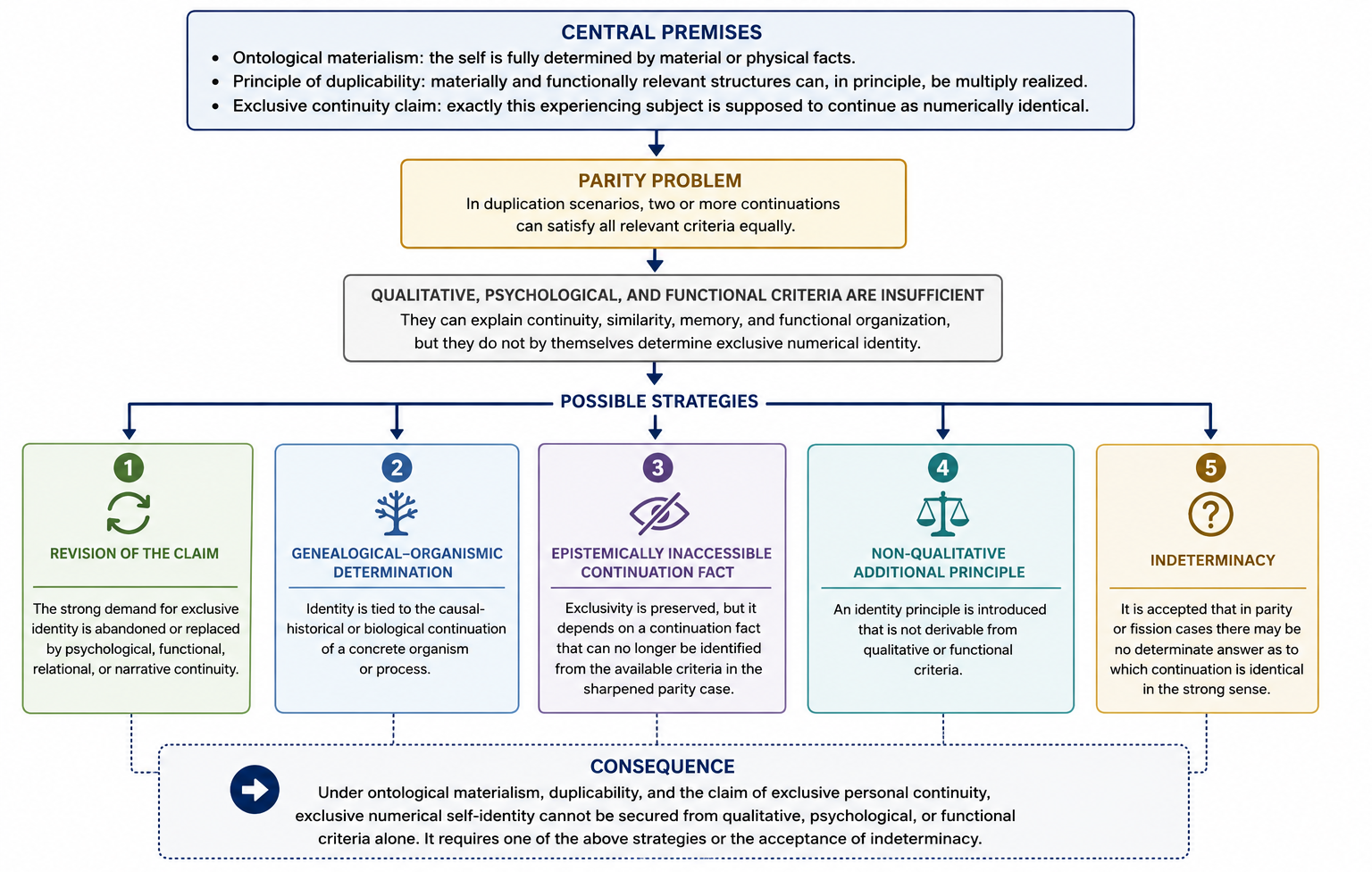
7.4 Consequence: Five Possible Strategies
Five consistent strategies follow from the analysis:
- Revision of the claim: One gives up strong exclusive personal identity and accepts psychological, functional, relational, or narrative continuation as what matters.
- Genealogical-organismic determination: One binds exclusivity to the causal-historical or biological continuation of a concrete organism or process.
- Epistemically inaccessible fact of continuation: One holds that, even in the sharpened parity case, there is a correct continuation, but accepts that this fact of continuation can no longer be identified from the available psychological, functional, or observable genealogical criteria.
- Non-qualitative additional principle: One supplements the description with a principle of identity that guarantees exclusivity but is not derivable from qualitative or functional criteria.
- Indeterminacy: One accepts that in parity or fission cases there is no determinate answer to which continuation is identical in the strong sense.
None of these options can be forced by additional empirical data alone. They are different ways of determining the claim of personal identity. Materialism is not refuted by this. Its scope is, however, made more precise: it can describe continuation, function, organization, and organism. Whether exclusive first-personal continuation follows from this depends on the strategy chosen with respect to the claim.
The following figure summarizes this argumentative structure schematically.
7.5 Interim Conclusion
Ontological materialism does not generally reach a limit with respect to personal identity. It reaches a limit where it seeks to derive the exclusive continuation of precisely this experiencing subject from material-functional, in-principle duplicable criteria.
The result can be formulated precisely: under the joint assumption of ontological materialism, the in-principle duplicability of material-functional structures, and a strong exclusivity claim of personal continuation, exclusive numerical identity cannot be derived from qualitative, psychological, or functional facts alone. It must either be revised as a claim, determined causal-historically or organismically, accepted as an epistemically no longer accessible fact of continuation, supplemented by a non-qualitative additional principle, or treated as indeterminate in parity cases.
The metaphysical scope of materialist self-interpretations is thereby determined more precisely. Materialism remains untouched as a method and as a description of biological, psychological, and functional processes. What is limited is only the stronger claim that the self, as an exclusively identical experiencing subject, can be fully derived from duplicable material-functional criteria.
8. The Self and the Limits of Materialist Self-Interpretation
The aim of this article was to examine the viability of materialist self-interpretations with respect to personal identity insofar as they retain a strong exclusivity claim: precisely this experiencing subject is supposed to continue over time. The analysis has shown that, within an ontological-materialist framework, this claim cannot be derived from qualitative, psychological, functional, or duplicable material-functional criteria alone.
The starting point was the distinction between qualitative identity and numerical sameness. Qualitative, psychological, and functional criteria can explain continuation, similarity, memory, character continuity, and practical orientation. Under conditions of possible duplicability, however, they contain no exclusive identity marker. Copying and fission scenarios make this point visible as a conceptual stress test: if several continuations satisfy the same relevant criteria, it does not follow from these criteria alone which instance is the exclusive continuation of the presently experiencing subject.
The inclusion of biological metabolism, especially material exchange in the brain, was not meant to prove this result empirically. It had a more limited function: it shows that “material bearer continuity” is not a simple concept. If it is understood as the preservation of the same material components, it does not convincingly carry personal identity. If it is understood as functional or organizational continuity, it approaches duplicable criteria. If it is understood as causal-organismic process continuity, it remains the strongest materialist answer, but must be explicitly identified as a genealogical-organismic rule of continuation.
The material continuity of the self is therefore not itself refuted, but it loses its apparent conceptual innocence. As a biological or causal-historical line of continuation, it is describable in materialist terms. As a guarantor of exclusive first-personal continuation, however, it assumes a role that does not follow from material, functional, and psychological criteria alone. Exactly at this point, bearer continuity becomes a metaphysically burdened assumption within materialism itself.
Alternative theories of personal identity confirm this diagnosis not by failing, but by choosing different strategies of the claim. Psychological and functional approaches explain continuation without securing exclusivity in the strong sense. Parfitian reductionism makes this revision of the claim explicit. Perdurantism and stage theories change the ontological framing of the question. Animalism preserves exclusivity most strongly, but binds it to the continued existence of the same biological organism. This makes visible that exclusivity is not a cost-free consequence of materialist description, but must either be revised, determined genealogical-organismically, accepted as an epistemically no longer accessible fact of continuation, supported by an additional principle of identity, or treated as indeterminate in parity cases.
This result does not mark a refutation of methodological materialism. Nor does it show that materialist theories of personal identity as a whole are inconsistent. Rather, the analysis determines the scope of a specific claim: materialist self-interpretations can describe biological, psychological, functional, and causal-historical continuation. What they cannot provide without an additional step is the derivation of exclusive first-personal continuation from duplicable material-functional criteria alone.
The central insight can therefore be formulated precisely: under the joint assumption of ontological materialism, the in-principle duplicability of material-functional structures, and a strong exclusivity claim of personal continuation, exclusive numerical identity cannot be derived from qualitative, psychological, or functional facts alone. It must either be revised as a claim, determined causal-historically or organismically, accepted as an epistemically no longer accessible fact of continuation, supplemented by a non-qualitative additional principle, or treated as indeterminate in parity cases.
This limit is not to be understood as a deficit of materialist research, but as a conceptual clarification of its scope. It separates the legitimate achievements of materialist explanation from expectations that go beyond qualitative, functional, and empirically describable relations of continuation. In this sense, the inquiry does not contribute to the abolition of materialist self-interpretations, but to their conceptual discipline.
The question of the self therefore proves not to be simply an empirical puzzle that could be solved by better data. It marks a threshold at which a decision must be made about what kind of identity claim is being defended. Whoever retains strong exclusive personal continuation needs more than functional or psychological continuity. Whoever dispenses with such a further element obtains a more economical, but also differently determined, theory of personal continuation.
Literature
Fornasiero, Eugenio F., et al. 2018. “Protein Lifetimes in the Mouse Brain.” Nature Communications 9: 4230.
Lewis, David. 1976. “Survival and Identity.” In The Identities of Persons, edited by Amélie Oksenberg Rorty, 17–40. Berkeley: University of California Press.
Olson, Eric T. 1997. The Human Animal: Personal Identity Without Psychology. Oxford: Oxford University Press.
Parfit, Derek. 1984. Reasons and Persons. Oxford: Oxford University Press.
Perry, John. 1979. “The Problem of the Essential Indexical.” Noûs 13 (1): 3–21.
Réu, Patrícia, et al. 2017. “The Lifespan and Turnover of Microglia in the Human Brain.” Cell Reports 18 (5): 1162–1175.
Savas, Jeffrey N., et al. 2012. “Extremely Long-Lived Nuclear Pore Proteins in the Rat Brain.” Science 335 (6071): 942–945.
Shoemaker, Sydney. 1963. Self-Knowledge and Self-Identity. Ithaca, NY: Cornell University Press.
Sider, Theodore. 2001. Four-Dimensionalism: An Ontology of Persistence and Time. Oxford: Oxford University Press.
Appendix A: Epistemic Addendum on Materialist Self-Description
The present article examines the limits of ontological-materialist explanations of personal identity under an exclusivity claim. The main argument deliberately operates within the classical language of personal identity: materialism, qualitative identity, numerical sameness, psychological continuity, bearer continuity, and exclusivity. In addition, however, an epistemic presupposition of this framework can be marked.
Every materialist self-description presupposes a perspective from which this description is undertaken. In ontological materialism, the self appears as an object within a physically described world, for example as a brain, organism, functionally realized system, or biological process. This objectification is methodologically legitimate and indispensable for scientific explanation. Yet it already presupposes that there is an experiencing standpoint for which a world appears as describable.
Experience as experience is not objectifiable in the same way as its neurophysiological correlates. Materialist models can describe structures, processes, and conditions that correlate with experience or functionally carry it. But they do not thereby straightforwardly capture experience as a given first-person perspective. Precisely for this reason, the question of exclusive self-continuation is not identical with the question of biological or functional process continuity.
The fragility of personal identity diagnosed in the main text therefore does not concern the reality of subjective experience as such. It concerns the ontological projection in which the self is to be fixed as an exclusively identifiable object within a materially described world. In this projection, the epistemic system reconstructs itself from out of the world order it has stabilized, for example as brain, organism, or process line. The limit arises where this reverse reconstruction is supposed to fully capture its own indexical continuation.
This epistemic note is not a premise of the main argument. The central finding remains an internal consistency analysis of materialist identity claims. The appendix merely marks the broader connection: the paper can be read as an analysis of a limit of materialist self-objectification, without this reading having to be presupposed for the narrower finding about identity.
This connecting note points to the broader framework of the Epistemic Reality Project, especially to the analysis developed there of the reverse reconstruction of the cognitive system within stabilized models of reality. As a direct point of entry, see Rapp, Stefan. 2026. Realism Without an Outside: Cognition-Relative Realism and the Limit of Positive Determinability. Zenodo. https://doi.org/10.5281/zenodo.20107915. This broader framing is not presupposed for the main argument of the present article.