The Intersubjective Domain
Intersubjective Conditionality, Take-Up, and Shared Connectability under Finite Conditions
Abstract
This paper examines the intersubjective domain within the project of Epistemic Reality. Its starting point is the question of how subjective orientation is co-conditioned by the orientations of others without this already entailing consensus, recognition, or shared reality. The central concept is intersubjective conditionality: subjects stand under expectations, references, rules, interpretations, and forms of correction that they must take into account even when they do not agree with them.
The paper reconstructs the intersubjective domain through communicability, take-up, shared connectability, and correction. Intersubjectivity does not begin with identical inner worlds, nor only with successful understanding. It begins when a reference can be taken up, answered, contested, shifted, or corrected by others. For individual subjects, intersubjective order is subjectively reconstructible, but not subjectively freely available.
The intersubjective domain is thereby distinguished from merely subjective orientation, social consensus, normative recognition, and functional-empirical robustness. It does not first produce the resistance of the world. Rather, it makes orientations, experiences, and references jointly workable among several cognitive systems. Its specific contribution lies in uncovering a shared space of connection and correction in which subjective orientations do not simply merge, but can be continued, strained, and transformed under the conditions of other orientations.
The paper thus determines the elementary conditional structure on which later analyses of shared epistemic reality, shared reference spaces, trust, institutionalization, and science can build. It does not present itself as a complete social philosophy or a theory of normative legitimacy, but as an epistemic-architectural grounding of the intersubjective domain under finite conditions.
Keywords
Epistemic Reality; intersubjectivity; intersubjective conditionality; shared connectability; take-up; correction; validity; orientation; domain; finite conditions
1. Subjective Orientation under Intersubjective Conditions
1.1 Starting Point: Subjective Orientation under Other Orientations
The project of Epistemic Reality investigates how finite cognitive systems do not simply find orientation, order, and reality already given, but form, stabilize, and correct them under limited conditions. In this respect, it takes up the determination of Epistemics as model management under finite conditions (Rapp 2026f). One central difficulty is that orientation does not remain purely subjective once other cognitive systems enter the picture. Human beings, groups, institutions, and technical systems do not operate only with their own interpretations. They move within spaces in which other orientations, expectations, references, and corrections become operative.
This paper stands within the project of Epistemic Reality and connects to several of its earlier foundations. The limit of positive determinability is prepared by epistemic realism (Rapp 2026a); the preliminary zone of model-capable order by the analysis of epistemic experiential fields (Rapp 2026b); the stabilization of reference-capable units by the theory of ontologization (Rapp 2026c). The distinction between relative forms of reality, domain-relative validity, and model-related management forms the broader framework within which the intersubjective domain is examined as a distinct form of positive determination (Rapp 2026d; Rapp 2026e; Rapp 2026f).
The intersubjective domain does not designate this space as an ontologically separate region of the world, but as a domain-relative form of positive determination in the sense of the previously developed theory of domains (Rapp 2026e). It is not a second realm alongside subjective experience and functional-empirical robustness. It designates a distinct form of positive determination: subjective orientation is co-conditioned by the orientations of others. What a subject can say, mean, show, do, or expect stands not only under the conditions of its own enactment, but also under conditions of shared connectability.
This basic structure is easily overlooked because intersubjective orders already operate as a matter of course in everyday life. Language, expectations, roles, concepts, rules, forms of correction, and social interpretations often do not appear as special achievements, but as the background of ordinary orientation. A subject moves within them without constantly reflecting on them explicitly. For that very reason, the impression can arise that intersubjective order is simply present. In fact, it must be formed, maintained, reconstructed, and corrected.
Before stable shared reality, shared reference spaces, institutions, or scientific procedures can be examined, it must first be clarified at a more elementary level how subjective orientation becomes intersubjectively connectable at all. In this respect, the paper begins below the already developed analysis of reference-capable units and relative forms of reality (Rapp 2026c; Rapp 2026d). This question stands at the center of the present paper. It does not first investigate developed forms of shared epistemic reality, but the basic conditions of the intersubjective domain itself.
1.2 Proximity to Traditions and the Paper’s Own Starting Point
The paper therefore begins beneath several well-known theoretical alternatives. It understands intersubjectivity neither primarily as consensus nor primarily as conflict. It also does not begin with recognition in the normative sense. Consensus, conflict, and recognition are possible forms or consequences of intersubjective order, but they are not its elementary structure. More basic is the fact that a subject stands under conditions that are co-formed by other orientations. These conditions can be accepted, contested, bypassed, or changed. Yet they are already operative before the subject agrees to them.
The perspective developed here stands in proximity to several classical lines of discussion concerning intersubjectivity, experience of the other, social reference, recognition, and communicative order. Phenomenological approaches, for example in Husserl (1950) and Schütz (1967), have shown that experience cannot be understood as a purely isolated private world. Pragmatist and interactionist approaches, for example in Mead (1934), emphasize action, response, and social reference. Discourse-theoretical and recognition-theoretical models, for example in Habermas (1981) and Honneth (1992), examine normative, communicative, and institutional conditions of shared order. The present paper, however, does not adopt these starting points unchanged. It begins one level earlier.
The contribution of this paper therefore does not lie in another theory of recognition, communication, consensus, or social integration. It reconstructs a prior conditional level: the question of how subjective orientation is co-conditioned by other orientations and becomes communicable, available for take-up, connectable, and open to correction in the first place. This shifts the focus from elaborated forms of intersubjective order to their elementary functional conditions. The paper should therefore not be read primarily as a comprehensive social-philosophical thesis, but as an epistemic-architectural grounding of the intersubjective domain within epistemic reality.
The central concept of this paper is therefore intersubjective conditionality. It designates the fact that subjective orientation is co-determined by intersubjectively stabilized expectations, references, roles, rules, interpretations, and forms of correction. These conditions do not have to be recognized, accepted, or adopted in order to be operative. They must, however, be taken into account as long as they structure the shared space of connection.
This yields the operative starting point of the paper: a subject cannot make its orientation intersubjectively effective at will. It can stabilize an interpretation internally, but it does not follow from this that others can take it up, understand it, continue it, or correct it. Likewise, a subject can reject an intersubjective order and nevertheless be forced to take it into account as a condition of its orientation. A language, a social expectation, a shared rule, or a dominant interpretation is operative even when an individual subject does not agree with it.
This makes the intersubjective domain visible as a distinct object. It is not merely social agreement. It is not simply normative recognition. And it does not first generate the functional-empirical resistance of the world. A cognitive system can already experience resistance, repetition, and practical consequences before these experiences are intersubjectively shared or jointly examined.
The specific achievement of the intersubjective domain does not lie in bringing resistance into being in the first place, but in making orientations among several cognitive systems communicable, capable of take-up, connectable, and correctable.
This distinction is decisive for the architecture of the project. The intersubjective domain does not stand as a mediating intermediate stage between subjective experience and functional-empirical robustness. Subjective orientation can be directly exposed to functional-empirical testing, for example through body, action, resistance, repetition, and practical consequence. The intersubjective domain accomplishes something else: it makes orientations, including experiences already exposed to functional-empirical testing, jointly workable. It opens the space in which references can be taken up, contested, corrected, and continued.
The present paper thereby prepares later analyses of shared epistemic reality without already presupposing them. Shared epistemic reality emerges where intersubjective conditionality is expanded into more stable reference spaces, orders of expectation, forms of trust, institutional structures, and robust procedures of correction. The present paper begins earlier. It asks about the elementary structure through which subjective orientation can enter a shared space of connection at all.
1.3 Guiding Thesis and Structure of the Paper
The guiding thesis is:
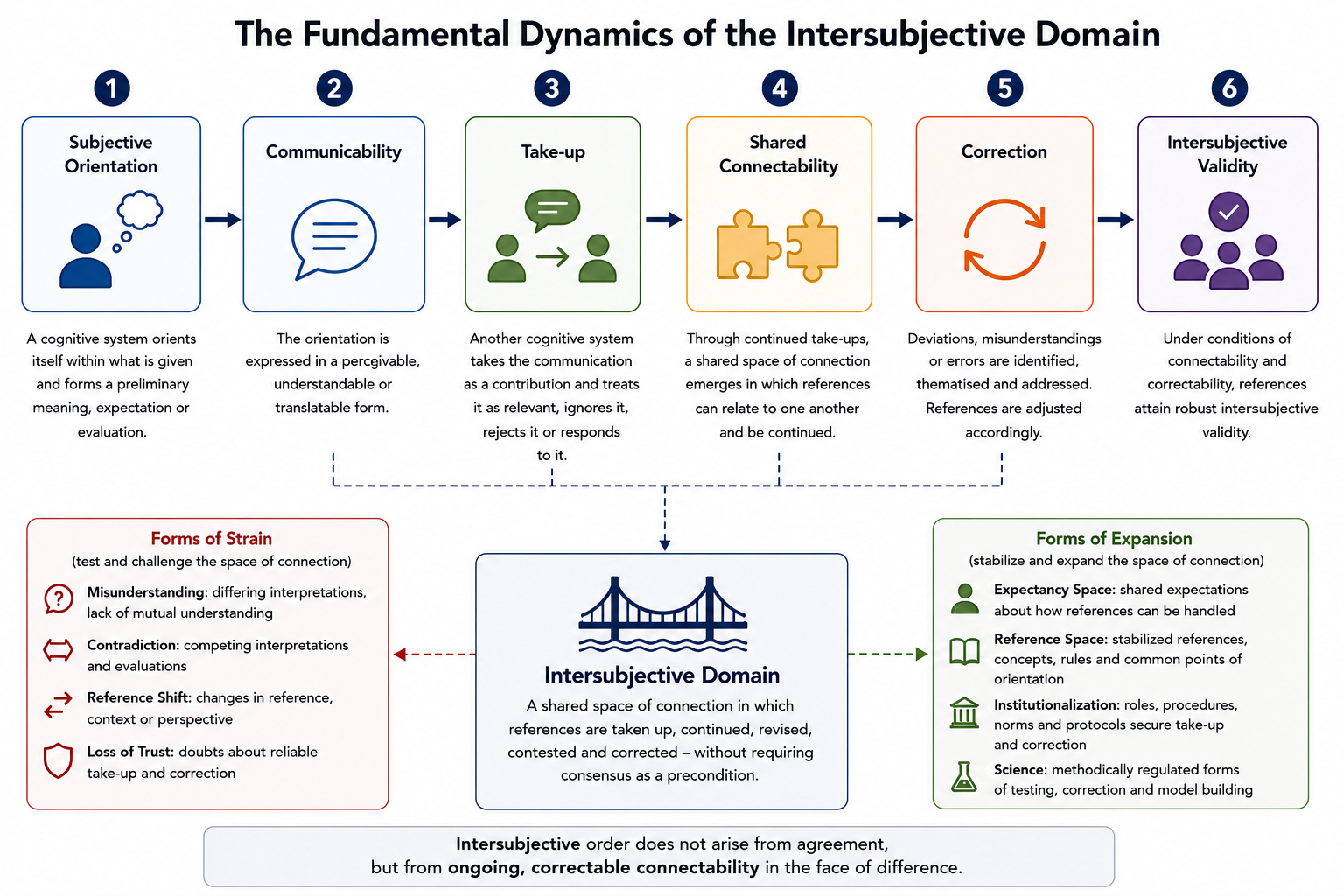
The intersubjective domain emerges where subjective orientation is co-conditioned by the orientations of others and this conditionality becomes workable in forms of communicability, take-up, shared connectability, and correction.
The intersubjective domain does not emerge because it forms an ontologically separate region alongside subjective experience and functional-empirical robustness. It emerges because intersubjective conditionality has its own form of stability, resistance, cost, correction, and validity. What holds or fails within it is decided neither solely by whether a subject experiences something nor solely by whether an action has functional-empirical consequences, but by whether references can be taken up, continued, contested, and corrected within a shared space of connection.
The paper unfolds this thesis in several steps. First, it clarifies the methodological perspective: the reconstruction that follows is not an empirical developmental history of a particular organism, but an analysis of functional conditions. It then shows how subjective orientation is structured by intersubjective conditionality. After that, communicability, take-up, shared connectability, and correction are developed as basic operations of the intersubjective domain. Further chapters address forms of resistance, costs, malfunctioning forms, and the distinction from the functional-empirical domain.
The aim is not a complete social philosophy. Nor is a theory of normative legitimacy or a theory of science in the narrower sense developed. The paper pursues a more fundamental question: what structure must be present for orientation not only to be enacted subjectively, but also to be shared, contested, corrected, and continued among several cognitive systems?
2. Constructive Perspective and Functional Conditions
2.1 Constructive Perspective Rather Than Developmental History
The following reconstruction works with a constructive perspective. This does not mean that it empirically describes how a human child, an animal, a social group, or an artificial system actually arrives at intersubjectivity step by step. Such a description would require developmental-psychological, biological, social-scientific, and technical investigations. That is not the task of this paper.
2.2 Empirical Reference Points as Auxiliary Models
The empirical reference points used in what follows, such as subject, child, body, object, action, group, institution, or artificial system, are to be understood methodologically as model-like forms of orientation and analogy. They serve the reader as a bridge to the functional forms examined by the paper. They do not describe the project’s self-understanding and do not form the final starting point of the analysis. The project does not presuppose ontologically finished entities, neither subjects nor objects nor social counterparts. It investigates conditions under which such determinations become operative, connectable, and correctable within epistemic reality.
When the paper speaks of a falling object, a responding subject, a hardened institution, or the human being, these designations must therefore be read in a methodologically controlled way. They illustrate functional forms without overwriting their status through ontological posits. The human being is not treated here as the starting point of an anthropology, but as the bearer of a cognitive system within epistemic reality: a form in which cognition, orientation, stabilization, correction, and reality-formation operatively converge. Biological, bodily, or social descriptions remain model-like explanations and do not replace the epistemic-architectural analysis.
Not every system that merely reacts counts here as an intersubjectively relevant cognitive system. At minimum, references must be capable of being taken up, distinguished, continued, or rejected, and feedback must be able to alter the system’s further orientation. This does not assert an equivalence among human, institutional, and artificial systems. The claim is only that different system-forms can occupy intersubjective functional positions in different ways.
The constructive perspective serves here as a heuristic procedure. It does not first ask about a historical or empirical path of emergence, but about functional conditions. It attempts to make visible which achievements must be present for subjective orientation to become intersubjectively connectable. The construction is therefore not to be read as a temporal sequence in the strict sense, but as an analytic unfolding of conditions.
This is especially important for the sequence of the following chapters. Communicability, take-up, shared connectability, and correction are presented one after another because they stand in a dependency relation among conditions. Correction presupposes a shared space of connection; connectability presupposes take-up; take-up presupposes that an orientation can assume a communicable form at all. This order, however, is not an empirical developmental sequence. In actual enactment, these moments can occur simultaneously, overlap, and stabilize one another reciprocally.
2.3 Cognitive Systems and Different Forms of Realization
This distinction is important because different forms of cognitive systems can begin differently. From this perspective, a human cognitive system can be modeled as biologically, bodily, affectively, and socially prestructured. It does not begin as an empty point that subsequently assembles world, body, other subjects, and meaning. What in this is innate, learned early, bodily mediated, or culturally shaped remains open here. The decisive point is only that human orientation stands from the beginning under conditions that do not arise completely from reflected self-determination.
An artificial system, by contrast, can be initialized with linguistic, semantic, statistical, rule-based, or social patterns without undergoing the same bodily development. It can already process forms of response, role-reference, correction, and social expectation without having built them up from its own bodily experience or early childhood interaction. It does not follow from this that human and artificial cognitive systems function in the same way. It follows only that the same functional positions can be realized differently in different system-forms.
The coupling of the domains can also be organized differently depending on the cognitive system. In the human case, this coupling can be described as strongly bodily and phenotypically embedded: the body is the bearer of subjective experience, the interface of functional-empirical resistance, and at the same time a visible, audible, and addressable counterpart for others. In language-based artificial systems, by contrast, access to the functional-empirical domain can proceed more strongly through intersubjectively mediated data, texts, and descriptions. The paper does not decide these differences, but keeps the analysis at the level of functional conditions.
The analysis thereby avoids two mistakes. The first mistake would be to describe the intersubjective domain as an empirical developmental stage of the human being. An epistemic-architectural question would then become a psychological or anthropological theory. The second mistake would be to treat all cognitive systems according to the same developmental model. This would overlook the fact that humans, animals, organizations, and artificial systems can have very different presuppositions and forms of realization.
The constructive perspective asks instead: which functional positions must be occupied for intersubjective order to become possible? A system need not emerge in the same way, but it must be able to perform or take over certain achievements. It must be able to bring orientations into communicable forms. It must make take-up possible. It must be able to distinguish whether a reference is continued, answered, shifted, or rejected. It must be able to reconstruct intersubjective conditions. And it must be able to process forms of correction.
These functional conditions are not necessarily conscious. A subject need not explicitly know that it is intersubjectively conditioned. It need not reflect on the fact that it takes the expectations of others into account or reconstructs shared references. Many intersubjective achievements operate pre-reflectively or in the background. One answers, understands, asks for clarification, corrects, or adapts without theoretically grasping the structure of these processes. The analysis therefore makes explicit what often remains implicit in enactment.
2.4 Intersubjective Differentiation without a Finished Outside
After this methodological clarification, intersubjective differentiation itself can be determined. The intersubjective domain is not derived from an already finished theoretical distinction among domains. A cognitive system does not first encounter a neatly divided world made up of subjective experience, intersubjective order, and functional-empirical robustness. Rather, it operates in contexts in which these forms are often intertwined. Only through stabilization, repetition, response, resistance, and correction do different forms of order become distinguishable.
At the same time, the intersubjective domain is not presupposed as an already positively determined outside; it remains bound to the limit of positive determinability that was already clarified in epistemic realism (Rapp 2026a). The paper posits neither a finished social world nor an absolutely graspable sphere of other subjects. It works instead with a methodological determination: within a cognitive system, certain givens can be stabilized as other centers of orientation because of particular forms of connection and resistance.
Such determinations, for example as other subjects, biological systems, or social counterparts, are functional boundary assumptions under finite conditions. They do not claim metaphysical transparency into the other, but structure appearances that cannot be adequately described as mere things, resistances, or causal reactions.
This stabilization operates as a stopping structure: it does not close the space of interpretation definitively, but it closes it provisionally enough for orientation, expectation, take-up, and correction to become possible. The intersubjective domain designates the interpretive and stability context in which such posits become operative as conditions of subjective orientation while remaining correctable.
For the present paper, the decisive point is to determine the intersubjective direction of this differentiation. It does not lie simply in the emergence of a relation to an outside. A cognitive system can encounter resistance or experience repeatable consequences even without developed intersubjectivity. Orientation becomes intersubjective only where another cognitive system appears not merely as resistance or reaction, but as a response-capable and connection-relevant instance: it can take up, reject, alter, confirm, or correct references.
This distinction protects against a linear misreading of the domains. The functional-empirical domain is not first opened up by the intersubjective domain. Resistance, repeatability, and practical robustness can already occur within subjective orientation. Rather, the intersubjective domain performs the joint working-through of these and other orientations. It makes them communicable, capable of take-up, comparable, and correctable.
Nor is the intersubjective domain merely an expansion of the subjective. It is true that, for each individual subject, it is available only through subjective reconstruction. A subject must reconstruct what others mean, expect, understand, reject, or correct. But this reconstruction is not arbitrary. It stands under feedback, response, and resistance from others. The intersubjective domain is therefore subjectively reconstructible, but not subjectively freely available.
This formula marks an important intermediate position. Intersubjective order is not derived individualistically from private acts, because it operates as a condition that an individual subject cannot generate or abolish at will. But neither is it holistically reified, as if it existed independently of reconstructing, responding, and correcting cognitive systems. It arises in relation: subjective systems reconstruct shared conditions, but these conditions confront them as structures of connection and resistance that are not freely available.
The constructive perspective therefore permits a double insight. On the one hand, every intersubjective order remains perspectivally mediated for an individual system. No one possesses the shared space completely and immediately. On the other hand, reciprocal take-up, expectation, and correction generate an order-context that cannot be reduced to private interpretation. The intersubjective domain lies precisely in this tension.
For the following argument, this means that concepts such as communicability, take-up, intersubjective conditionality, shared connectability, and correction are not introduced as empirical developmental stages, but as functional moments. They describe what an intersubjective space of order must accomplish, regardless of whether this achievement is realized biologically, socially, culturally, technically, or institutionally.
This methodological limitation keeps the paper both open and controlled. It does not claim to explain the emergence of human sociality in full. Nor does it claim to determine the architecture of artificial systems conclusively. It provides a grounding of the intersubjective domain as a functional context: wherever subjective orientation is co-conditioned by the orientations of others and this conditionality can be worked through in forms of communicability, take-up, connectability, and correction, intersubjective order emerges.
3. Subjective Orientation and Intersubjective Conditionality
Subjective orientation designates the way in which a cognitive system orders its givens so that continuation becomes possible. A subject distinguishes, focuses, remembers, expects, evaluates, and acts. In doing so, it does not form a merely passive inner world, but stabilizes a context in which something can appear as meaningful, recognizable, relevant, or action-guiding. Orientation is therefore already an achievement of order. It does not presuppose that this order is explicitly reflected. A cognitive system can orient itself before it conceptually sees through the conditions of this orientation.
This orientation is initially subject-bound. This does not mean that it is arbitrary, isolated, or purely private. A subject-bound system, too, can encounter resistances, experience repeatable consequences, react to others, and move within an environment. Subject-bound means only that the order is initially operative in the enactment of this system. What appears, how it appears, what is reacted to, and which continuation seems possible are bound to the perspective and structure of this cognitive system.
The intersubjective domain begins where this subject-bound orientation is co-conditioned by other orientations. A subject then no longer orients itself only by what it itself perceives, means, expects, or wants to do. It must also take into account how others might take up its references, which expectations already operate in the shared space, which interpretations are stabilized, which responses become likely, and which corrections are possible. The subject’s orientation remains subject-bound, but it can no longer be understood solely from itself. It stands under conditions that are co-formed by other subjects and shared orders.
The term intersubjective conditionality is used here for this structure. Intersubjective conditionality means that subjective orientation is co-determined by intersubjectively stabilized expectations, references, rules, roles, interpretations, and forms of correction. These conditions do not have to be accepted in order to be operative. A subject can contradict them, criticize them, bypass them, or seek to change them. Nevertheless, it must take them into account as long as they structure the shared space of connection.
This distinguishes intersubjective conditionality from recognition. Recognition suggests agreement, legitimacy, or voluntary acceptance. For the basic structure of the intersubjective domain, that is too strong. A social expectation, a linguistic convention, a shared interpretation, or an institutional rule can be operative for a subject even though the subject rejects it. The subject does not have to say: “I recognize this order.” It is enough that the subject must say: “I have to take into account that this order is operative.”
This makes the intersubjective domain visible as a space of resistance of its own kind. It is not merely a space of successful understanding. It is also a space of conditions, constraints, expectations, misunderstandings, corrections, and possible exclusions. Other orientations confront the subject not only as offers of shared meaning-formation, but also as limits to its private interpretation. A subject cannot make its own view intersubjectively effective simply by stabilizing it internally. It must deal with what is already operative in the shared space as reference, expectation, rule, or form of correction.
Intersubjective conditionality therefore does not mean the dissolution of subjective orientation into social order. The subject does not disappear into intersubjectivity. It remains the place where intersubjective conditions are reconstructed, evaluated, adopted, rejected, or transformed. But this reconstruction does not occur free of intersubjective resistance. What others expect, what they understand, what they reject, what they correct, and what they treat as a contribution forms conditions under which subjective orientation must be continued.
This yields a decisive determination: for the individual subject, intersubjective order is subjectively reconstructible, but not subjectively freely available. It is subjectively reconstructible because each subject can grasp only from its own perspective what others mean, expect, understand, accept, or reject. It does not possess the shared space completely and immediately. It forms conceptions of which interpretations are stabilized, which rules hold, which expectations operate, and which corrections are possible.
This reconstruction, however, is not arbitrary. The subject can misjudge an intersubjective order, overstate it, underestimate it, or overwrite it through its own interpretation. But it cannot simply privately determine what is actually connectable in the shared space. Others can contradict, fail to understand, correct, refuse expectations, or decline to take up contributions. It is precisely in this way that intersubjective order shows itself to be reconstructed only subjectively, while not dissolving into subjective preference.
The subject can therefore form different relations to intersubjective conditions. It can adopt an intersubjective interpretation and integrate it into its own orientation. It can keep it separate from its own interpretation and nevertheless take it into account. It can reject it and work against it. It can overwrite it through its own interpretation. Or it can mistakenly assume that its own interpretation is already the shared interpretation. These possibilities show that intersubjective conditionality does not presuppose agreement, but a coupling of subjective reconstructions with a shared space of connection.
For this very reason, intersubjective order must not be confused with identical inner interpretation. Several subjects can participate in a shared order without their inner structures of meaning fully coinciding. What matters is not identity of interpretation, but sufficient coupling among the reconstructions. Participants must be able to coordinate their references with one another in such a way that continuation remains possible. Where this coupling breaks down, pseudo-consensus, misunderstanding, decoupling, or conflict emerges.
The intersubjective domain therefore does not emerge where everyone thinks the same thing. It emerges where subjective orientations are co-conditioned by the orientations of others and this conditionality remains workable within a shared space of connection. This is the elementary difference between merely subjective orientation and intersubjective order: the subject can no longer stabilize its orientation exclusively from its own enactment, but must reckon with the stabilized orientations of others.
This basic structure also explains why intersubjectivity does not begin with harmony or agreement. It can become visible just as much in contradiction, correction, constraint, expectation, or rejection. Whoever contradicts is already related to a shared reference. Whoever disappoints an expectation already stands under an intersubjective structure of expectation. Whoever breaks a rule moves within a space in which this rule is operative as a condition. Whoever rejects an interpretation nevertheless treats it as something to which they must relate.
Intersubjective conditionality is therefore the elementary form in which other orientations become meaningful for a subject without simply being absorbed into its private interpretation. It forms the starting point for communicability, take-up, shared connectability, and correction. Only on this basis can later discussion address shared epistemic reality, institutional stabilization, or scientific testing.
4. Communicability and Take-Up
If subjective orientation is to become intersubjectively operative, it must assume a form that becomes available beyond its own enactment. This first opening can be called communicability. Communicability does not mean only linguistic utterance. It also includes gestures, signs, actions, glances, practical indications, symbolic forms, or regulated procedures. What matters is not the medium, but the transformation: a subject-bound orientation is formed in such a way that it can become accessible to others.
Communicability alone, however, is not enough. An utterance can remain unintelligible, be ignored, find no addressee, or be taken up in a sense other than the one intended. For this reason, intersubjectivity does not already begin with mere expression. It begins where an utterance, action, or reference can be taken up again. Take-up is the threshold at which a subjective orientation enters a shared space of continuation.
Take-up means that another cognitive system can refer to an orientation. It has a range of forms. Minimally, take-up can consist in the fact that a reference is registered at all or treated as relevant. It becomes semantic when an utterance, gesture, or action is understood or misunderstood as intended. It becomes practical when a reference is answered, continued, or translated into action. It becomes corrective when it is contested, rectified, or shifted. It can stabilize when certain forms of take-up become expectable, repeatable, or rule-governed. All these forms are intersubjectively meaningful. Misunderstanding and contradiction also show that a reference has entered a shared space. The decisive point is therefore not that take-up be identical with what was originally meant, but that a reference enters a shared space of continuation.
This distinguishes take-up from mere reaction. An object can react to an action by falling, breaking, resisting, or producing a consequence. This reaction can be functionally and empirically meaningful. A reaction becomes intersubjective, however, only when it can appear as an answer to a reference. An answer does not merely take up an impulse causally; it changes a shared space of continuation. In the broadest sense, it says: what was said, shown, done, or meant has become relevant for another orientation.
This distinction is important because the intersubjective domain does not generate the functional-empirical domain. A cognitive system can experience resistance and repeatable consequences even without intersubjective mediation. An object falls, fire burns, a body encounters limits, an action has repeatable consequences. Such stabilities do not first have to be socially shared in order to be practically operative. The intersubjective domain accomplishes something else: it makes these and other orientations communicable, capable of take-up, and correctable among several cognitive systems.
Take-up is therefore the basic process through which subjective orientation gains intersubjective form. What a subject means, sees, shows, or does does not become shared because it is stable within the subject. It becomes jointly relevant when it can be taken up by others and carried forward in their orientation. This take-up need not be identical. It can diverge. It can introduce another perspective. It can alter the original reference. This is precisely where the productive and risky structure of intersubjectivity lies.
Shared reference emerges from stabilized take-up. When a reference can be taken up repeatedly and continued in such a way that several subjects treat it as a reference to “the same,” a shared reference point emerges. This “same” does not have to mean that all participants possess the same inner content. It means that their references are sufficiently coupled to make shared orientation possible. A shared reference point is therefore not a guarantee of identical interpretation, but a stabilized form of reference capable of take-up.
This structure already appears in simple cases. When one subject points to something and another follows this pointing, no complete shared world has yet emerged. But a first form of shared reference has emerged. The other treats the gesture as indicating something. The other takes it up. The other orients themselves by it. The other can confirm that they see the same object, or ask what is meant. In both cases, a shared space of continuation emerges.
Communicability also has another side. The intersubjective domain is structured not only by what is explicitly communicated, but also by what finds no form of take-up. What cannot be said, what remains unspoken, what runs along as self-evident, or what does not appear as a contribution in a shared space also operates as a condition. Silence, omission, taboo, or a lack of expressive forms are therefore not mere absences. They can shape the space of connection just as explicit utterances do.
This is decisive for the concept of communicability. An orientation is not already intersubjectively available merely because it is internally present. It needs a form in which it can be taken up. If this form is absent, it remains invisible in the shared space or only indirectly operative. As a result, certain experiences, objections, or interpretations can become structurally difficult to connect, without being subjectively unreal for that reason. The limit of what is communicable is itself an intersubjective condition.
The more stable forms of take-up become, the more forms of expectation can arise. A subject expects that certain signs will be understood, certain indications taken up, certain roles recognized, or certain utterances answered. Intersubjectivity thereby becomes not only punctual, but expectation-shaped. The subject orients itself toward possible reactions by others before those reactions actually occur. It acts, speaks, and interprets under the condition of expectable take-up.
This expectation structure is ambivalent. It enables shared orientation because not every reference has to be built anew. But it can also restrict orientation because expectations determine which forms count as intelligible, appropriate, or connectable. A subject can therefore move within an intersubjective space without sharing its expectations. It can take them into account in order to be understood, avoid conflict, formulate criticism, or change an existing order.
Communicability and take-up therefore form the first operative structure of the intersubjective domain. Communicability opens subjective orientation to others. Take-up decides whether this opening enters a shared space of continuation. Repeated take-up gives rise to shared references, expectations, and first forms of intersubjective stabilization. But this stabilization remains fallible, because every take-up is a reconstruction, and every reconstruction can turn out differently from what was intended.
5. Shared Connectability
Shared connectability designates the capacity of an intersubjective space of order to couple different subjective orientations with one another in such a way that continuation remains possible. It is more than communicability and more than punctual take-up. An utterance can be communicable without becoming durably connectable. A reference can be taken up once without forming a stable shared space. Shared connectability emerges only when contributions, reactions, and corrections can be linked with one another in such a way that a context capable of continuation arises.
Connectability does not mean sameness. An intersubjective space does not require all participants to have the same interpretation, the same experience, or the same evaluation. It requires only that their different orientations remain sufficiently relatable to one another. Subjects can contradict, ask questions, add something, diverge, or correct and still remain within the same space of connection. The shared order holds as long as such differences do not immediately lead to complete decoupling.
This distinguishes the intersubjective domain from mere consensus. Consensus is one possible form of intersubjective stabilization, but it is not its origin. Many intersubjective orders hold precisely because they can take up dissent, correction, and differences of role. A shared space does not arise only when everyone agrees, but also when participants know what they disagree about, which objections count, which answers are possible, and which reference is being continued.
Shared connectability presupposes intersubjective conditionality. A subject can participate in a shared space only if it takes the conditions of that space into account. These include linguistic forms, shared reference points, expectable reactions, standards of correction, and implicit rules of contribution. These conditions do not have to be explicitly formulated. Often, they operate precisely by appearing self-evident in enactment. One knows how to answer, when to ask for clarification, what counts as an objection, which concepts can be used, and which deviations call for explanation.
This self-evidence, however, is not neutral. It can enable connection, but it can also limit it. Whoever does not know the conditions of a shared space may not be understood. Whoever knows them but rejects them must nevertheless deal with them. Whoever wants to change them risks resistance. Shared connectability is therefore always also an order of inclusion and exclusion. It determines what can count as a contribution, as an error, as a correction, as a misunderstanding, or as a relevant deviation.
For this reason, the intersubjective domain must not be idealized. It is not simply the space of free understanding. It is a space in which the orientations of others become conditions of one’s own orientation. This conditionality can be productive because it enables shared world-formation, language, cooperation, and correction. But it can also become burdensome or distorting when certain interpretations become dominant, divergent contributions are not taken up, or expectations are stabilized in ways that make correction more difficult.
Shared connectability therefore remains dependent on ongoing reconstruction. No subject possesses the shared order completely. Each subject reconstructs what holds, what is expected, what can be understood, and which contributions count. These reconstructions must fit one another sufficiently. They need not be identical. Intersubjectivity lives from a controlled non-identity: the participants remain different, but their difference is brought into forms that allow shared continuation.
This non-identity is not a deficiency, but a condition of intersubjective order. If all interpretations were identical, intersubjectivity in the strong sense would not be needed. If they were completely uncoupled, no shared space would emerge. Intersubjectivity lies between these extremes: it connects different perspectives without fully fusing them. Shared connectability is the form in which this connection becomes viable.
An example can clarify the structure. In a conversation, one person states a thesis, another objects, a third asks for clarification, and a fourth proposes a different concept. There is no consensus. Nevertheless, shared connectability exists as long as all contributions remain related to one another and can be treated as continuations of the same context. The shared space does not break down through difference, but only when it is no longer clear what the contributions refer to, which answers count, or which correction would be possible.
Shared connectability is therefore the elementary form of order of the intersubjective domain. It explains how subjective orientations become operative beyond their own perspective without completely losing their subject-bound character. It also explains why intersubjective stability does not simply mean agreement. An intersubjective order is stable when it can bear take-up, difference, answer, and correction. It becomes unstable when these forms break down.
Shared connectability leads directly to the question of intersubjective validity. An order has intersubjective validity not because it is inwardly adopted by all, but because it remains viable as a shared space of continuation. This viability becomes especially visible when the order is placed under strain: through misunderstanding, contradiction, criticism, or change. Shared connectability therefore forms the stability form of the intersubjective domain, while correction forms its strain form.
6. Correction and Intersubjective Validity
Correction is not a later supplementary achievement of the intersubjective domain. It belongs to its core. If subjective orientations were only communicable and capable of take-up, but could not be corrected, a form of shared stabilization would emerge, but not a viable intersubjective validity. An order could be shared, repeated, or enforced without its flaws becoming workable. It would be socially stable, but it would not necessarily have intersubjective validity.
Intersubjective validity begins where a shared order can not only be continued, but also rectified. This does not mean that every correction is accepted or that every objection is justified. It means that the shared space provides forms in which deviation, misunderstanding, contradiction, or error can be worked through. An order has intersubjective validity when it does not merely organize agreement, but also makes correction possible.
This distinguishes validity from consensus. Consensus can stabilize an order, but it does not guarantee its correctability. A group can agree and still stabilize false, distorted, or exclusionary interpretations. Conversely, an order can be intersubjectively viable despite dissent if it can take up objections and continue the shared reference. Intersubjective validity therefore does not lie in mere agreement, but in correctable connectability.
In this foundational paper, intersubjective validity initially designates the correctable form of intersubjective conditionality. An order can acquire intersubjective validity when it structures subjective orientation through shared conditions and, at the same time, provides forms in which these conditions can be examined, rectified, or changed. In later analyses of shared epistemic reality, this concept can be specified more narrowly: there, intersubjective validity designates the correctable viability of stabilized reference and expectation spaces. The concept used here is therefore more basic; the later concept is an elaborated application.
Not every formally available form of correction already grounds intersubjective validity. Correction contributes to validity only where deviation is not merely symbolically permitted, not completely blocked in an asymmetrical way, and not neutralized solely in order to confirm the existing order. Intersubjective validity therefore requires correctable connectability, not merely the existence of social rituals of rectification.
Correction presupposes that contributions appear as workable. An objection must be intelligible as an objection. A question must be capable of being taken up as a question. A divergent interpretation must be able to enter the shared space without immediately being excluded as mere disturbance. Here, too, intersubjective conditionality becomes visible: what counts as correction is itself conditioned by shared expectations, concepts, and rules. Correction is therefore never without presuppositions. It operates within a space that already determines which kinds of rectification appear possible, plausible, or legitimate.
For this very reason, correction itself can become problematic. An order can allow certain forms of correction and exclude others. It can accept criticism only in familiar concepts. It can devalue objections because they do not fit established expectations. It can understand itself as open and still take up only those contributions that do not touch its basic structure. In such cases, connectability remains intact, but it becomes asymmetrical. The order has not simply broken down, but its correctability is limited.
The intersubjective domain therefore has a double structure. It needs stability so that shared orientation remains possible. But it also needs mobility so that correction remains possible. Too little stability leads to decoupling: contributions no longer find a shared reference. Too much stability leads to hardening: contributions are taken up only when they confirm the existing order. Intersubjective validity emerges in the balance between continuability and correctability.
Under finite conditions, this balance is never secured once and for all. Subjects have limited attention, limited concepts, limited time, and limited willingness to change their own interpretations. Shared orders must therefore simplify. They cannot examine every deviation completely, integrate every perspective immediately, or keep every correction open without limit. Intersubjective validity is therefore not ideal transparency, but a finite form of correctable stabilization.
At this point, trust receives its elementary functional position. Trust is not merely personal sympathy, nor already institutional reliability. Here it designates the expectation that take-up and correction will not break off arbitrarily. Whoever trusts a shared space expects that references will, in principle, be taken up, that objections will not be blocked without reason, and that corrections will not be refused at will. Trust relieves intersubjective orientation because not every reference has to be secured completely from the outset. When this trust collapses, correction remains possible, but it becomes more demanding, more uncertain, and more prone to conflict.
The concept of correction must not be understood too narrowly. Correction can be explicit, for example as contradiction, criticism, or rectification. But it can also occur implicitly: through irritation, a question, an altered reaction, absent confirmation, or the practical non-continuability of a shared reference. Sometimes an interpretation is not corrected by an argument, but by the fact that others do not take it up, continue it differently, or fail to produce the expected effect.
Intersubjective validity is therefore always bound to feedback. A subject can believe that it has correctly reconstructed a shared order. Only the reactions of others show whether this reconstruction holds. An utterance can be intended, but understood differently. A rule can seem known, but be applied differently. An expectation can seem self-evident, but not be shared by others. Correction is the process through which such deviations become visible and workable.
The intersubjective domain thereby receives its specific form of strain. It is not first strained by the contradiction of an external fact, but by the divergence of references, expectations, and reconstructions. Non-understanding, contradiction, reference shift, loss of trust, and the breakdown of shared forms of correction are typical strains on intersubjective order. They show that shared connectability is not simply given, but must be stabilized continuously.
Correction therefore connects three levels: subjective reconstruction, shared connectability, and intersubjective validity. The subject reconstructs what holds in common. This reconstruction is tested in the space of connection. When deviations arise, they must be worked through. If this succeeds, the shared order stabilizes. If it fails, misunderstanding, pseudo-consensus, decoupling, or hardening emerge.
The central thesis is therefore: intersubjective validity rests not on agreement, but on correctable conditionality. An order has intersubjective validity when it not only allows shared conditions to become operative, but also keeps them workable. An order that only binds but cannot be corrected is intersubjectively stabilized, but its intersubjective validity remains insufficient. An order that is only open but offers no continuable structure remains capable of correction, but not stable. Viable intersubjective validity needs both.
This brings the basic body of the paper into view. The intersubjective domain emerges from subjective orientation under the condition of other orientation. It opens through communicability, stabilizes through take-up, forms shared connectability, and gains validity through correction. Only on this basis can developed forms of shared epistemic reality, institutional stabilization, and scientific testing be examined.
7. Forms of Resistance in the Intersubjective Domain
The intersubjective domain becomes visible not only where understanding succeeds. It appears just as clearly where understanding fails to occur, expectations are disappointed, references diverge, or correction is no longer possible. Resistance in this domain is therefore not merely an external disruptive factor. It belongs to the structure of intersubjective orientation itself, because subjective orientation here stands under conditions that cannot be completely controlled by the individual subject.
This resistance differs from functional-empirical testing. In the functional-empirical domain, orientations fail because of repeatable resistance, practical consequences, or interventions that do not hold. In the intersubjective domain, they fail because references are not taken up, expectations are not shared, interpretations are shifted, or forms of correction are no longer recognized. Resistance therefore does not first concern an external thing, but the shared space of connection.
The simplest form of resistance is non-understanding. An utterance, gesture, action, or reference finds no connectable take-up. For others, it remains unclear, irrelevant, ambiguous, or unrecognizable as a contribution. In this case, it is not necessarily the content of an interpretation that fails, but its intersubjective availability. A subject can mean something, but this meaning does not enter a shared space of continuation in a viable way.
Misunderstanding must be distinguished from this. Here, a reference is taken up, but reconstructed differently from how it was intended. Misunderstanding is especially revealing for intersubjectivity because it shows that take-up must not be confused with identity of interpretation. A reference can be continued and still shift its meaning. This is exactly why the intersubjective domain requires forms of correction through which such shifts become visible and workable.
A further form of resistance is contradiction. Contradiction is not simply a failure of intersubjective order. On the contrary, it can show that a shared reference point is present. Whoever contradicts takes up a reference and opposes it with another interpretation, evaluation, or expectation. Contradiction becomes a destabilizing strain only when it can no longer be clarified what the contradiction refers to, what form it has, or how it is to be worked through in the shared space.
Disappointed expectation also belongs to the basic forms of intersubjective resistance. A subject acts, speaks, or reacts in a way that does not fit the stabilized expectations of others. Disappointed expectation can be productive when it makes new correction or new interpretation possible. But it can also lead to exclusion when the existing order cannot take up deviation as a workable contribution. Disappointed expectation makes visible that intersubjective conditionality is not neutral: it determines what counts as appropriate, intelligible, or connectable.
Reference shift is especially important. It arises when participants seem to be speaking about the same thing, while their references gradually diverge. A shared designation remains in place, while the underlying interpretations, expectations, or ways of applying it shift. This can produce pseudo-consensus. Participants believe they share a common order, even though their subjective reconstructions are no longer sufficiently coupled. Reference shift is therefore often more dangerous than open contradiction, because it can conceal the loss of shared connectability.
Reference shift does not concern only concepts, but also aspects. Several subjects can refer to the same object, the same situation, or the same rule and nevertheless set different aspects of it as relevant. They then appear to be speaking about the same thing, but not under the same aspect. This is precisely how misunderstandings can arise and remain stable for a long time, because the shared reference seems externally preserved. Intersubjective correction must therefore clarify not only what is being referred to, but also under which aspect the reference occurs.
A related form is the projection of one’s own interpretation onto the shared space. A subject takes its own stabilization to be intersubjectively shared. It treats a private or group-specific interpretation as if it were already a general condition of shared orientation. This produces a faulty coupling between the subjective and the intersubjective domain. The subject no longer sufficiently reconstructs the shared order, but overwrites it with its own interpretation.
Conversely, an intersubjectively stabilized interpretation can overwrite subjective orientation. A subject adopts a shared expectation, role, or interpretation so strongly that it no longer remains visible as an intersubjective condition, but appears as its own self-evidence. This is not necessarily problematic. Many forms of shared orientation function only because they are internalized subjectively. It becomes problematic when the origin of this condition becomes invisible and correction is made more difficult as a result.
A further resistance lies in the loss of trust. Trust here designates the expectation that take-up and correction will not break off arbitrarily. When trust collapses, contributions have to be examined more closely, intentions reconstructed more often, and expectations secured with greater effort. The shared space of connection is not immediately destroyed, but its costs rise. Orientation becomes more difficult because the self-evidence of take-up has been lost.
More serious is the loss of shared forms of correction. An intersubjective order can bear contradiction, deviation, and misunderstanding as long as forms exist through which they can be worked through. But when there is no longer shared agreement about what counts as an objection, which question is justified, which answer is sufficient, or which rectification is possible, the order loses its correctability. Social stability may still remain, but intersubjective validity becomes weak.
These forms of resistance show that the intersubjective domain has its own logic of strain. It does not fail first because an external fact contradicts it, but because take-up, reference, expectation, trust, or correction are no longer coupled in a viable way. Its resistances are therefore not merely psychological irritations, nor simply functional-empirical refutations. They concern the shared space of connection itself.
This also makes understandable why intersubjective order is never fully secured. It must be continuously reconstructed. Subjects must assess what others mean, expect, understand, reject, or correct. These assessments can hold, but they can also fail. Intersubjective stability is therefore always a finite achievement: it holds only as long as references, expectations, and corrections remain sufficiently capable of take-up.
8. Costs and Malfunctioning Forms of Intersubjective Stabilization
8.1 Costs of Intersubjective Stabilization
Intersubjective stabilization is not cost-free. It requires attention, coordination, translation, patience, repetition, the building of trust, and readiness for correction. The more complex a shared space of order becomes, the greater the demands placed on its maintenance. Shared connectability does not arise simply because several subjects exist alongside one another. It must be produced, sustained, and renewed under strain.
A first form of cost is coordination. Subjects must relate their references to one another in such a way that shared continuation becomes possible. To do so, they must know, or find out, what others are referring to, which concepts they use, which expectations are present in the space, and which reactions count as appropriate. Coordination reduces uncertainty, but it also generates effort. Without coordination, shared spaces break apart into parallel subjective orientations.
A second form of cost is translation. Different subjects or groups do not necessarily have the same experiential spaces, concepts, roles, or backgrounds of expectation. What is self-evident in one context may require explanation in another. Translation here does not mean only the shift from one language to another, but the transfer of an orientation into a form that can be taken up in another space of connection. Every translation changes. It makes accessible, but it also shifts.
A third form of cost is the building of trust. Shared orientation becomes easier when subjects can expect that references will not be arbitrarily distorted, answers will not be refused at will, and corrections will not be fundamentally blocked. Trust reduces the effort of constant examination. Where trust is absent, every element must be secured more strongly. Intersubjective order then becomes sluggish, distrustful, or conflict-prone.
A fourth form of cost is conflict processing. Intersubjective spaces necessarily generate divergence because subjective reconstructions are never fully identical. Conflict is therefore not a mere accident, but a normal form of strain within shared orientation. It becomes problematic when no forms exist for bringing different interpretations, expectations, or claims into a workable structure. Conflict processing costs time and attention, but without it correction breaks down into mere opposition.
A fifth form of cost lies in the stabilization of shared forms. Concepts, rules, roles, procedures, and standards of correction must remain sufficiently repeatable if they are to support orientation. This repeatability produces relief because not every situation has to be negotiated anew. At the same time, it creates binding force. A stabilized form can later become difficult to change, even when it is imprecise, exclusionary, or outdated.
A sixth form of cost is exhaustion. Exhaustion does not designate a punctual disturbance, but a cumulative burden on the operations that support shared connectability. When take-up, translation, conflict processing, and correction continuously demand too much attention, patience, or social energy, the shared space is not necessarily destroyed immediately, but its viability declines. Exhaustion shows itself when contributions are taken up less carefully, corrections are avoided, translation efforts are abandoned, or conflicts are merely managed.
In addition to these general costs, there is a structural asymmetry. Intersubjective spaces are rarely evenly distributed. Not all participants bear the same burden of reconstruction, possess the same corrective power, or have the same chances of bringing a reference into the shared space. Whoever already commands a dominant language, role, institution, or interpretation has to perform less translation work than someone who must first find connection. Asymmetry is therefore not only a malfunctioning form. It belongs to the intersubjective domain as a basic burden. It becomes dysfunctional where it systematically blocks correction, take-up, or equivalent chances of connection.
8.2 Malfunctioning Forms of Intersubjective Stabilization
Typical malfunctioning forms arise from these costs and asymmetries. The first malfunctioning form is pseudo-connection. Here, a shared space seems to exist because the same words, signs, or routines are used. In fact, however, the subjective reconstructions are not sufficiently coupled. Pseudo-connection is especially stable as long as no strain appears. Only in response to questioning, contradiction, or practical continuation does it become apparent that the shared order carries less than it claims to carry.
A second malfunctioning form is pseudo-consensus. It emerges when agreement takes the place of correction. A group can seem to agree because divergent interpretations are not expressed, not heard, or not treated as contributions. Pseudo-consensus produces social calm, but not strong intersubjective validity. It stabilizes order by avoiding correction.
A third malfunctioning form is asymmetrical stabilization. Here, the orientations of certain subjects or groups are treated more strongly as conditions of the shared space than others. Some contributions appear self-evidently connectable, while others must constantly justify themselves or are not taken up at all. In such cases, the shared space is not neutral. It distributes connectability unequally. Asymmetrical stabilization is therefore not every inequality as such, but the consolidation of an inequality that damages the shared space of correction.
A fourth malfunctioning form is institutional or formal hardening. Even though the present paper does not treat institutions in detail, the basic structure can already be recognized: a form that was originally meant to stabilize shared orientation can become so fixed that it blocks correction. The order is then no longer supported by its capacity to work through deviation, but by its own continuation. Stability replaces validity.
Hardening can intensify when an order makes its own continuation the most important criterion of stability. Deviations then no longer appear primarily as possible correction, but as threats to the order’s self-stabilization. The order reproduces itself by confirming its own form of observation and thereby loses its capacity for self-irritation.
A fifth malfunctioning form is fragmentation. It emerges when shared connectability still functions only within separate subspaces. Different groups, milieus, or interpretive spaces can remain internally stable while losing reciprocal take-up. There is then not simply no order anymore, but several orders whose coupling becomes weak. Fragmentation is therefore not mere disorder, but the loss of overarching forms of correction and connection.
A sixth malfunctioning form is complementary closure. It emerges when two poles of interpretation or expectation stabilize one another by treating each other only as counterpositions. Unlike asymmetrical stabilization, it does not rest primarily on unequal power of connection, but on a symmetrical hardening of opposed positions. The shared space of connection is then not lost because one side completely excludes the other, but because both sides derive their own stability from the hardening of the opposition. Correction becomes more difficult because every irritation can immediately be read as confirmation of the opposing side.
A seventh malfunctioning form is overadaptation. A subject takes intersubjective conditions into account so strongly that its own orientation can hardly appear as an independent contribution anymore. It then acts primarily according to expected expectations. This, too, can secure connection in the short term, but in the long term it can weaken the corrective achievement of subjective deviation. Where everyone says only what appears connectable, the shared space loses the capacity to be renewed through difference.
An eighth malfunctioning form is private overwriting. The subject replaces the intersubjective order with its own interpretation and treats this interpretation as if it were already stabilized in common. As a result, it can lose connection without noticing it. Private overwriting is the counterpart to overadaptation: while overadaptation binds one’s own orientation too strongly to the shared space, private overwriting detaches one’s own interpretation too strongly from correctable take-up.
8.3 Viability under Costs and Malfunctioning Forms
These malfunctioning forms show that intersubjective stabilization always requires a balance. It must have enough firmness to make orientation possible, but enough openness to allow correction. It must form expectations without excluding deviation entirely. It must stabilize shared forms without immunizing them against change. It must bind subjective orientation without erasing it.
The costs of intersubjective stabilization are therefore not mere side effects. They belong to the structure of the domain. A shared order that generated no costs would either be trivial or already completely absorbed into the background. Wherever several cognitive systems couple their orientations, effort, coordination, friction, and a need for maintenance necessarily arise. This is precisely what shows that intersubjective reality is not simply present, but must be continuously carried.
For the further argument, this yields an important consequence. The intersubjective domain must not be judged according to the ideal of complete harmony. Its strength does not lie in avoiding resistance, costs, and malfunctioning forms. Its strength lies in working through these strains in such a way that shared connectability and correctability are preserved. An intersubjective order is viable when it not only stabilizes, but also keeps its own stabilization costs and malfunctioning forms workable.
9. Distinction from the Functional-Empirical Domain
The intersubjective domain must not be understood as if it first brought the functional-empirical domain into being. That would be the wrong order. A cognitive system can already experience resistance, repetition, and practical consequences before these experiences are intersubjectively shared, linguistically stabilized, or methodically examined. An object falls, a body encounters limits, fire burns, an action has repeatable consequences. Such experiences can already functionally strain subjective orientation without first having to be confirmed by others.
The functional-empirical domain therefore does not simply designate the result of intersubjective agreement. It emerges where orders are supported by repeatable resistance, practical robustness, intervention, consequence, and stability under conditions. This resistance can already confront an individual cognitive system before it is transferred into a shared language or a shared procedure of examination. The subject does not first have to agree with others in order to experience that an action fails, an object offers resistance, or a repetition has expectable consequences.
The specific achievement of the intersubjective domain therefore does not lie in generating functional-empirical robustness. It lies in making such robustness jointly available. What a subject experiences as resistance, regularity, or practical consequence can become communicable, capable of take-up, comparable, and correctable through intersubjective forms. This does not first produce resistance itself; it produces a shared space in which resistance can be spoken about, contested, examined, and learned from.
This distinction is decisive for the entire architecture of domains. The three domains should not be understood as a simple developmental ladder: first subjective, then intersubjective, then functional-empirical. Such a sequence would derive the functional-empirical domain too strongly from the intersubjective one. In fact, subjective, intersubjective, and functional-empirical forms of stability stand in a triadic relation of coupling. A cognitive system can simultaneously develop its own orientation, encounter resistance, and react to others without already theoretically distinguishing these forms.
Subjective orientation can therefore be directly exposed to functional-empirical testing. It does not first need the detour through intersubjective confirmation in order to experience resistance, repetition, or practical consequence. At the same time, the same orientation can be intersubjectively conditioned when other orientations, expectations, references, or forms of correction become operative.
The intersubjective domain therefore does not stand between subjective experience and functional-empirical robustness, as if it first had to mediate between the two. It forms a distinct mode of coupling within a triangle: subjective orientation, intersubjective conditionality, and functional-empirical robustness can each be directly related to one another.
Only in analysis do different logics of stability become visible. Subjective orientation concerns the perspectival ordering of a cognitive system. Intersubjective order concerns the co-conditioning of this orientation by other orientations, expectations, references, and forms of correction. Functional-empirical robustness concerns repeatable resistances, practical consequences, and stable regularities that do not disappear simply because an individual subject interprets them differently or a group describes them differently.
This does not mean that functional-empirical order would be immediately and unmediatedly given for the subject. Functional-empirical resistance, too, is experienced, interpreted, and incorporated into orientation. But its form of strain differs from intersubjective conditionality. In the intersubjective domain, an order typically fails because references, expectations, take-ups, or forms of correction no longer hold. In the functional-empirical domain, an order fails because actions, interventions, repetitions, or predictions do not show the expected robustness.
An example clarifies the difference. When a child lets go of an object and it falls, the child encounters a functional-empirical regularity, even if it does not understand this regularity conceptually. When another subject points to the falling, names it, explains it, contests it, or transfers it into a shared expectation, an intersubjective working-through of this regularity emerges. The falling motion is not first brought about by the shared reference. But through the shared reference it is transferred into a shared space of order.
This transfer does not alter the stability arbitrarily, but it changes its availability. What was previously experienced practically can now be named, remembered, passed on, contested, examined, or methodically repeated. The intersubjective domain therefore expands the handling of functional-empirical stability. It turns experienced resistance into resistance that can be worked through jointly.
This is where the special significance of science lies, without science needing to be treated in detail here. Science is not the invention of functional-empirical robustness through social agreement. It is a developed mode of coupling in which intersubjective forms of correction are systematically linked with functional-empirical testing. Measurement, repetition, documentation, method, and criticism presuppose that functional resistances are not only experienced, but made jointly examinable.
For the present paper, however, only the basic distinction is necessary. The intersubjective domain does not mediate the first access to the resistance of the world. Nor does it generally mediate between the subjective and functional-empirical domains in the sense of a necessary intermediate stage. It performs the joint working-through of orientations, which may also include functional-empirical experiences. It does not generate the falling of an object, but it makes it possible for this falling to be jointly referenced, compared, explained, examined, or incorporated into shared structures of expectation.
At the same time, this avoids a possible misreading. When reality is said to be epistemically or intersubjectively stabilized, this does not mean that resistance is merely socially produced. It means that the status of a resistance as a shared, interpretable, examinable, and correctable order requires an intersubjective form. Between resistance and shared cognition there is not mere mirroring, but a working-through: reference, take-up, comparison, correction, and stabilization.
10. Transition to Shared Epistemic Reality
10.1 From Elementary Connectability to Stabilized Shared Order
With the determination of the intersubjective domain, the basic structure has been uncovered through which subjective orientation can enter shared spaces of connection. Subjective orientation is intersubjectively conditioned, opened through communicability, transferred into a shared space of continuation through take-up, stabilized through shared connectability, and made capable of intersubjective validity through correction. This does not yet describe the developed architecture of shared epistemic reality, but it does describe its elementary conditional structure.
Shared epistemic reality emerges where intersubjective conditionality passes into more stable reference, expectation, and correction spaces. A single instance of take-up is not sufficient for this. Nor is punctual understanding enough. Shared reality requires references to remain repeatable, expectations to become reliable, corrections to remain connectable, and shared orders to become viable beyond individual situations.
The transition from the intersubjective domain to shared epistemic reality is therefore a transition from elementary connectability to stabilized shared order. The present paper describes how subjective orientation can enter a shared space at all. A subsequent architectural paper can build on this and investigate how this shared space is stabilized durably, institutionally, linguistically, socially, and methodically. The foundational paper is therefore not a mere prelude, but the grounding of the functional form on which later elaborations can build.
10.2 Reference, Expectation, and Trust
Shared reference forms a first expansion of this basic form. In the present paper, reference was described as stabilized capacity for take-up. A reference becomes shared when different subjects can continue it in such a way that it is treated as a reference to “the same.” A later analysis of shared epistemic reality can further develop how such references become shared reference spaces: orders in which things, persons, concepts, roles, events, and rules remain recognizable and jointly workable over longer periods of time.
Expectation spaces form a second expansion. Intersubjective conditionality already operates because subjects must take possible reactions, interpretations, and corrections by others into account. Shared epistemic reality, however, emerges only when such expectations do not merely occur situationally, but form more stable patterns. Then it becomes expectable what counts as intelligible, which contributions count, which answers are possible, and which corrections appear acceptable. Expectation spaces relieve orientation, but they can also limit it.
Trust forms a third expansion. In the foundational paper, trust was determined as the expectation of reliable take-up and correction. In the architecture of shared reality, this function gains broader reach. Trust stabilizes the expectation that references will not be arbitrarily distorted, that corrections will not be blocked without reason, and that shared forms will remain continuable. Without trust, intersubjective conditions must constantly be examined anew. With trust, shared orders can operate in the background.
10.3 Institutionalization and Science as Later Expansions
Institutionalization forms a further expansion of the intersubjective basic form. An intersubjective order can become durable through roles, procedures, rules, documents, organizations, rituals, or technical infrastructures. As a result, it becomes less dependent on individual situations and persons. Institutionalization can expand shared connectability because it stabilizes take-up. But it can also intensify malfunctioning forms when it makes correction more difficult or permanently privileges certain interpretations.
Institutionalization is not restricted to formal organizations in the narrow sense. It designates a degree of consolidation of intersubjective order. This consolidation can be weak, informal, or lifeworldly, for example in family, household, group, or habitual orders; and it can appear in highly formalized ways, for example in organizations, law, administration, science, or state structures. Not every intersubjective order is already institutionalized. But institutionalization begins where roles, rules, routines, expectations, affiliations, or procedures are stabilized beyond individual situations in a repeatable way that supports connection.
Science finally forms a special case. It is not a simple continuation of intersubjective agreement, nor a countermodel to shared reality. Science can be understood as a specialized form of shared epistemic reality in which intersubjective forms of correction are systematically coupled with functional-empirical testing. Concepts, methods, measurements, repetitions, protocols, and criticism serve to stabilize shared connectability not only socially, but also under repeatable strain.
This makes visible why the intersubjective domain must be determined as an independent basic form. Without this grounding, shared epistemic reality would too easily be misunderstood as consensus, institution, social construction, or shared belief.
The later analysis of shared epistemic reality must therefore build on several distinctions. First, shared reality is not identical with agreement. It can contain dissent, correction, and conflict. Second, shared reality is not identical with functional-empirical robustness. It can take up and examine functional resistances, but it has its own intersubjective conditions. Third, shared reality is not identical with normative legitimacy. An order can be intersubjectively stable and still remain unjust, asymmetrical, or in need of correction.
The grounding of the intersubjective domain thereby protects against several misreadings. It prevents intersubjectivity from being reduced to harmony. It prevents social stability from being equated with validity. It prevents functional-empirical robustness from being treated as a mere product of shared interpretation. And it prevents subjective orientation from being understood as if it could fully stabilize itself independently of the orientations of others.
At the same time, it opens a clear line of continuation. The present paper determines the minimal structure: intersubjective conditionality, communicability, take-up, shared connectability, and correction. Building on this, the paper on shared epistemic reality can examine how more stable orders emerge from this structure: shared reference spaces, orders of expectation, trust, institutionalization, science, strain, and revision.
The concluding thought is therefore this: the intersubjective domain is not yet shared reality in elaborated form. It is the conditional structure through which shared reality becomes possible. It begins where subjective orientation can no longer ignore the orientations of others. It stabilizes where this conditionality becomes communicable, capable of take-up, and connectable. It gains validity where shared order remains correctable.
The basic function of this paper has thereby been fulfilled. It shows why the intersubjective domain must be treated as an independent form of positive determination. It is neither merely subjective nor functional-empirical, neither mere consensus nor normative recognition. It is the context in which subjective orientations stand under the conditions of other orientations and, through this, can enter shared, robust, and correctable orders.
Conceptual Canon of This Paper
The following conceptual canon serves to stabilize central meanings within this text. It is used wherever the argument of this paper requires an explicit conceptual reference base. It does not claim completeness or final systematic status. Concepts not listed here either do not belong to the functional core of this paper or are treated separately in other works.
This paper stands in systematic proximity to discussions of intersubjectivity, experience of the other, social reference, recognition, communicative order, and social cognition. It does not, however, adopt any existing theory as its conceptual superstructure. The concepts introduced here serve the local argument of this paper: subjective orientation, intersubjective conditionality, communicability, take-up, shared connectability, correction, intersubjective validity, social stability, functional-empirical robustness, and the intersubjective domain.
The concepts in this canon are not to be understood as ultimate metaphysical concepts. They do not describe ontologically separate regions, but stabilize those meanings that are required for the analysis of the intersubjective domain within Epistemic Reality. In particular, the intersubjective domain does not designate a separate region of the world alongside subjective experience and functional-empirical robustness, but a distinct form of stabilization, resistance, cost, correction, and validity.
The conceptual canon is limited to those concepts that are necessary for the independence of the argument.
Subjective Orientation
This concept designates the way in which a cognitive system orders givens so that continuation becomes possible. It is not merely private opinion, but a subject-bound achievement of ordering.
Intersubjective Conditionality
This concept designates the fact that subjective orientation is co-determined by other orientations, expectations, references, rules, interpretations, and forms of correction. These conditions do not have to be recognized, accepted, or adopted in order to be operative.
Communicability
This term refers to the formation of a subjective orientation into a form that can potentially be taken up by others. An orientation is not automatically shared as a result, but it is brought into a form in which take-up can become possible.
Take-Up
This concept designates the entry of a reference into a shared space of continuation. It can occur as understanding, misunderstanding, answer, continuation, shift, contradiction, or correction. What matters is not identity of interpretation, but that a reference can be taken up and carried forward by others.
Shared Connectability
This concept designates the capacity of an intersubjective space of order to couple different subjective orientations in such a way that continuation under difference remains possible. It does not presuppose complete agreement.
Correction
This term refers to the working-through of deviation, misunderstanding, contradiction, or faulty coupling within a shared space of connection. Correction is not mere feedback and not every social ritual of rectification, but a form through which shared orientation remains examinable and transformable.
Intersubjective Validity
This concept designates the correctable viability of a shared space of connection under difference. An order has intersubjective validity not because everyone agrees, but because it can bear take-up, deviation, and correction.
Social Stability
This term refers to the factual continuation of a shared order. It can support intersubjective validity, but it is not identical with it, because an order can be socially stable and nevertheless poorly correctable.
Functional-Empirical Robustness
This concept designates the viability of an orientation in relation to resistance, repetition, intervention, consequence, and practical confirmation. It is not generated by the intersubjective domain, but can become jointly workable through it.
Intersubjective Domain
This term does not designate an ontologically separate region of the world, but a distinct form of positive determination. It emerges where subjective orientation is co-conditioned by other orientations and this conditionality becomes workable in forms of communicability, take-up, shared connectability, and correction.
Institutionalization
This concept designates a degree of consolidation of intersubjective order in which spaces of connection are stabilized beyond individual situations through roles, rules, routines, expectations, affiliations, procedures, documents, or organizations. Institutionalization is not identical with formal organization. It can occur in weak and informal forms, for example in family, household, group, or habitual orders, or in strongly formalized forms, for example in law, administration, science, businesses, or state structures. Not every intersubjective order is institutionalized; institutionalization, however, presupposes intersubjective connectability and gives it continuity.
Trust
This concept designates the expectation that take-up and correction will not break off arbitrarily. Trust relieves intersubjective orientation because not every reference, answer, or form of correction has to be secured completely anew. It is not mere sympathy and not a guarantee of successful understanding, but an expectation of stabilization within a shared space of connection.
Expectation Space
This term refers to a stabilized context of expectable take-ups, answers, roles, interpretations, and forms of correction. An expectation space relieves orientation because not every reference has to be built up anew. It can enable connectability, but it can also limit it when certain contributions, deviations, or corrections no longer appear expectable or permissible.
Shared Reference Space
This concept designates a stabilized context in which different cognitive systems can continue references in such a way that they are treated as references to “the same.” Shared reference does not presuppose identical inner interpretation, but sufficiently coupled take-up and correctability.
Canonical Status and Scope of Validity
The concepts stabilized in this paper apply to the argumentative context of the intersubjective domain. They serve to clarify the question of how subjective orientation is co-conditioned by other orientations and becomes communicable, capable of take-up, connectable, and correctable. The concepts can be used as reference concepts in later works, provided that their local status remains explicit. They do not replace a comprehensive social philosophy, a theory of normative legitimacy, or a complete theory of science, but determine the conceptual functional core of this paper.
References
Habermas, Jürgen. 1981. Theorie des kommunikativen Handelns. 2 vols. Frankfurt am Main: Suhrkamp.
Honneth, Axel. 1992. Kampf um Anerkennung: Zur moralischen Grammatik sozialer Konflikte. Frankfurt am Main: Suhrkamp.
Husserl, Edmund. 1950. Cartesianische Meditationen und Pariser Vorträge. Husserliana I. Edited by Stephan Strasser. The Hague: Martinus Nijhoff.
Mead, George Herbert. 1934. Mind, Self, and Society: From the Standpoint of a Social Behaviorist. Edited by Charles W. Morris. Chicago: University of Chicago Press.
Rapp, Stefan. 2026a. Realism Without an Outside: Cognition-Relative Realism and the Limit of Positive Determinability. Last revised May 9, 2026. Zenodo. https://doi.org/10.5281/zenodo.20107915.
Rapp, Stefan. 2026b. From the Field of Experience to the Model: Epistemic Stabilization and the Localization of Uncertainty under Finite Conditions. Zenodo. https://doi.org/10.5281/zenodo.19917105.
Rapp, Stefan. 2026c. Ontologization as an Epistemic Basic Operation: Functional Stabilization, Intersubjectivity, and Malfunction. Zenodo. https://doi.org/10.5281/zenodo.18346602.
Rapp, Stefan. 2026d. Relative Reality Theory: Degrees of Reality, Validity, and Stability in Fragmented Knowledge Environments. Zenodo. https://doi.org/10.5281/zenodo.18000510.
Rapp, Stefan. 2026e. Domains, Boundaries, and Transition Functions: On the Domain-Relative Validity, Migration, and Coupling of Models under Finite Conditions. Zenodo. https://doi.org/10.5281/zenodo.19542526.
Rapp, Stefan. 2026f. Epistemics: Model Management Under Finite Conditions. Zenodo. https://doi.org/10.5281/zenodo.18441326.
Schütz, Alfred. 1967. The Phenomenology of the Social World. Translated by George Walsh and Frederick Lehnert. Evanston, IL: Northwestern University Press.
Appendix: Didactic Examples for the Intersubjective Domain
The following examples do not belong to the systematic justificatory argument of the paper. They serve didactic illustration, teaching, and the easier application of the concepts developed in the main text. The examples do not replace conceptual definitions and do not independently ground the intersubjective domain. They merely show how intersubjective conditionality, communicability, take-up, shared connectability, correction, and intersubjective validity can be made visible in simple situations.
The examples should therefore be read as auxiliary models. They illustrate functional forms without reducing the methodological level of the paper to individual empirical cases. When the following speaks of subject, child, object, group, institution, science, or artificial system, these designations are not meant as ontological starting points, but as model-like orientations for the functional forms developed in the main text.
1. Pointing and Take-Up
A simple example of take-up is pointing. A subject directs attention to something by pointing to an object, a direction, or a situation. This gesture initially remains subject-bound: it is a way in which a cognitive system brings its orientation into a possible form of communication. It becomes intersubjectively relevant only when another cognitive system can take up the gesture.
This take-up can unfold in different ways. The other subject can follow the gesture and grasp the intended object. But it can also see something else, misunderstand the gesture, ask for clarification, or ignore the reference. These possibilities already show that take-up must not be equated with identical understanding. A reference does not enter the intersubjective space only when it is understood correctly. It already enters it when it can be taken up, answered, shifted, or corrected by another orientation.
The example shows the threshold between communicability and take-up. The gesture makes a subjective orientation communicable. Take-up decides whether this produces a shared space of continuation. When the other subject asks “What do you mean?,” “There?,” or “No, I see something else,” the reference has already become intersubjective, even though no shared understanding is yet present.
This makes visible that intersubjectivity does not begin with identical inner worlds. It begins where an orientation is formed in such a way that it can be taken up and continued by others.
2. Misunderstanding and Correction in Conversation
A second example is a conversation in which one person makes a statement and another understands it differently from how it was intended. One person says, for instance: “That is not stable.” What they may mean is that a shared interpretation is not sufficiently correctable. The other person, however, understands the sentence technically or materially and thinks of an unstable object.
This is not a mere failure. Rather, the misunderstanding shows that take-up has occurred. The statement was not ignored. It was taken up, but reconstructed under a different aspect. This is exactly what creates the possibility of correction. The first person can explain: “I did not mean material stability, but intersubjective viability.” The second person can respond, ask further questions, or change their own interpretation.
The example shows three levels. First, a subjective orientation is made communicable. Second, it is taken up, but not understood identically. Third, questioning and rectification produce correctable connectability. The shared space holds not because both understand the same thing from the beginning, but because the deviation remains workable.
Misunderstandings are therefore not merely defects of intersubjective order. They are often the place where the structure of intersubjective order becomes visible. Where misunderstandings remain correctable, intersubjective validity can emerge. Where they cannot be worked through, pseudo-consensus, decoupling, or the breakdown of shared connectability arises.
3. Rule and Expectation
Another example concerns social rules. A person enters a room in which a particular order of conversation applies. Perhaps it is expected that one raises one’s hand, respects certain roles, or uses certain concepts in a certain way. The person does not have to recognize this order inwardly. They can reject it, criticize it, or regard it as wrong. Nevertheless, the order operates as a condition of their orientation.
The example shows the difference between recognition and intersubjective conditionality. A rule is not intersubjectively operative only when all participants agree to it. It already operates when it structures the shared space of connection. Whoever violates the rule may be corrected, misunderstood, excluded, or asked to justify themselves. Even rejection then remains related to the rule.
This makes understandable why intersubjective conditionality is more elementary than consensus or recognition. A subject can orient itself in a shared space only by taking the expectations of others into account. These expectations can be productive because they make shared continuation possible. But they can also be burdensome or exclusionary when they no longer take up deviation as a correctable contribution.
The example also shows why intersubjective order must not be idealized. It enables shared orientation, but it also generates conditions, limits, and asymmetrical chances of connection. The decisive point is therefore not only whether an order is stable, but whether it can bear deviation and correction.
4. Correction and Intersubjective Validity
A shared space can be socially stable without being strongly capable of intersubjective validity. One can imagine a group in which a particular interpretation is repeatedly confirmed. Everyone uses the same concepts, the same explanations, and the same routines. From the outside, the order appears stable. But objections are not taken up, questions are treated as disturbances, and divergent experiences are immediately neutralized.
In such a case, there is social stability, but only weak intersubjective validity. The order continues, but it is poorly correctable. It can take up contributions as long as they confirm the existing structure. But it cannot work through deviation as possible correction. Stability thereby replaces validity.
The case is different when a shared order can take up objections. One person introduces a divergent observation. Others may initially contest it, but they ask questions, examine the reference, alter concepts, or adjust expectations. The order does not simply remain unchanged, but processes the deviation. Intersubjective validity then arises not from mere agreement, but from correctable connectability.
The example shows the central function of correction. Correction is not every form of feedback and not every formal ritual of rectification. It is the working-through of deviation in a shared space of connection. An order has intersubjective validity when it can not only be continued, but when it keeps its own continuation under difference examinable and transformable.
5. Expanded Spaces of Connection: Institutional Protocols, Artificial Systems, and Science
Institutions, artificial systems, and science do not belong to the elementary justificatory argument of this paper. They show, however, that the functional concepts developed in the main text extend beyond simple conversational situations.
Diplomatic procedures show exemplarily how institutionalization can stabilize take-up and connectability. When two political representatives meet, consensus does not have to exist first. Often, rather, a protocol is established: forms of address, sequence, gestures, topics, forms of response, and possible corrections are ordered in such a way that continuation remains possible despite difference. Such a protocol does not generate agreement, but a shared space of connection in which references can be taken up, rejected, shifted, or corrected. At the same time, the example shows the limit of institutionalized forms: a protocol can secure connectability, but it can also harden when it permits correction only formally.
An artificial system can participate in a space of connection if it can take up, continue, reformulate, or correct references. This does not equate it with a human subject. It merely occupies certain intersubjective functional positions in a different way.
Science can be understood as a developed form of coupling in which intersubjective correction is connected with functional-empirical testing. Observations, measurements, or experiments do not become true through agreement, but they become jointly examinable through communication, repetition, documentation, and criticism.
These examples are not elaborated here. They merely mark that institutionalization, artificial systems, and science require later analyses of connection. For the present paper, the decisive point remains: intersubjective order emerges where orientation becomes communicable, capable of take-up, connectable, and correctable.
6. Summary Function of the Examples
The examples show the same basic movement in different situations. An orientation does not simply remain private, but is brought into a communicable form. Others take it up, understand it, misunderstand it, answer it, or reject it. A shared space of continuation emerges as a result. This space becomes stable when different orientations remain connectable despite difference. It gains intersubjective validity when deviations are not merely suppressed, but worked through in a correctable way.
The examples do not prove this structure. They make it intuitive. The systematic claim of the paper does not lie in the examples, but in the conceptual reconstruction of the intersubjective domain. The examples can, however, help relate the functional concepts to concrete situations and better understand their distinction from consensus, recognition, social stability, and functional-empirical robustness.