Friction
Boundary Signal of Finite Load-Bearing Capacity in Subjective, Intersubjective, and Functional-Empirical Domains
Abstract
This paper develops friction as an epistemic structural concept for stability under finite conditions. Friction is not understood as mere disturbance, technical friction loss, or refutation, but as a boundary signal: it indicates where stabilization under strain remains possible only with increasing or disproportionately rising effort. Starting from the distinction between subjective, intersubjective, and functional-empirical domains, friction is defined as a diagnostic variable for validity under load. It makes boundaries visible, translates strain into cost profiles, and shows over the course of a process which patterns of stabilization remain load-bearing, must be transformed, limited, or abandoned. Boundaries are understood here in a strictly functional sense: not as ontological barriers, but as markers of the limited load-bearing capacity of concrete models, routines, institutions, or technical procedures. The paper distinguishes friction from disturbance, anomaly, falsification, and revision. Not every difficulty is friction, and not every friction means that a model is false. Friction arises where an activated expectation or model structure fails to carry in a fitting way under conditions of enactment. It may indicate overextension, incorrect domain assignment, changed conditions of strain, or coupling errors between appearance, model, and context. On this basis, the paper develops a typology of subjective, intersubjective, functional-empirical, and cross-domain forms of friction. It shows how technical, organizational, legal, and AI-based systems often do not eliminate friction, but displace, conceal, or rapidly redistribute it. Finally, friction competence is introduced as a principle of design and diagnosis: systems should not eliminate friction as much as possible, but keep it legible, attributable, and handleable in such a way that stability under strain can be tested, limited, or transformed.
Keywords
Friction, stability, boundary signal, cost profile, selection over the course of a process, Epistemics, relative reality, model-dependence, model boundaries, friction competence, artificial intelligence
1. Why Friction Is a Basic Concept
Many central conflicts in modern societies share a common structure, even when they appear in very different fields: an order, a model, a routine, or an institution claims stability, comes under strain, and thereby shows the limits of its load-bearing capacity. What in everyday life often appears only as “disturbance,” “resistance,” or “problem” can be read more precisely as friction: as a sign that a previously load-bearing stabilization no longer carries as a matter of course, but becomes sluggish, effortful, or unstable. Friction does not designate the rubbing of a world in itself. It occurs within Epistemic Reality, that is, wherever systems of cognition, orientation, or action do not simply represent reality, but make it load-bearing through distinction, stabilization, model formation, and expectation. Friction arises when such a stabilization no longer carries fittingly under strain and can be maintained only with increasing effort. It therefore designates a non-fitting of epistemic stabilization that becomes visible in enactment. This paper advances a clear thesis: friction is not the opponent of order, but a condition of robust order. The reason lies in the finitude of every stabilization. An order can count as load-bearing only if it does not immediately collapse under strain, but makes its boundaries, costs, and conditions of adaptation visible. Friction makes precisely this visibility possible. It shows where stability still carries, where it carries only under increasing effort, and where displacement, limitation, or transformation becomes necessary. Without friction, there would be no legible boundaries, no pressure toward decision, and no stable selection of models, norms, routines, or technologies. Friction makes visible that stability is never cost-free. It must be carried by energy, attention, legitimacy, coordination, resources, and ongoing ordering work. The decisive task, therefore, is not to avoid friction in principle, but to read it in such a way that the costs and boundaries of a stabilization remain recognizable. At the same time, friction is expressly not ontologically elevated here. It is not a primordial principle, not a metaphysical basic element, and not a property of reality in itself. Friction is a functional description: a signal that appears where stability is claimed and finite load-bearing capacity is present. Friction is therefore general in a limited sense, but not absolute. General, because it can occur wherever stabilization comes under strain. Limited, because it adds nothing to reality, but makes visible where an existing order can assert its load-bearing capacity only under rising costs.
2. Minimal Definition: Friction as a Boundary Signal of Finite Load-Bearing Capacity
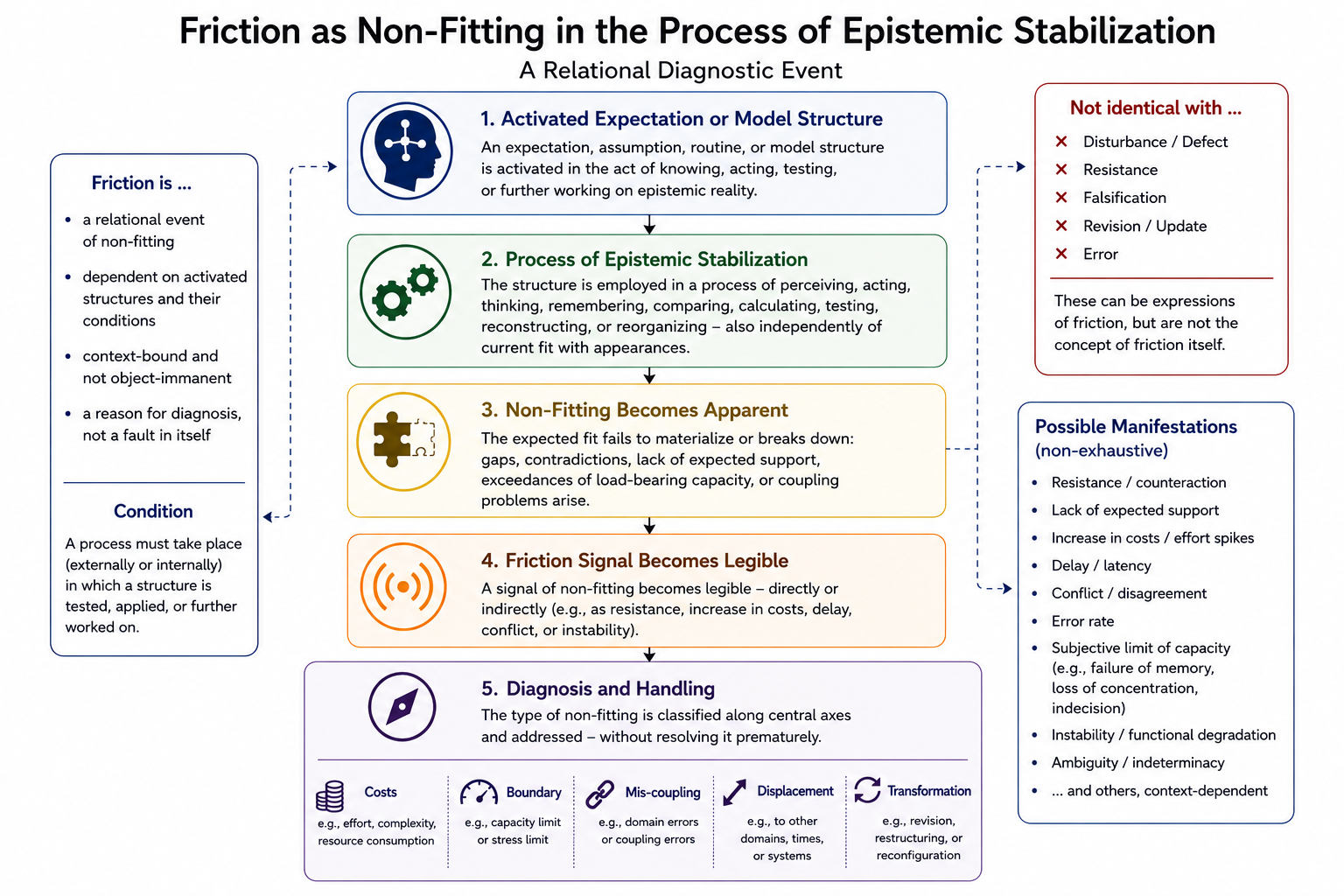
The working definition of this paper is: Friction is the epistemically legible non-fitting of an activated expectation or model structure under conditions of enactment. This non-fitting becomes friction-relevant when it makes the load-bearing capacity of a pattern of stabilization visible under strain: as rising effort, as resistance, as lack of expected support, as anticipated limitation, as mis-coupling, or as increasing need for coordination. The expression “boundary” designates an important special case of such non-fitting and is used below in a strictly functional sense. It designates neither an ontological impossibility nor a limit of reality in itself, but the cost-related limitation of a concrete pattern of stabilization under strain. Friction therefore initially designates non-fitting within finite stabilization under strain. It becomes epistemically relevant where stabilized orders are conducted, tested, or maintained as models, routines, institutions, expectations, or technical procedures (Rapp 2026b; Rapp 2026e; Rapp 2026i). Friction therefore operates on two levels: generally as a strain dynamic of finite stabilization, and in the narrower epistemic sense as a diagnostic signal of model-capable orders. This definition is deliberately minimal. It describes friction neither as a cause nor as an independent thing or isolated event, but as a signal that appears where a system under relevant strain attempts to maintain its stability. Friction therefore designates neither damage nor disturbance as such, but the point or range at which stabilization remains possible only with increasing effort or begins to fail. Three functional elements are decisive here: (1) Stability space. There are rules, invariances, or mechanisms through which something counts as stable, for instance coherence in experience, trust and expectation security in social orders, or reproducible efficacy in technical and empirical systems. (2) Strain. This stability is claimed by demands, for instance by stress, conflicts, scaling, scarcity of resources, contradiction, or time pressure. Strain is not exceptional here, but the normal condition of finite systems. (3) Boundary signal. Under sufficient strain, signs appear that the load-bearing capacity of the system has been reached or exceeded. These signs typically appear as nonlinearly rising effort, delay, error rates, expectation structures that fail to carry fittingly, or cost escalation. The decisive point is the signal character: friction is information about the costs of stabilization under load. It indicates where a system loses its stability or can maintain it only at the price of disproportionately rising effort. These costs do not have to be fully measurable or quantitatively determinable. They may appear qualitatively, reconstructively, or comparatively, for instance as rising complexity, growing coordination load, binding of attention, loss of legitimacy, resource consumption, or error rate. Not every difficulty or irritation constitutes friction. This paper speaks of friction only where an activated expectation or model structure fails to carry in a fitting way under conditions of enactment and thereby visibly strains the load-bearing capacity of a pattern of stabilization. This non-fitting may appear as rising effort, as resistance, as lack of expected support, as anticipated limitation, as mis-coupling, or as increasing need for coordination. Accidental disturbances, singular errors, or short-term irritations without a claim to stability do not fall under this concept. Friction is thereby distinguished from related concepts. A disturbance may occur punctually without making a structural cost profile visible. Resistance designates a non-fitting or counterforce, but not necessarily the boundary of a pattern of stabilization. Conflict is a possible intersubjective manifestation of friction, but is not identical with it. An anomaly is a scientific special case of model tension. Falsification marks a loss of validity under specific scientific conditions. Revision is a possible response to friction, not friction itself. Friction is therefore neither an event nor a state, and also not a causal operative factor, but a relational diagnostic variable. It becomes visible where an activated expectation or model structure is bound, in enactment, to the load-bearing capacity of a pattern of stabilization and where costs, boundaries, or mis-couplings become visible under strain. Friction does not immediately explain why a system fails or remains stable, but indicates where and under which conditions the validity of existing patterns of stabilization comes under pressure.
3. Three Domains of Reality as Axes of Analysis
To apply the concept of friction precisely, a clear distinction is needed among the contexts in which friction becomes legible. Friction does not occur everywhere in the same way, because stability does not carry everywhere according to the same criteria. Inner coherence, social expectability, and reproducible efficacy are different forms of stability. They can be strained, but they are not strained, tested, or restored in the same way. For this purpose, the paper distinguishes three domains of reality, which are not to be understood ontologically but serve as analytical axes. They do not designate separate regions of reality or a final division of reality, but different regimes for testing stability (Rapp 2026a; Rapp 2026c). In the subjective domain, stability becomes legible through inner coherence, decidability, and integration of meaning. In the intersubjective domain, it becomes legible through expectability, trust, legitimacy, and coordination. In the functional-empirical domain, it becomes legible through reproducible efficacy under resistance. These domains are compatible with the theory of relative reality (Rapp 2026h), but in this paper they are not used as an independent ontology of reality. Their function is methodological: they are meant to prevent friction from being misread or handled incorrectly where it occurs. Many theoretical and practical conflicts arise because friction becomes visible in one domain but is to be explained, evaluated, or solved with the means of another domain. (1) Subjective domain (experience). In the subjective domain, stability designates the inner coherence of perception, attention, decidability, and integration of meaning. Friction appears here when expected performances of memory, concentration, decision, or orientation fail to carry fittingly in enactment. Such breakdowns, tensions, or undecidabilities in enactment are therefore not already friction as such, but they may serve as boundary signals of a non-fitting between a subjective expectation of ability and actual enactment capacity. (2) Intersubjective domain (social order). In the intersubjective domain, stability consists in shared expectations, trust, legitimacy, and the reliability of institutional arrangements. Friction appears here as a densification of conflict, loss of trust, coordination problems, or crises of legitimacy. What is characteristic is that friction in this domain rarely remains local, but can spread systemically and produce high downstream costs. (3) Functional-empirical domain (efficacy under resistance). The functional-empirical domain concerns the stability of systems measured by reproducible efficacy. This includes technical, organizational, computational, or physical systems whose performance must prove itself under real resistance. Friction appears here as a capacity limit, performance decline, error rate, need for energy or resources, and as nonlinearly rising maintenance or control effort. The term “empirical” does not exclusively designate natural-scientific measurement practice here, but generally the testing of efficacy under straining conditions.
The distinction among these three domains does not serve to separate kinds of reality, but to assign friction precisely. If friction is interpreted or handled in a domain-inappropriate way, typical maldevelopments arise: subjective non-fitting is moralized as individual failure, social problems of legitimacy are treated as technical efficiency issues, or functional limits are dismissed as mere imagination. By contrast, the differentiation of domains makes it possible first to read friction where it arises, to keep its couplings visible, and to examine when it is displaced into other domains or evaluated incorrectly.
4. The Functional Logic of Friction
Friction marks the range in which the validity of a pattern of stabilization comes under pressure under strain. It is the primary signal that existing positings must be diagnostically examined before revision occurs (Rapp 2026g). Friction does not itself force adaptation, but opens the decision space between continued stabilization, selective modification, limited recoupling, and structural change. Friction, however, forces neither perception nor handling. Its diagnostic value arises only when it is read as a signal, attributed to a stabilization, and evaluated in relation to costs, boundaries, or mis-couplings. Friction does not immediately show that a model, an order, or a routine is false. It initially shows only that an existing stabilization no longer carries fittingly under certain conditions of strain. The appropriate response depends on what gives rise to the friction: an actual boundary of the model, overextension, incorrect assignment, domain-inappropriate handling, changed strain, or a coupling error within a more complex model context. Friction is therefore first an occasion for diagnosis, not already a judgment.
4.1 Boundary
Friction makes boundaries visible. These are not formal prohibitions and not limits of reality in itself, but points or ranges at which stabilization no longer functions linearly under strain. What is characteristic is that small additional demands have disproportionately large effects on coherence, performance, or coordination. In many contexts, such boundary phenomena are too quickly interpreted ontologically, as indications of a principled impossibility or of “limits of the world.” This interpretation is epistemically relieving, because it ends further processes of analysis and adaptation. Friction itself, however, does not decide this question. It merely indicates that stability under the given conditions can be maintained only with rising costs or not at all. Whether this is an external impossibility, a boundary of current stabilization, a misassignment, or a transition into another modeling regime remains an open question for further diagnosis. Friction thus protects against two premature interpretations. On the one hand, friction must not be immediately dismissed as mere disturbance. On the other hand, it must not be interpreted as a final limit of reality in itself. Its epistemic value lies precisely in making the boundary of a stabilization visible without already determining how this boundary is to be interpreted.
4.2 Costs
Friction translates boundary phenomena into costs. Costs are not limited here to monetary quantities, but designate any additional effort that becomes necessary to maintain stability against strain. They may appear as time demand, energy use, binding of attention, coordination effort, resource consumption, loss of legitimacy, rising complexity, error rates, or growing control load. What is decisive is not the existence of costs as such, but their dynamic. Stability is never cost-free. Friction, however, is spoken of only where costs increase disproportionately under repeated or rising strain and thereby indicate that a pattern of stabilization is reaching the boundary of its load-bearing capacity. Friction makes visible that rising effort is a central diagnostic criterion of limited load-bearing capacity. A cost profile does not have to be fully measurable or quantitatively determinable. It can be grasped qualitatively, reconstructively, or comparatively. What matters is that a structured course becomes visible: a stabilization does not simply become more difficult; its maintenance increasingly binds more resources, attention, coordination, legitimacy, or technical control. Friction designates this increasing cost tension in relation to a claimed stability core.
4.3 Selection over the Course of a Process
Under repeated strain, different cost profiles become visible. Patterns of stabilization that generate low or controllable additional costs under relevant strain remain load-bearing. Patterns of stabilization whose costs escalate lose stability, are limited, transformed, or replaced. This selective effect is not to be understood as an intentional, Darwinian, or teleological mechanism. It designates a minimal logic of finite stabilization: not every order can continue to be carried unchanged under rising costs. Repeated demands in connection with different cost trajectories lead to certain structures persisting while others are adapted, relieved, displaced, or abandoned. The expression “course” is deliberately preferable here because friction does not depend on a naively presupposed external stage of time. What is meant are ordered patterns of change within finite stabilization: stabilization, strain, change, and reorganization become distinguishable in enactment without time having to be presupposed as an ontological basic quantity. When the following discussion speaks of earlier, later, suddenly, or gradually, it refers to process patterns within epistemic stabilization, not to properties of an independently posited time in itself. In this way, friction connects possibility and reality functionally: the structures that remain really effective are those that are load-bearing under relevant friction or can change their form in such a way that connectability is preserved. This requires no ontological determination of what exists “in itself.” What matters is which stabilization continues to carry under strain, which must transform, and which loses its validity.
4.4 Process Patterns and Coupling Diagnosis
Friction shows not only that stabilization comes under pressure. It also shows how this strain proceeds. The process pattern of friction can therefore be diagnostically relevant. Gradually increasing friction suggests that a basically fitting model, routine, or order is reaching a boundary of strain. In such cases, costs rise gradually: more effort, more coordination, more auxiliary assumptions, more control, or more energy become necessary to maintain the same stability. The appropriate response may then consist in limitation, relief, local modification, or structural revision. By contrast, friction that appears abruptly or with disproportionate intensity suggests rather that the model itself is not slowly reaching its boundary, but that an incorrect assignment, an incorrect context, or a faulty coupling is present. A load-bearing model can be applied to the wrong case; a load-bearing submodel can be incorrectly activated or incorrectly embedded in a more complex context. What at first appears to be refutation may then be mis-coupling. This expands friction diagnosis without changing the concept of friction itself. Friction does not immediately show that a model is false. It initially shows that a stabilization no longer carries fittingly under strain. Only further diagnosis decides whether the problem lies in the model, in its range, in its domain, in the context, in the coupling of its submodels, or in a changed condition of strain.
5. Typology: Forms of Friction
The following forms of friction are not to be understood as completely separate phenomena. They designate different ways in which boundaries of strain become visible within the three analytical axes. In concrete cases, they may interlock, reinforce one another, or be displaced into one another. The typology therefore does not serve rigid classification, but more precise diagnosis.
5.1 Subjective Friction
Subjective friction designates the non-fitting between an activated expectation concerning one’s own capacity for cognition, memory, concentration, decision, or orientation and actual subjective enactment. It does not arise merely because the cognitive system is operationally limited. Such limits may already be stably integrated into the cognitive self-image and then occur as expected. A subjective boundary becomes friction-relevant only where an ability is expected that fails to carry fittingly in enactment. Someone expects, for example, to be able to remember an earlier situation well, but notices in the attempt to remember that nothing comes to mind. Someone expects to be able to concentrate on a text, but repeatedly loses the thread. Or someone expects to be able to perform a calculation mentally, but discovers in enactment that their own calculating capacity does not carry. Subjective friction therefore does not simply show that the cognitive system is limited. It shows that a subjective expectation or self-image structure fails to carry fittingly under given conditions of enactment. For precisely this reason, such experiences must not be dismissed as mere feelings: they may be boundary signals of a non-fitting between cognitive self-image, activated expectation of ability, and actual capacity to carry through in enactment.
5.2 Intersubjective Friction
Intersubjective friction concerns shared expectations, trust, legitimacy, and social order. It occurs where shared references, institutional procedures, or normative expectations can be kept stable only with increasing coordination and legitimation effort. Typical manifestations are:
- conflict spirals, loss of trust
- crises of legitimacy, diffusion of responsibility
- norm overextension, rule inflation, sanction backlog
Friction is often especially consequential in this domain because it rarely remains purely local. A breach of trust, a crisis of legitimacy, or persistent diffusion of responsibility can destabilize entire expectation spaces, even when the functional-empirical infrastructure remains intact.
5.3 Functional-Empirical Friction
Functional-empirical friction concerns systems whose stability is measured by reproducible efficacy under resistance. Here the classical case of “friction” is closest, but extended to technical, organizational, computational, and physical contexts. Typical manifestations are:
- energy demand, entropy effects, material fatigue
- capacity limits, bottlenecks, maintenance effort
- computational complexity, latency, error rates
A modern special case is digital friction. Scaling here generates not only rising costs, but often new classes of error: security risks, drift, dependence on infrastructure, coupling problems between systems, or difficult-to-detect downstream costs of automated processes.
5.4 Cross-Domain Friction and Externalization
Friction becomes especially relevant where its primary domain, its couplings, and its handling are not clearly distinguished. Two cases must be distinguished here: cross-domain friction and externalization. Cross-domain friction arises when friction occurs in one domain but is evaluated with the concepts, expectations, or solution patterns of another domain. Subjective friction can then be moralized as individual failure. Social problems of legitimacy can be treated as mere efficiency problems. Functional limits can be misunderstood as imagination, unwillingness, or a communication problem. In such cases, friction is not displaced, but interpreted in a domain-inappropriate way and thereby made handleable in the wrong terms. Externalization, by contrast, designates the displacement of friction into other domains, other actors, or later points in a process. Many systems “solve” friction by relocating it:
- Subjective friction is translated into social friction: an inner non-fitting appears outwardly as aggression, withdrawal, or conflict.
- Social friction is translated into functional friction: bureaucracy replaces trust with control and thereby generates process costs.
- Functional friction is translated into subjective friction: technical failure, complexity, or system instability are experienced as chronic stress.
Externalization is not wrong per se. It may be necessary because no system can handle all friction in place. It becomes problematic where it remains invisible. Then a local impression of frictionlessness arises while new instability is built up globally. The decisive question is therefore not whether friction is displaced, but whether its displacement remains visible, attributable, and handleable.
6. Friction in Science and Model Formation
Scientific model formation is an especially precise case of application for the concept of friction (Giere 2006; Hacking 1983; Parker 2020; van Fraassen 1980). Models are not only developed in order to order phenomena; they are also exposed to strain: measurements, replications, boundary cases, competing models, technical applications, or unexpected findings test whether a stabilization carries. Friction becomes visible here where a model is not simply refuted, but generates growing costs under increasing strain: additional assumptions, rising complexity, declining explanatory yield, parameter tuning, or fragile connectability.
6.1 Entity Focus and Boundary Focus as Competing Search Heuristics
A large part of scientific research has historically been shaped by an implicit entity focus. Knowledge is then understood primarily as the identification, specification, or ontologization of stable units, such as particles, fields, structures, or mechanisms. This focus was successful where new stable regimes were opened up and robust invariances emerged. In boundary areas, however, its heuristic performance can turn into its opposite. Precisely near presumed boundaries, entities become increasingly speculative, while the actual signals of knowledge appear in the form of instabilities, nonlinearities, cost escalations, or model tensions. Scientific upheavals therefore often appear not only as discoveries of new things, but as reorganizations of existing regimes of description (Godfrey-Smith 2006; Kuhn 1962). The decisive impulses often come from boundary phenomena, not from the successful stabilization of additional entities. Scientific realism tends to read such boundary phenomena as deficits of existing theories that are to be remedied by extending, refining, or supplementing ontological assumptions. This can shift the research focus toward saving existing patterns of stabilization, while friction itself is treated as mere disturbance. This prioritization is not methodologically necessary, but represents a historically grown search heuristic. By contrast, a boundary focus permits an alternative search strategy. Boundary areas are understood here not as points of termination, but as epistemically dense zones in which the load-bearing capacity of existing models under strain is decided. In this framework, friction functions not as a signal of mere failure, but as an indication of where search spaces should be expanded, descriptions transformed, or new regimes considered. Entities then appear not as primary aims of knowledge, but as local results of stabilization within specific cost and validity ranges. This reweighting does not imply anti-realism. It merely shifts the methodological priority: instead of maximizing ontological commitments early, boundary phenomena are systematically used as search indicators. In this sense, friction proves to be not only a diagnostic instrument, but also an orienting variable of scientific exploration. Especially in boundary areas, knowledge may then arise less through the multiplication of entities than through the reflective handling of those boundaries at which existing patterns of stabilization lose their load-bearing capacity.
6.2 Friction as a Criterion of Selection and Transformation for Scientific Models
Scientific knowledge can be understood as an organized culture of friction: models are intentionally exposed to strain so that boundaries become visible. Friction can not only occur; it can also be methodically induced: by re-examining earlier assumptions, by comparison, by searching for contradictions, or by reactivating suspended open points. Experiments, replications, measurement conflicts, boundary cases, and competing theories generate situations in which a model must show whether it remains load-bearing under load. Here friction appears, for example, as:
- anomalies, replication problems, measurement conflicts (Kuhn 1962; Oreskes, Shrader-Frechette, and Belitz 1994)
- model overextension, parameter tuning, ad hoc rescues
- growing complexity, declining explanatory yield
- unstable assignments between submodels, measurement practice, and theoretical interpretation
- naive realism: “If it is measurable, it is real.”
- naive relativism: “If it is model-dependent, it is arbitrary.”
The decisive point is this: not every friction is refutation. Some frictions are transformation signals; others indicate overextension, incorrect assignment, or unclear coupling. An anomaly is therefore not already falsification, but initially a friction signal within a specific modeling context. Falsification designates only a specific loss of validity under scientifically regulated conditions (Popper 1959; Rapp 2026d). Revision, in turn, is a possible response to friction, not friction itself. The central question is therefore not immediately whether a model is false. One must first examine what kind of friction is present: Does it affect the core of the model, its range, its coupling to measurement procedures, its assignment to a phenomenon, or only a local auxiliary assumption? A model can productively integrate friction as long as its cost structure does not escalate and its connectability is not destroyed. If, by contrast, its stabilization is maintained only through growing complexity, ad hoc rescues, or uncontrolled auxiliary assumptions, friction indicates a boundary of its load-bearing capacity. Friction thereby becomes a precise criterion against two errors:
Friction shows: model-dependence is unavoidable, but not arbitrary, because cost profiles select under strain (Goodman 1978; Putnam 1981). Models do not stand outside epistemic stabilization, but neither are they freely interchangeable. Their load-bearing capacity appears in how they absorb strain, make boundaries visible, integrate friction, or must be transformed under rising costs.
The epistemic benefit of the concept of friction therefore lies not in explaining new phenomena, but in better guiding existing processes of knowledge. Friction makes it possible to diagnose the boundaries of models, theories, and institutions functionally without prematurely misinterpreting them as refutation or as mere disturbance. This avoids two systematic maldevelopments: the dogmatic stabilization of overextended models through rising complexity, and the premature abandonment of viable approaches because strain signals have been interpreted incorrectly. Friction thus functions as an intermediate level between falsification and arbitrariness: it makes costs visible before epistemic decisions become irreversible.
7. Physical Boundary Concepts, Mathematical Indeterminacy, and the Ontologization of Hard Boundaries
In the intuitive interpretation of physical theories, physics is often regarded as the domain of hard, objective boundaries. The speed of light, absolute zero, Planck scales, or singularities appear as unambiguous limits of what is possible. This idea shapes not only popular images of physics, but also constitutes a central source of our ontological understanding of reality: the world appears as structured by fixed, objectively posited boundaries, independently of modeling, costs, or conditions of cognition. Precisely this intuition is epistemically risky because it too quickly collapses model boundaries, limit values, and real impossibilities into one another. The following considerations are not intended as a critique of physical theories as such, but as an exemplary illustration of the concept of friction in an especially precise field of application. Physics is chosen here as a paradigmatic case because its formal boundary concepts make friction especially clearly visible. The analysis claims neither a new physical evaluation nor an ontological decision. Rather, it examines how mathematically precise boundary structures are read epistemically: as real impossibility, as a model boundary, as an asymptotic limit value, or as an indication of a possible regime change. In this sense, physical boundary concepts become legible as especially precise cases of that non-fitting in which model expectations no longer carry as a matter of course under boundary conditions. In what follows, the concept of boundary designates no ontological barrier of reality, but a functional marking of those levels of strain beyond which the stabilization of a model remains possible only under nonlinearly rising costs. The expression “ontologization” is also not used here in the sense of an ontology (Rapp 2026f). What is meant is the stabilization of boundary markings into seemingly fixed units of reference. This ontologization becomes problematic where mathematical or model-theoretical boundary forms are read as final boundaries of reality. Physical theories do not measure boundaries in the sense of ontological endpoints. What is empirically accessible are finite quantities, trends, scalings, and trajectories of stability under finite conditions. Limit values appear as idealized points of reference that can be empirically approached only asymptotically. What becomes visible experimentally are not absolute barriers, but characteristic regimes in which effort, instability, or inconsistency increase strongly and nonlinearly. At this point, mathematics usually enters as an anchor of precision. While physical model descriptions often remain heuristically or linguistically underdetermined, mathematical formulation is expected to provide the decisive precision. In boundary areas, however, even this expectation reaches a boundary. The mathematical formalisms of physics are syntactically precise but semantically underdetermined. They produce divergences, singularities, or limit values without formally marking whether these are to be read as real impossibilities, mere model boundaries, asymptotic idealizations, or transitions into new theoretical domains. A paradigmatic example is the theory of relativity. If one inserts the speed of light into its formulas for a massive particle, the corresponding expressions formally diverge toward infinite values. This divergence is often interpreted in abbreviated form as the claim that “an infinite amount of energy” would be required to reach the speed of light. Physically, however, this is not a claim about real infinities, but about the asymptotic boundary behavior of a model. The impossibility of reaching the speed of light is not encoded by the mathematical divergence alone, but is determined only through the physical interpretation of the model. The formula itself contains no symbol that distinguishes between formal divergence, physical realizability, and model boundary. This semantic underdetermination is not a special case of the theory of relativity. In thermodynamics, absolute zero marks a limit value that is mathematically defined but not reachable. In general relativity, singularities appear whose physical meaning remains unresolved. In quantum field theory, divergences appear that become handleable only through renormalization. In all these cases, mathematics provides precise computational structures, but no unambiguous world-meaning of the limit values. Physics is not imprecise here in the sense of incorrect calculations; rather, it is epistemically underdetermined in the explicit marking of the meaning of its boundary concepts. This semantic underdetermination gives rise to the widespread tendency to read mathematical boundary structures ontologically. Divergences and limit values are then interpreted as properties of the world itself, although they initially function as functional markers of model boundaries. What appears as friction within a theoretical framework is thus reinterpreted as a supposedly objective barrier of reality. This displacement favors ontologically realist readings of physical model boundaries, in which physical theories are understood as immediate descriptions of the world, while the epistemic role of modeling, costs, and stabilization recedes into the background. Such an interpretation is not sufficiently secured epistemically. Physical theories are historically themselves the result of regime changes. The theory of relativity did not replace Newtonian mechanics simply because a hard boundary of the world had been discovered, but because frictions accumulated at the margins of the old theory and new patterns of stabilization became necessary. It does not follow from this history that present-day physical boundary concepts are merely provisional or false. But it does show that even highly stable theories do not themselves conclusively interpret their boundary areas ontologically. Whether boundary behavior remains asymptotic, turns into a breakdown, or releases new dynamics remains a question of further modeling, measurement, and theoretical stabilization. At precisely this point, the concept of friction gains its reach. Friction designates not the end of reality, but the end or boundary of strain of the load-bearing stabilization of a model under given conditions. It marks cost escalations, nonlinearities, and selection points without forcing final ontological decisions. Friction in physical model contexts therefore does not differ in its basic logic from subjective or intersubjective friction, but in the kind of costs that become visible: measurement effort, mathematical instability, theoretical inconsistency, technical inaccessibility, or regime change.
The explicit dissolution of the idea of hard physical boundaries is therefore not a relativization of physics, but a clarification of its epistemic status. It makes visible that physics is not a special case beyond the friction approach, but its most stable case of application. Precisely because physical models are highly precise, their boundary areas show especially clearly that order does not arise through absolute barriers, but through selected stabilization under rising costs. In this sense, physics does not form a counterpole to friction, but an especially demanding stress test of the concept of friction.
8. Friction in Technology, Organization, Law, and AI
In technical, organizational, and legal systems, friction appears especially clearly, but is often misunderstood. A typical response is the attempt to reduce local friction in a targeted way in order to increase efficiency, speed, reliability, or steerability. Such optimizations, however, regularly generate new strains elsewhere. Friction does not simply disappear, but is redistributed, condensed, or displaced into less visible areas. The common point of these systems is that they establish stability through procedures, rules, technical infrastructure, or automated processes. This can lower local friction costs. Decisions become faster, processes more standardized, responsibilities formalized, or procedures more calculable. At the same time, new cost profiles arise: increasing coordination effort, maintenance demand, control load, dependence on infrastructure, diffusion of responsibility, or problems of legitimacy. In organizations, friction appears as rising coordination effort, as a densification of control and coordination processes, or as slowing decision-making capacity. In legal systems, it appears in costs of enactment, problems of enforcement, or in the tension between normative clarity and practical implementability. Friction becomes problematic where it is made politically or institutionally invisible. Decisions then appear as objective constraints or as mere individual cases, although in reality they displace cost profiles and change patterns of stabilization.
Bureaucracy as a Case of Systematic Friction Displacement
Bureaucratic systems can be understood as institutional responses to intersubjective friction. Where trust, shared expectations, or informal coordination no longer carry stably, rules, procedures, and control mechanisms are introduced in order to maintain order. In the short term, this can reduce intersubjective friction by restricting decision spaces, formalizing responsibilities, and documenting accountability. This reduction of friction, however, is not cost-free. The relieved intersubjective domain generates growing functional-empirical friction in the form of process delays, coordination effort, rule inflation, and administrative complexity. At the same time, bureaucracy can weaken the exploratory dynamic of a system: it not only binds existing resources, but also makes it harder to open up new resources because deviation, initiative, and experimental search movements are discouraged or formally overloaded. If this displacement is not explicitly reflected, the impression of objective constraints arises, although what is at stake is a redistribution of friction. Bureaucratic overextension is in this sense not a moral failure, but a structural result of friction displacement that has become invisible.
Technical Automation and the Illusion of Local Frictionlessness
Technical automation often reduces local friction in work, decision, or coordination processes. Activities become faster, more consistent, and seemingly frictionless. These efficiency gains, however, regularly generate new forms of friction elsewhere. A typical pattern is the displacement of functional-empirical friction into increased dependence on infrastructure, maintenance, energy demand, interface stability, or susceptibility to error. At the same time, intersubjective friction shifts into questions of responsibility, control, liability, and trust. Subjectively, this dynamic may appear as relief with downstream costs, for instance through overtrust in technical systems, loss of situational competence, or increased dependence on opaque procedures. Automation therefore does not abolish friction, but reorganizes it. Friction thereby often becomes less visible, not smaller.
Artificial Intelligence as a Case of Accelerated Friction Displacement
In what follows, artificial intelligence is not treated as an independent special case, but as an accelerated and condensed example of general friction displacement. The use of artificial intelligence can be described as the systematic reduction of local friction in decision, coordination, and knowledge processes. Tasks that were previously time-intensive, effort-intensive, or conflict-intensive are seemingly automated, delegated, or prestructured with little apparent friction. This reduction of friction, however, does not mean cost-freedom, but a displacement of cost profiles at increased speed and with reduced legibility. Functional-empirical friction occurs in the form of computational, energy, data, maintenance, and integration costs. Intersubjective friction shifts into questions of responsibility, liability, trust, legitimacy, and traceability. Subjective friction appears, for example, in overtrust, the illusion of control, loss of competence, or cognitive relief with later downstream costs. Artificial intelligence therefore does not generate entirely new basic forms of friction, but accelerates known patterns of friction and makes their displacement harder to recognize. The special point of artificial intelligence therefore lies in the connection between local friction reduction, increased system speed, and reduced transparency. Where decisions, texts, classifications, or action proposals are generated automatically, immediate effort often decreases. At the same time, the requirements for checking, assigning responsibility, contextual sensitivity, and error diagnosis increase. Precisely this creates an intensified form of epistemic strain: friction is not abolished, but displaced into downstream control, interpretation, and responsibility structures. The analysis of this mechanism is deliberately limited here to conceptual classification. Further dynamics and risks of accelerated friction displacement, especially in learning technical systems, remain reserved for separate investigation.
9. Problematic Forms in the Handling of Friction: Avoidance, Displacement, Overvaluation of Friction
The following problematic forms are to be understood in a strictly functional sense. They designate neither a moral defect, nor a political wrong decision, nor individual guilt, but long-term unstable forms of epistemic or institutional architecture relative to explicit stability goals. A way of dealing with friction becomes problematic where rising costs, blocked revision, or concealed displacement systematically undermine the load-bearing capacity of existing stabilization under finite conditions. Three problematic forms are especially typical. (1) Avoidance of friction. Friction is treated in principle as disturbing, inefficient, or avoidable. The aim is then to eliminate friction as completely as possible. The result is often not genuine stabilization, but concealment of boundary signals. Instabilities initially remain invisible because the signals by which boundaries of strain would become recognizable are suppressed or smoothed over. (2) Displacement of friction. Friction is reduced locally, but systematically shifted into other domains, other actors, or later points in time. The result is apparent efficiency with increasing total strain. This form becomes especially problematic when the displacement does not remain visible: a system then appears locally low-friction while producing legitimacy costs, subjective burdens, process loads, or functional instability elsewhere. (3) Overvaluation of friction. High friction is treated as proof of seriousness, truth, depth, or moral superiority. The legibility of boundaries is then no longer the decisive factor; rather, the hardness of the strain itself becomes decisive. The result is unnecessary difficulty, blocked innovation, moralized suffering, or the stabilization of structures precisely because they generate high costs. The criterion against all three problematic forms is simple: friction must neither be eliminated in principle, nor unreflectively displaced, nor intensified for its own sake. It must remain visible, attributable, and handleable in such a way that stabilization under strain can be tested, limited, or transformed.
10. Practical Guidelines: Friction Competence as a Design Principle
The problematic forms described in the previous section show that friction should neither be eliminated in principle nor unreflectively displaced or elevated. What follows from this is not a normative doctrine of what ought to be done, but a functional question of design and diagnosis: How must systems be built, observed, or steered so that friction under strain remains legible, attributable, and handleable? The following guidelines are to be understood as principles of design and diagnosis, not as final moral or political rules. They describe conditions under which systems can process friction in such a way that long-term stability under strain remains possible, independently of concrete value commitments. Friction competence means building, observing, or steering systems in such a way that friction becomes visible early, in accordance with its domain, and in an attributable way. Its aim is not maximum friction reduction, but the controlled legibility of boundaries of strain. Minimal principles:
1. Legibility before optimization.
Friction should first be recognized, understood, and assigned before it is reduced. Optimization without friction diagnosis often generates hidden costs.
2. Domain correctness.
Friction must first be read correctly according to its primary domain. Its handling, however, may occur across domains, provided that the coupling structure remains visible. Subjective friction may require intersubjective support, social friction may require functional procedures, and functional-empirical friction may require subjective or social relief. Handling becomes problematic only where a friction is interpreted in a domain-inappropriate way or its coupling is made invisible.
3. Cost legibility.
Every stabilization has costs. Hidden costs function like instability credits: they relieve locally, but generate later strain or strain that appears elsewhere.
4. Attributability.
If friction is distributed or displaced, it must remain visible who or what carries it, what gives rise to it, and which stabilization is relieved by it.
5. Transformation instead of suppression.
Friction may indicate that not merely a parameter must be adjusted, but that a structure must be limited, relieved, recoupled, or transformed.
Diagnostic Routine: Reading Friction Systematically
The guidelines developed in this paper can be condensed into a simple diagnostic sequence. This sequence does not replace detailed analysis, but enables an initial orientation as to whether observed problems indicate mere local disturbances or structural boundaries of existing patterns of stabilization. (1) Domain assignment and coupling. In which domain does the friction primarily occur: subjective, intersubjective, or functional-empirical? Which other domains are involved in its emergence, displacement, or handling? (2) Stability core. What form of stability is being claimed: coherence, trust, legitimacy, performance, reproducibility, or connectability? (3) Cost profile. How do the costs of this stabilization develop under increasing or repeated strain? Do they show linear growth, nonlinear escalation, tipping points, or recurring patterns of strain? (4) Process pattern. Does friction occur gradually, abruptly, or recurrently? Gradual friction suggests overextension or rising stabilization costs. Abrupt friction may indicate incorrect assignment, an incorrect context, or coupling errors. Recurring friction at the same point may indicate a durable interface or model boundary. (5) Displacement. Where is friction shifted when it is locally reduced or suppressed: into other domains, other actors, or later points in time? (6) Form of response. Which response is appropriate: continuation of stabilization, local modification, relief, recoupling, limitation, or structural transformation? Friction competence appears in asking these questions early, before cost profiles generate irreversible instabilities. It does not consist in avoiding friction, but in keeping friction legible in such a way that systems can recognize their own boundaries of strain and respond to them appropriately.
11. Friction as a Condition of Robust Order
Friction is a basic concept because it accomplishes three things at once: it marks boundaries, makes costs visible, and shows which patterns of stabilization remain load-bearing under strain. Friction thus becomes a diagnostic logic of selection through which open possibility is transferred into stable epistemic forms of reality without requiring final ontological claims. The point is sober: order is not the state without friction. Order is the state in which friction remains legible, attributable, and handleable in such a way that stability remains load-bearing under relevant strain. Friction does not simply show that order fails, but under which conditions it carries, where it displaces its costs, and when it must be limited or transformed. Friction thereby changes from a term of disturbance into a diagnostic tool. Its epistemic value lies in making boundaries of strain visible without prematurely interpreting them as mere disturbance, as final refutation, or as an ontological barrier. The concept of friction developed here is therefore not a metaphorical supplement, but a theoretical instrument for analyzing stability, costs, selection, and order in finite epistemic systems. The further question of how meaning arises from repeated processing of friction remains an adjacent problem. For this paper, the structural point is sufficient: stable epistemic reality does not arise through freedom from friction, but through the capacity of finite systems to keep friction legible, to distinguish cost profiles, and to limit, distribute, or transform stabilization under strain.
Conceptual Canon of This Paper
The following conceptual canon serves to stabilize central meanings within this text and makes no claim to completeness or final systematicity. Terms not listed here either do not belong to the functional core of this paper or are treated in separate works. The conceptual canon is to be understood as an explicitly stabilized reference basis. It forms the starting point for the conceptual work of this paper, but it is not rigid or dogmatic. Changes, specifications, or extensions of the canon are possible in principle, but they are subject to a strict condition: every deviation, modification, or extension of the canon must be expressly identified, locally limited, and justified. Implicit shifts of meaning, silent extensions, or retrospective reinterpretations are excluded.
Adoption of the Basic Canon of Epistemics
This paper adopts the conceptual canon defined in the basic paper on Epistemics as an unchanged reference basis. The terms introduced there are used without reinterpretation and without implicit displacement of their functional meaning. This paper introduces no divergent definitions of the adopted canonical terms.
Canonical Deviations or Modifications
This paper introduces no deviations, modifications, or refinements of the basic canon of Epistemics. All adopted canonical terms are used strictly in the sense of the basic paper.
Friction-Specific Canonical Extensions
In addition to the adopted basic canon of Epistemics, this paper introduces several friction-specific terms. These extensions do not change the meaning of the basic canon, but specify derived concepts of analysis and diagnosis for the legibility of stability under strain.
Friction
Concise definition: The epistemically legible non-fitting of an activated expectation or model structure under conditions of enactment. Function: This term marks where a pattern of stabilization no longer connects fittingly enough to experience, action, situation, or orientation under strain and thereby makes costs, boundaries, mis-couplings, or the need for transformation visible. Distinction: It is not identical with resistance, disturbance, error, anomaly, falsification, or revision. Resistance is only one possible form in which friction becomes visible.
Stability Space
Concise definition: A concrete order context in which something counts as stable according to specific criteria. Function: This term names which stability is being tested under strain and where friction becomes legible as a boundary signal. Distinction: It is not an ontological space and not an independent domain. Domains designate basic modes of testing stability; stability spaces designate concrete order contexts within or between such modes of testing.
Strain
Concise definition: The claiming of a pattern of stabilization by relevant demands. Function: This term describes the conditions of load under which costs rise and boundaries become visible. Distinction: It is not a state of exception; not a moral or psychological attribution; not every irritation is already strain in the friction-relevant sense.
Boundary Signal
Concise definition: An epistemically legible sign of a limit of load-bearing capacity under strain. Function: This term marks the transition from linearly load-bearing stabilization to disproportionate effort, loss of stability, or the need for transformation. Distinction: It is not an ontological impossibility; not proof of hard boundaries of the world.
Cost Profile
Concise definition: A structured course of cost development under strain. Function: This term makes different load-bearing capacities of patterns of stabilization comparable and diagnostically evaluable. Distinction: It is not a reduction to money, energy, or measurability; not a claim to a complete metric. Cost profiles can be grasped qualitatively, reconstructively, comparatively, or quantitatively.
Selection over the Course of a Process
Concise definition: The non-intentional effect of repeated strain through which certain patterns of stabilization persist, are transformed, or are abandoned. Function: This term explains why certain patterns of stabilization remain load-bearing under strain, while others are limited, changed, recoupled, or abandoned. Distinction: It is not a Darwinian, teleological, or normative mechanism; it does not presuppose an ontologically posited external stage of time. What is meant are process patterns within ordered stabilization.
Externalization
Concise definition: The displacement of friction into other domains, actors, or later points in a process. Function: This term explains apparent local frictionlessness amid growing total strain or global instability. Distinction: It is not per se a malform; it becomes problematic only when it remains invisible, is not attributable, or blocks revision.
Cross-Domain Friction
Concise definition: Friction effects arising from domain-inappropriate evaluation or handling. Function: This is a diagnostic concept for cases in which friction arises in one domain but is read or handled with the concepts, expectations, or solution patterns of another domain. Distinction: It is not a mere displacement of friction, but an incorrect assignment of the form of handling; not an ontological domain conflict; not a hierarchization of domains.
Friction Competence
Concise definition: The capacity to keep friction legible early, in accordance with its domain, attributable, and handleable. Function: This term serves as a principle of design and diagnosis for systems that are to maintain stability under load without making friction invisible or handling it incorrectly. Distinction: It is not a normative doctrine of virtue; not a moral charge; not a principle of maximum friction reduction.
Connectable Diagnostic Concepts
The following terms are not developed in this paper as full canonical extensions, but are relevant as connectable concepts for later works.
Coupling Error
Concise definition: A form of friction in which it is not necessarily a model itself that fails, but its assignment to an appearance, domain, situation, or submodel context that has been incorrectly stabilized. Function: This term prevents the premature interpretation of friction as model error or falsification. Distinction: It is not a replacement for model error, model overextension, or revision; rather, it is an additional diagnostic level between friction and possible revision.
Process Pattern of Friction
Concise definition: The diagnosis of the way in which friction occurs within a course of stabilization, for instance gradually, abruptly, or recurrently. Function: This term helps to distinguish whether friction is more likely to indicate boundaries of strain, overextension, misassignment, coupling errors, or durable interface problems. Distinction: It is not a naive concept of time; what is meant are reconstructable patterns of intensity and recurrence within ordered stabilization.
Canonical Status and Scope of Validity
The friction-specific terms introduced in this paper constitute an explicit canonical extension of the framework of Epistemics. They are stabilized for the scope of validity of this paper and may be used as reference terms in subsequent works, provided that their use is expressly identified. The additionally named connectable concepts do not possess a fully developed canonical status in this paper. They mark diagnostic possibilities that arise from the concept of friction, but must be developed more precisely in separate works. There is no silent extension, reinterpretation, or retrospective modification of the basic canon of Epistemics. The core canon remains unchanged in meaning, function, and distinction. Every future deviation, specification, or further extension of the canon is subject to the metarule of canonical development established in the basic paper on Epistemics. It must be expressly identified, locally limited, and justified. Implicit shifts of meaning or informal canon extensions are excluded.
References
Giere, Ronald N. 2006. Scientific Perspectivism. Chicago: University of Chicago Press.
Godfrey-Smith, Peter. 2006. Theory and Reality: An Introduction to the Philosophy of Science. Chicago: University of Chicago Press.
Goodman, Nelson. 1978. Ways of Worldmaking. Indianapolis: Hackett.
Hacking, Ian. 1983. Representing and Intervening. Cambridge: Cambridge University Press.
Kuhn, Thomas S. 1962. The Structure of Scientific Revolutions. Chicago: University of Chicago Press.
Oreskes, Naomi, Kristin Shrader-Frechette, and Kenneth Belitz. 1994. “Verification, Validation, and Confirmation of Numerical Models in the Earth Sciences.” Science 263 (5147): 641–646.
Parker, Wendy S. 2020. Modeling and Evidence. Cambridge: Cambridge University Press.
Popper, Karl R. 1959. The Logic of Scientific Discovery. London: Routledge.
Putnam, Hilary. 1981. Reason, Truth and History. Cambridge: Cambridge University Press.
Rapp, Stefan. 2026a. Domains, Boundaries, and Transition Functions: On the Domain-Relative Validity, Migration, and Coupling of Models under Finite Conditions. Zenodo. https://doi.org/10.5281/zenodo.19542526.
Rapp, Stefan. 2026b. Epistemics: Model Management Under Finite Conditions. Zenodo. https://doi.org/10.5281/zenodo.18441326.
Rapp, Stefan. 2026c. Beyond Physics and Metaphysics: Epistemics and the Differentiation of Reality into Subjective, Intersubjective, and Functional-Empirical Physics. Zenodo. https://doi.org/10.5281/zenodo.18317965.
Rapp, Stefan. 2026d. Contextual and Global Falsification of Scientific Models: An Integrated Theory of Epistemic Validity. Zenodo. https://doi.org/10.5281/zenodo.17714966.
Rapp, Stefan. 2026e. Contingency Mechanics: Variation, Stabilization Tension, and the Emergence of Viable Order in Finite Systems. Zenodo. https://doi.org/10.5281/zenodo.20048581.
Rapp, Stefan. 2026f. Ontologization as an Epistemic Basic Operation: Functional Stabilization, Intersubjectivity, and Malfunction. Zenodo. https://doi.org/10.5281/zenodo.18346602.
Rapp, Stefan. 2026g. Revision under Finite Conditions: A Theory of Model Transformation in Epistemics. Zenodo. https://doi.org/10.5281/zenodo.18935928.
Rapp, Stefan. 2026h. Relative Reality Theory: Degrees of Reality, Validity, and Stability in Fragmented Knowledge Environments. Zenodo. https://doi.org/10.5281/zenodo.18000510.
Rapp, Stefan. 2026i. From the Field of Experience to the Model: Epistemic Stabilization and the Localization of Uncertainty under Finite Conditions. Zenodo. https://doi.org/10.5281/zenodo.19917105.
van Fraassen, Bas C. 1980. The Scientific Image. Oxford: Clarendon Press.
Appendix A: Didactic Illustration of the Concept of Friction
Note on the Status of This Appendix
The following section serves exclusively as a didactic illustration of the concept of friction developed in the main text. It introduces no new concepts, grounds no additional theses, and has no independent argumentative function. Its aim is to make vivid the structural logic of friction in subjective, intersubjective, and functional-empirical domains. The appendix is therefore intended primarily for teaching and mediation contexts.
A.1 Basic Formula: Friction as the Non-Fitting of an Expectation or Model Structure
Friction does not simply designate resistance. It arises where an activated expectation or model structure fails to carry fittingly in experiencing, acting, thinking, or orienting. This non-fitting may appear as increasing resistance, as lack of expected support, as anticipated limitation, as a subjective limit in enactment, as mis-coupling, or as the repeated non-confirmation of a search strategy.
The following examples show different forms of the same structure. What is decisive in each case is not the object or event by itself, but the relation between expectation, model, enactment, and experienced or anticipated boundary.
A.2 Increasing Resistance: A Group Moves Through Water
Imagine a group of people moving together through clear, shallow water. Movement is at first easy, coordinated, and not very strenuous. The implicit situation model is: “This is water; one can move here.” In this state, stability is present in all three domains: subjectively, because the movement remains internally bearable; intersubjectively, because the group acts in a coordinated way; functionally-empirically, because the medium permits movement without significant resistance.
As the movement continues, the water gradually becomes cloudier and more viscous. Movement is still possible, but the effort noticeably increases. Individual group members experience growing exertion, discomfort, or doubt about the appropriateness of continuing. These reactions may mark subjective friction when they occur against the expectation that one can continue to carry the movement internally. At this point, there is still no factual impossibility of movement. The group may nevertheless stop already here because the inner load-bearing capacity of individual participants is exceeded.
As viscosity continues to increase, discussions begin within the group: How much farther should one go? Are all members carrying the increasing strain equally? Is the goal still worth the effort? Movement remains possible, but coordination itself becomes costly. Here intersubjective friction occurs. The group may stop even though individual members could continue and no functional boundary of movement has been reached. The reason for stopping then lies not primarily in the medium, but in the impossibility of stable shared coordination.
Finally, the water turns into marshy terrain. Every step requires disproportionate force, individual persons get stuck, and progress becomes factually impossible. Here functional-empirical friction becomes visible. Under the given conditions, this boundary is independent of motivation, individual resilience, or social agreement. It is not only inner perseverance or shared coordination that reaches its limits, but the efficacy of the action under resistance.
A.3 Didactic Assignment of the Three Forms of Friction
The water example allows a simple distinction. Subjective friction is present when the expectation of being able to carry continued movement internally no longer carries fittingly in enactment. Intersubjective friction is present when shared coordination is no longer possible under rising costs. Functional-empirical friction is present when the medium no longer permits movement under the given conditions.
All three reasons for stopping are real, legitimate, and structurally different. Friction does not designate only the final standstill, but already that phase in which stability is still possible, but only under increasing and nonlinearly rising costs.
A.4 Expected Resistance: The Wall
A group walks along a path and sees a wall ahead. As long as no one tries to continue walking against the wall, its resistance is not immediately experienced. Yet friction can already arise because the model “wall” leads one to expect resistance. The group anticipates that continuing would fail, be painful, or be costly.
The wall then acts not through currently experienced resistance, but through expected resistance. Friction arises as pressure of orientation and decision: stop, go around, test, or continue anyway. The example shows that friction need not arise only through collision. It may already occur where a model expects resistance in a sufficiently stable way and thereby blocks continuation or makes a decision necessary.
A.5 Lack of Expected Support: The Chair Pulled Away
A child sits down on a chair. Its situation model is: “The seat is there and will carry me.” The action therefore presupposes expected support. If the chair is pulled away unnoticed, this expected support is absent. The child experiences friction not through resistance, but through the absence of an expected resistance or hold. It lands on the floor because the coupling between appearance, model, and action does not carry.
For the child who pulls the chair away, by contrast, the same event does not constitute friction, but confirmation of expectation. That child’s model was: if the chair is pulled away, the other child will sit into empty space. Depending on the activated model expectation, the same occurrence can therefore generate friction, confirmation, or social conflict friction.
The example makes clear: friction does not lie in the event alone. It arises in the relation between expectation, model, action, and outcome.
A.6 Subject-Internal Friction: Counting Forever
Someone thinks: “I can keep counting forever.” As a theoretical thought, this continuation is easily stabilized. But if the person actually begins to count, the situation changes. Attention, will, motivation, or strength may diminish. At some point, it becomes visible that theoretical continuability is not identical with subjective capacity to carry through in enactment.
Here friction arises neither at an external wall nor in a social conflict. It arises within subjective enactment: an activated expectation or model structure does not carry practically without limit. The example shows that friction can occur entirely within the subject.
A.7 Friction of Boundary Setting: Prime Numbers
A learner discovers numbers that are divisible only by 1 and by themselves. At first, the learner may expect such numbers to occur only in the range of small numbers. A boundary is set: at the latest after 100, there will no longer be such numbers. Later, however, corresponding numbers are found beyond this boundary. Then a new boundary is set, perhaps at 1000. This expectation, too, is broken by further cases.
The friction here does not concern only a single false expectation. The strategy of assigning a finite upper boundary to the phenomenon repeatedly fails. The learner cannot fully test arbitrarily large numbers, because total testing would be practically overwhelming. Nevertheless, the repeated non-confirmation of local boundary settings changes the model strategy: it was not this or that boundary that was false; rather, boundary setting itself proves to be a non-fitting model form here.
The example shows that friction can correct not only individual expectations. It can also put the form of expectation formation itself under strain and thereby open new search spaces.
A.8 Didactic Closing Formula
The examples show: friction is not simply resistance. Resistance is only one possible form in which friction becomes visible. Friction arises where an activated expectation or model structure fails to carry fittingly in experiencing, acting, thinking, or orienting.
This can happen through increasing resistance, but also through lack of expected support, anticipated limitation, subjective limits in enactment, mis-coupling, or the repeated non-confirmation of a search strategy. Friction therefore designates not a thing and not merely an obstacle, but the relational non-fitting of a stabilization in enactment.