From the Field of Experience to the Model
Epistemic Stabilization and the Localization of Uncertainty under Finite Conditions
Abstract
Epistemics understands epistemic practice as model management under finite conditions (Rapp 2026a). This determination remains incomplete, however, as long as it remains unclear how fields of experience become model-capable, that is, available for model formation, in the first place. Models do not arise directly from experience; rather, they presuppose that experience has already been ordered, differentiated, and epistemically stabilized. The present paper examines this prior level of stabilization and determines models as explicitly identifiable, workable, and revisable stabilizations of epistemically ordered fields of experience.
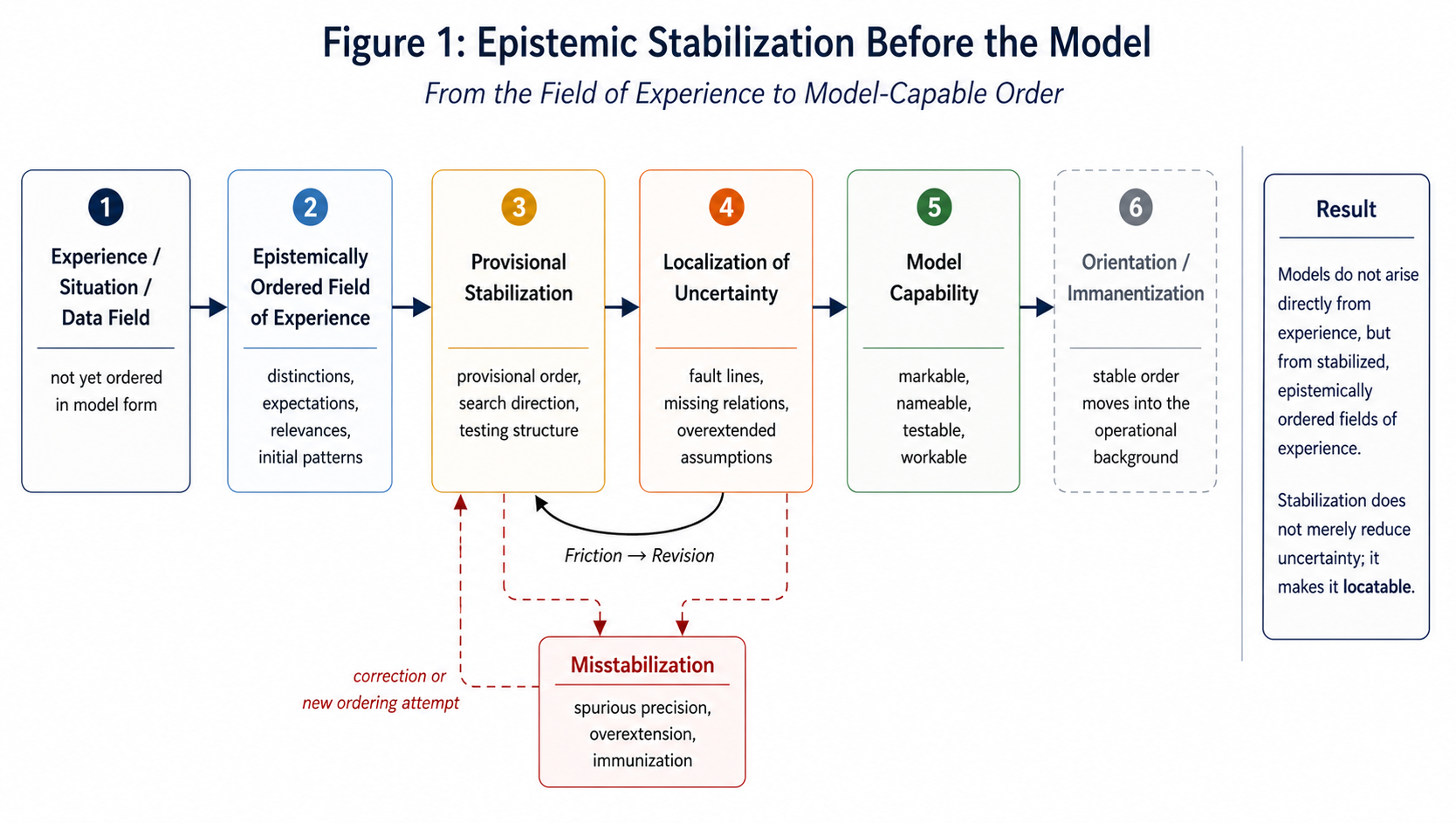
The central thesis is this: epistemic stabilization does not simply reduce uncertainty; it often first makes it localizable. As long as a field of experience remains diffuse, it also remains unclear what precisely its uncertainty consists in. Only when an epistemic system posits a provisional order, such as a heuristic, a schema, a case hypothesis, or a model, does it become apparent which relations hold, which information is missing, which assumptions are too strong, and where fault lines arise.
This provisional stabilization is therefore not merely a preliminary stage of secured knowledge, but an epistemic act of testing. From this perspective, central concepts of Epistemics are made more precise. Validity designates the carrying capacity of a stabilization under finite conditions. Friction is the point at which its boundary becomes visible. Revision is the restructuring of a stabilization when this boundary becomes epistemically relevant. At the same time, the paper shows that degrees of stabilization, from heuristic through schema and model to formalization, do not form a ladder of progress. Stronger stabilization is not automatically better inquiry; what is decisive is the adequacy of the stabilization in relation to the state of information, purpose, domain of validity, costs, and revisability.
The paper supplements Epistemics by systematically opening up the area before the explicit model. Model management does not begin only with completed models, but wherever an epistemic system stabilizes a field of experience in such a way that it can become visible what holds, what is missing, and what does not fit.
Keywords
Epistemics; stabilization; model management; uncertainty; friction; revision; heuristic; model formation; epistemic experience; scientific inquiry
1. Why Model Management Presupposes Stabilization
Epistemics understands epistemic practice as model management under finite conditions (Rapp 2026a). Epistemic systems do not operate under unlimited information, unlimited time, unlimited attention, or unlimited formal penetration. They must order fields of experience, data, and problems in such a way that orientation, testing, connectivity, and revision become possible. Models play a central role in this process. They make complex fields workable by bringing relations, assumptions, boundaries, and conditions of validity into an explicit form.
This determination remains incomplete, however, as long as it has not been clarified how a field of experience becomes available for model formation in the first place. Models do not arise directly from experience. Before a structure can be marked, named, tested, or revised as a model, an order must already be present. Differences must emerge, relations must become recognizable, expectations must form, relevances must be set, and certain elements must be weighted against others. A model therefore presupposes a prior stabilization of the field of experience.
The present paper examines this prior level of stabilization. It does not primarily ask what models do once they are already available as models. Rather, it asks how a workable order emerges from an open, uncertain, or only partially ordered field of experience, an order from which heuristics, schemata, hypotheses, models, or formalizations can later emerge.
The central thesis is this: epistemic stabilization does not simply reduce uncertainty; it often first makes it localizable. As long as a field of experience remains diffuse, its uncertainty also remains diffuse. One may then perhaps know that something is unclear, but not yet what precisely this lack of clarity consists in. Only when an epistemic system posits a provisional order does it become apparent which relations hold, which information is missing, which assumptions are too strong, and where contradictions arise.
This form of stabilization is understood in what follows as provisional stabilization. An epistemic system does not always stabilize a field because it already knows how this field is ordered. It often stabilizes in order to find out whether a particular order can hold at all. Stabilization is then not only fixation, but an act of testing. It generates order and at the same time makes visible where this order breaks.
The mechanism can first be illustrated by a simple case before it is unfolded more systematically in later chapters. A detective attempting to solve a case initially has traces, statements, points in time, motives, behaviors, and gaps. These elements are not simply raw givens; they are already ordered in a certain way. Some traces appear relevant, some statements doubtful, some persons suspicious. Nevertheless, no stable model of the case is yet present. Only when the detective forms a case hypothesis do the elements become more strongly connected. Motive, opportunity, timeline, access, and behavior enter into a possible order. Precisely through this, it becomes apparent whether this order holds. A hypothesis may appear diffusely plausible, but in the attempt to consolidate it, it may break on a time indication, a missing access route, or a contradictory statement.
This example shows the core of the argument. Uncertainty is not always already clearly given and merely waiting to be reduced by a model. Often it is only determined through the attempt at modeling or pre-modeling. The posited order localizes its own fault line. Provisional stabilization is therefore a condition for friction to become readable at all.
The paper therefore does not claim to be the first to show that experience is already ordered. This insight is prepared in phenomenology, pragmatism, hermeneutics, Sellars’s critique of the myth of the given, McDowell’s concept of experience, Polanyi’s theory of tacit knowledge, and many approaches in the philosophy of science (Husserl 1939; Sellars 1956; McDowell 1994; Polanyi 1966). Its own contribution is narrower: it concerns the transition from epistemically ordered experience to model-capable stabilization and the thesis that uncertainty often becomes localizable only in the process of this stabilization.
This makes the concept of the model in Epistemics more precise. Not every ordered experience is already a model. A model is present only where a stabilized order becomes sufficiently explicit in the space of reflection to be marked, named, delimited, tested, and worked on. Before the model there are epistemically ordered fields of experience and forms of stabilization that already enable orientation without yet being explicitly articulated as a model.
This clarification also sharpens the concepts of validity, friction, and revision. Validity designates the carrying capacity of a stabilization under specific conditions. Friction is the point at which its boundary becomes visible. Revision is the restructuring of a stabilization when this boundary becomes epistemically relevant. Model management therefore does not begin only with the completed model. It begins where an epistemic system stabilizes a field of experience in such a way that it can become visible at all what holds, what is missing, and what does not fit.
The paper unfolds this connection in several steps. Chapter 2 clarifies the concept of epistemically ordered fields of experience and distinguishes it from the concept of the model. Chapter 3 determines epistemic stabilization as a transitional operation between ordered experience and explicit capacity for model formation. Chapter 4 develops the core concept of provisional stabilization and shows how uncertainty becomes visible in the attempt at stabilization. Chapter 5 treats different degrees of stabilization and rejects the idea that epistemic process necessarily moves from weak heuristic to ever stronger formalization. Chapter 6 determines friction as the point at which boundaries of stabilization become visible and revision as the restructuring of stabilization under friction. Chapter 7 situates the approach in relation to existing philosophical, philosophy-of-science, and cognitive-scientific lines. Chapter 8 marks the connection to orientation, immanentization, and ontologization. Chapter 9 summarizes the systematic significance of the approach for Epistemics.
2. Before the Model: Epistemically Ordered Fields of Experience
Epistemics determines epistemic practice as model management under finite conditions. This determination is viable only if the concept of the model is not overextended. Not every order, not every expectation, and not every implicit structure should already be called a model. Otherwise, the concept of the model loses its analytical sharpness. At the same time, model formation must not be understood as if it begins only where an explicit scientific model is formulated. Between unstructured givenness and the explicit model lies a domain of epistemically ordered experience that is fundamental for the emergence of models.
The thesis that experience is not simply given in raw form is not philosophically new. It belongs to the central insights of many modern theories of knowledge. The phenomenological tradition has shown that experience always already stands within horizons, contexts of expectation, and sedimented structures of meaning (Husserl 1939). Sellars’s critique of the “myth of the given” is directed against the idea that knowledge could rest on a purely unmediated given not yet conceptually or normatively embedded (Sellars 1956). McDowell emphasizes that experience does not stand outside the space of reasons, but already possesses a form of conceptual penetration (McDowell 1994). Polanyi shows, with the concept of tacit knowledge, that cognition rests on presuppositions that are not always explicitly thematic (Polanyi 1966).
The present paper adopts this basic direction, but does not make it the actual main thesis. The decisive point does not lie merely in the fact that experience is already ordered. Rather, what is decisive is the subsequent question of how such an order is stabilized far enough to become model-capable. The focus thereby shifts from the general structure of experience to the transition between implicit order and explicit epistemic workability.
For this transition, the concept of the epistemically ordered field of experience is helpful. An epistemically ordered field of experience is a domain of experience that no longer appears merely as disconnected givenness, but is already ordered by distinctions, expectations, relevances, relations, and initial patterns. This order need not yet be explicitly named or treated as a model. It can run in the background, guide attention, generate expectations, and prepare actions without itself being the object of conscious work.
Such a field is therefore neither raw experience nor an explicit model. It lies between them. It is already epistemic because experience no longer simply appears, but is ordered by distinctions, expectations, relevances, and initial patterns. At the same time, it is not yet model-shaped in the narrower sense, because its order is not necessarily marked, delimited, tested, or conceptually worked on.
At the same time, the epistemically ordered field of experience must not be understood as a merely passive intermediate domain. It can already be shaped by implicit, preconscious, or sedimented stabilizations that guide attention, relevance, recognition, and expectation without themselves already becoming explicitly thematic as order. The field of experience is therefore not simply a material that is ordered only afterward, but an already prestructured domain in which certain forms of order are operative before they become reflexively addressable or explicitly articulated as a model.
A simple example is an unclear social conflict. Even before someone formulates an explicit conflict model, the field is not completely unordered. Certain persons appear relevant, certain statements gain weight, earlier situations are remembered, possible motives are suspected, tensions are perceived. All of this already forms an order. But this order is not necessarily a model yet. It is an epistemically ordered field of experience: there is structure, but this structure is not yet explicitly marked as structure.
The same applies to scientific research. Before an object of research is modeled, there is usually already an ordered perception of a problem. Certain data count as striking, others as background. Certain connections are suspected, certain measurements appear relevant, certain deviations are perceived as needing explanation. Here too, there is not simply a raw field of data. But neither is there already a completed model. Between data, problem perception, heuristic, schema, and model there is a transitional domain in which the field is increasingly stabilized.
The concept of the epistemically ordered field of experience is intended to make this transitional domain visible. It prevents two reductions: a naive empiricism that lets knowledge begin with unstructured experience, and an overextended concept of the model that treats every order already as a model. Both reductions obscure the decisive process: experience is stabilized before it becomes explicitly articulated as a model.
One should therefore speak of a model only when a stabilized order is sufficiently available in the space of reflection. A model is present when a structure can be marked, named, delimited, tested, and worked on. An order is not model-shaped merely because it operates, but because it can become thematic as an order. In this sense, a model is an explicitly workable stabilization of an epistemically ordered field of experience. It is not just any mental, social, or scientific order, but an order that becomes epistemically addressable: one can compare, criticize, change, formalize, limit, or reject it.
This determination is important because many stabilizations operate in a pre-model form. A physician can develop initial diagnostic attention without yet having formed a fixed diagnostic model. A detective can have a direction of suspicion without already possessing a developed case hypothesis. A researcher can perceive an anomaly as significant without already formulating an explanatory model. In all cases, the field of experience is already ordered, but its order is not yet fully model-shaped.
The transition to the model begins where this order becomes more explicit. A diffuse direction of suspicion becomes a hypothesis. A perception of a problem becomes a schema. A schema becomes a model. A formalization can emerge from a model. This transition is not a mere increase in precision. It changes the status of the order. What previously operated as background orientation now itself becomes the object of work.
It is precisely at this point that the connection with stabilization becomes visible. Epistemic stabilization is the operation through which a field of experience is ordered in such a way that it becomes increasingly workable. It lies before the model, accompanies model formation, and remains operative even after model formation. Models are therefore not the origin of epistemic order, but a particular stage in its explicit articulation.
This perspective has an important consequence for Epistemics. If Epistemics is understood as model management, then it must also explain how models emerge from pre-model forms of order. Otherwise, it sets the model too early. The actual management does not begin only with the completed model, but already with the stabilization of the field of experience from which a model can emerge.
It remains important here that epistemically ordered fields of experience are not simply private subjective impressions. They can have subjective, intersubjective, or functional-empirical components, corresponding to the domain-relative logic of validity in Epistemics (Rapp 2026h). A personal field of experience can be ordered by biographical expectations. A social field of experience can be ordered by roles, norms, and shared interpretations. A scientific field of experience can be ordered by measurement practices, instruments, concepts, and existing theories. In all cases, it is experience that is already structured, but not necessarily already made explicit as a model.
The role of the model can thereby be determined more precisely. The model is not the first order of experience. Nor is it merely a retrospective representation of an already finished field. It is an explicit form of stabilization that emerges from an ordered field of experience and at the same time further structures this field. Model formation is therefore a transition: a previously partially implicit order is brought out far enough that it can be worked on.
This transition is decisive for the further argument. For only when an order becomes available for model formation can it also fail systematically. As long as a field of experience is ordered only diffusely, it often remains unclear where its uncertainty lies. But as soon as a structure is explicated and stabilized, fault lines, gaps, and frictions become visible. The question of the prefield of the model is therefore not only conceptually important. It prepares the central thesis of the paper: uncertainty often becomes visible only in the attempt at stabilization.
3. Epistemic Stabilization as a Transitional Operation
If models do not arise directly from experience, but emerge from already ordered fields of experience, the question arises as to the mediating operation. This operation is here called epistemic stabilization. It forms the transition between a field of experience that is still open, ambiguous, or only partially ordered and an order that becomes workable enough that it can later appear as a heuristic, schema, hypothesis, model, or formalization.
Epistemic stabilization does not simply mean that something is fixed. Nor does it merely mean that complexity is reduced. Reduction is indeed a component of many stabilizations, but it is not their actual core. Mere reduction can omit information without thereby generating a viable order. Stabilization is present only where a field of experience is ordered in such a way that relations, differences, expectations, or possibilities of connection become workable beyond the individual moment.
The difference can be shown simply. Someone who merely removes many details from a complex situation has not yet epistemically stabilized it. A list becomes shorter, but not necessarily more understandable. Only when certain elements emerge as relevant, others as marginal, certain relations as significant, and certain expectations as plausible does a stabilized order arise. Stabilization is therefore selective ordering, not merely the reduction of complexity.
What is stabilized above all are relations, patterns, distinctions, expectations, comparability, connectivity, and provisional conditions of validity. A relation is stabilized when two or more elements no longer merely stand alongside one another, but appear as a connection. A pattern is stabilized when repeatability or similarity becomes recognizable. A distinction is stabilized when a difference remains relevant for further work. An expectation is stabilized when previous orders generate a direction for further questioning, testing, or action.
This stabilization is necessary for epistemic process because an epistemic system operates under finite conditions. It cannot keep all possibilities open at the same time. It cannot weight all details equally. It cannot fully take account of every relation, every exception, and every context simultaneously. In order for epistemic process to continue, certain orders must be provisionally held. Without such provisional fixations, there would be no comparability, no connectivity, no question, and no revision.
For precisely this reason, stabilization is not an arbitrary construction. An epistemic system cannot simply bring a field of experience into any form. Every stabilization is bound to conditions: available information, existing concepts, earlier stabilizations, purposes, costs, and the respective domain of validity. An order can hold only if it fits the field in a certain respect. It can be too weak because it does not generate sufficient orientation. But it can also be too strong because it asserts more solidity than the state of information permits.
Stabilization is therefore not a one-sided imposition of order. It remains bound to resistances, repetitions, deviations, and possibilities of connection within the field. A field of experience does not already show a completed model by itself, but it limits which stabilizations can become viable.
This also makes visible what epistemic stabilization is not. Not every perception is already stabilization. A single impression can be the starting point of a stabilization, but is not yet itself a workable order. Not every association is stabilization. A mere connection between two ideas does not yet generate epistemic viability. Not every habit is stabilization in the sense meant here, unless it enables further orientation, testing, or work as a recognizable order. And not every social or linguistic fixation is already epistemically viable if it does not show an adequate relation to the field being worked on.
Epistemic stabilization begins where a field becomes recognizable, comparable, or further workable for an epistemic system. This can begin very weakly. An indeterminate feeling that “something does not fit” is not yet a developed stabilization, but it can open an initial search direction. As soon as the epistemic system begins to order possible reasons, differences, or relations, a weak stabilization arises. If this order is further condensed, a heuristic, a schema, a hypothesis, or a model can emerge from it.
The stabilization meant here, however, is not to be equated with the entire preconscious or prereflective processing of an epistemic system. Many distinctions, expectations, affective weights, recognitions, or directions of attention can already be operative without yet becoming epistemically addressable. For the present paper, the decisive point arises only where the results of such processing themselves become conditions of further work. Proto-model-like forms arise there: search directions, schemata, typifications, structures of suspicion, or initial rule formations that are not yet explicit models, but prepare later model formation. Stabilization here therefore does not simply lie in every implicit order, but in the point at which such orders become conditions for further epistemic work.
This transitional structure is important because it relieves the concept of the model. Models are not the first form of epistemic order. Nor are they merely retrospective representations of an already finished order. They are explicit forms of stabilization that emerge from a field that is already ordered but not yet fully model-shaped. Model formation is therefore a special case of stronger stabilization.
A heuristic stabilizes a search direction. It does not yet fully state how a field is constituted, but it marks what one should attend to. A typology stabilizes differences between cases. It permits comparison without fully explaining all relations. A schema stabilizes a basic order of relations or processes. A diagram stabilizes connections in visible form. A model stabilizes a domain of objects far enough that assumptions, boundaries, and relations become explicitly workable. A formalization additionally stabilizes the rules of derivation.
These forms differ in their degree of consolidation, but they rest on the same basic operation: an open field is ordered in such a way that it becomes available for further epistemic process. This availability is not neutral. What is stabilized guides further perception, expectation, and testing. A stabilization makes some things visible and others less visible. It generates orientation, but it also generates blind spots.
Here lies the double function of epistemic stabilization. On the one hand, it makes epistemic process possible because it transfers open experience into workable order. On the other hand, it limits epistemic process because every stabilization selects, weights, and excludes. This limitation is not simply an error. It is the condition of finite epistemic process. No epistemic system can be stably oriented without selection. But every selection can be too narrow, too early, or too strong.
For this reason, stabilization must not be equated with truth. A stabilized order can be viable, provisional, useful, or testable without being finally true. In Epistemics, validity does not designate absolute truth, but the carrying capacity of a form within a specific context. A stabilization is valid insofar as, under given conditions, it enables orientation, connectivity, or testing and does not conceal its own boundaries.
This brings the question of the costs of stabilization to the fore. Every stabilization costs something: it reduces openness, brackets alternatives, privileges certain relations, demands maintenance, and can make later revision more difficult. A weak stabilization is more mobile, but less precise. A strong stabilization is more testable and resilient, but also narrower and more costly. The epistemic value of a stabilization therefore depends not only on its solidity, but on its relation to the state of information, purpose, domain of validity, and revisability.
This determination prepares the central thought of the following chapter. If stabilization is not merely fixation, but a transitional operation, then it can also be understood as an act of testing. An epistemic system does not always stabilize a field because it already knows how this field is ordered. It often stabilizes in order to find out whether a particular order can hold at all. Precisely in this attempt, uncertainties, fault lines, and frictions become visible.
4. Provisional Stabilization: How Uncertainty Becomes Visible
The argument so far has determined epistemic stabilization as a transitional operation. It transfers an epistemically ordered field of experience into a workable order from which heuristics, schemata, hypotheses, models, or formalizations can emerge. Yet this describes only one side of stabilization. Stabilization generates order. Its second function, decisive for this paper, consists in making uncertainty visible.
In many epistemic situations, uncertainty is not clearly localized at first. A field appears confusing, contradictory, or incomplete, but it is not yet clear wherein the uncertainty precisely consists. Perhaps information is missing, perhaps a relation, perhaps a concept, perhaps a distinction, or perhaps the correct domain of consideration. As long as the field remains only diffusely open, uncertainty also remains diffuse. Only when an epistemic system attempts to stabilize this field provisionally does it become apparent which order holds and at which point it breaks.
Provisional stabilization designates the process in which an epistemic system provisionally orders a field of experience without already treating this order as secured. Such a stabilization is neither mere speculation nor final fixation. It is an epistemic attempt: the system posits a possible structure in order to test whether the available elements can be meaningfully connected under this structure. Precisely through this, gaps, contradictions, overextensions, and missing relations become visible.
Not every provisional order, however, is already provisional stabilization in the sense meant here. An order becomes provisionally stabilizing only when it allows fault lines. It must be able to fail against its field, be corrected, weakened, or revised. Mere guessing does not satisfy this condition because it does not generate a viable order. Pure pattern matching does not satisfy it either if it merely supplements similarities without testing coherence. An interpretation that retrospectively absorbs every deviation without being able to endanger its own viability is also not provisional stabilization, but immunization. Provisional stabilization is therefore characterized by openness to revision: it orders a field in such a way that its own boundary can become visible.
This can be clarified through the example of a detective. At the beginning of a case, traces, statements, points in time, possible motives, behaviors, and gaps stand alongside one another. These elements already form an epistemic field of experience, for they are not simply raw data. Some traces count as more relevant than others, some statements appear more credible, certain persons come into the foreground, temporal sequences are suspected. Nevertheless, there is not yet a stable model of the case.
When the detective now forms a case hypothesis, for example that person A may have committed the act, he posits a stronger order. The individual elements are reread under this hypothesis. The motive gains a function, the location becomes relevant, the timeline is tested, access to the crime scene becomes important, behavior before and after the act acquires explanatory significance. The hypothesis stabilizes the field because it brings scattered elements into a possible order.
Precisely through this, however, it can also fail. Perhaps the timeline does not fit. Perhaps person A could not have reached the crime scene. Perhaps the motive does not explain the concrete manner of the act. Perhaps a witness statement contradicts the assumed sequence. Perhaps a trace fits only if an additional assumption is introduced that is itself improbable. In this case, the uncertainty is not simply brought to the hypothesis from the outside. It becomes visible in the process of stabilization.
The detective example shows the mechanism especially clearly, but it contains a narrowing: it suggests that stabilization always moves toward a single correct solution. Many epistemic situations are more open. A suitable counterexample is medical differential diagnosis. A patient shows symptoms that may fit several possible clinical pictures. At the beginning, there is not a single case hypothesis, but a field of competing stabilizations. Medical history, physical examination, laboratory values, imaging, and therapeutic trials support or weaken individual possibilities.
A suspected diagnosis stabilizes the symptom field provisionally. It orders complaints, risk factors, measurements, and expectations about the course. At the same time, it remains alongside alternative diagnoses. A laboratory value can make one hypothesis more plausible without fully excluding another. A therapeutic trial can indicate that an order holds, or generate friction if the expected course does not occur. Here, the epistemic achievement does not consist in immediately finding the one correct order, but in localizing uncertainty step by step: Which diagnosis becomes more probable? Which explanation loses carrying capacity? Which information is still missing? Which stabilization would be premature?
This example also shows that provisional stabilization can be socially and technically distributed. Stabilization does not arise solely in the consciousness of a single epistemic subject. It can be distributed among physician, patient, laboratory, measurement instruments, guidelines, and specialists. This makes clear that provisional stabilization is not only an individual operation of thought, but also a distributed epistemic practice. The approach thereby also touches on questions of socially organized inquiry and distributed objectivity (Longino 1990).
This mechanism also appears in scientific research. A dataset can initially suggest a particular pattern. A researcher forms a hypothesis, develops a schema, or selects a model. As long as the model is only roughly formulated, it appears plausible. But once it is specified, operationalized, or confronted with further data, fault lines can become visible. Variables are missing, boundary conditions prove decisive, measurements fit only under auxiliary assumptions, an expected connection disappears when a third factor is controlled. Here too, uncertainty does not simply appear before the model, but through the attempt to stabilize the field in a model-shaped way.
A further example is provided by the physical order-of-magnitude estimate. A formal derivation stabilizes a particular path of derivation: assumptions, equations, units, transformations, and boundary conditions are brought into an explicit order. By contrast, an order-of-magnitude estimate does not stabilize a complete derivation, but an expected scale. It does not ask which exact result follows, but whether the result lies in a plausible range at all.
This example is important because a weaker stabilization can here assume a strong controlling function. If a formal derivation yields a value that deviates by several orders of magnitude from an expected scale, friction arises. The estimate does not automatically show where the error lies. But it makes visible that the formally stabilized order must be checked, for example for calculation errors, wrong units, unsuitable approximations, overlooked boundary conditions, or incorrect scaling.
From this follows an important correction to the image of scientific and general epistemic process. Epistemic process does not simply move from weak heuristic to strong formalization. An epistemic system can move to a stronger stabilization, discover friction there, and subsequently return to a weaker, more open form of stabilization. This return is not a failure. It can be rational if the stronger form fixes too much or conceals relevant uncertainties.
Provisional stabilization is therefore closely connected with consolidation and loosening of stabilization. A field is ordered, the order is tested, fault lines become visible, and the epistemic system decides whether the stabilization must be retained, weakened, strengthened, changed, or rejected. Sometimes the process leads to a model. Sometimes it leads to the insight that a model would be premature. Sometimes it shows that several alternative stabilizations must coexist because the available information does not permit an unequivocal order.
The epistemic value of this process lies in the fact that uncertainty becomes more determinate. Before stabilization, it is often clear only that something is unclear. After provisional stabilization, it can become clearer whether the problem lies in missing data, false relations, unsuitable concepts, overextended assumptions, or inappropriate conditions of validity. Uncertainty is not simply eliminated, but it becomes localizable.
In some cases, the process goes even further. Stabilization not only makes already existing uncertainty visible, but can also produce new forms of uncertainty. A particular modeling can generate questions that were previously not articulable. A new measurement method can make deviations visible that had no form within the old order. A theory can open problem fields that previously did not appear as problems. Here too, stabilization does not merely generate certainty, but changes the space of what can appear as questionable, testable, or fractured.
Provisional stabilization therefore differs from a mere reduction of uncertainty. Reduction would mean that uncertainty becomes smaller. Localization means that uncertainty obtains a recognizable place within the attempt at order. An epistemic system then does not necessarily already know the correct answer, but it better knows where the previous order does not hold. This is itself epistemic progress.
This perspective also changes the understanding of errors. A failed attempt at stabilization is not merely negative. It can be epistemically productive if it shows why an order does not hold. A case hypothesis that fails on a timeline does not conclusively solve the case, but it excludes a possible order or forces its revision. A suspected diagnosis that is weakened by laboratory findings reorders the diagnostic space. A scientific model that fails on a boundary condition can show which variable has so far been underestimated. A formal derivation that contradicts a physical order-of-magnitude estimate can point to a calculation error, a wrong unit, an unsuitable approximation, or a problematic starting assumption.
The central thesis of this chapter can thereby be formulated as follows:
Provisional stabilization is an epistemic act of testing in which an epistemic system provisionally orders a field in order to make both the possible carrying capacity and the fault lines of this order visible.
This thesis supplements Epistemics at a fundamental point. If epistemic practice is model management under finite conditions, then it must be explained how models become testable in the first place. They become testable because a field has first been stabilized. But this stabilization is itself already a test. It shows whether the field can be held under a particular order.
Friction does not appear only afterward in this context. It often arises in the process of provisional stabilization. An order is posited, and precisely thereby it becomes apparent where it does not fit. Friction is then not merely a disturbance, but information about the boundary of a stabilization.
As a result, provisional stabilization shows that inquiry advances not only through successful orders, but also through orders that fail in a controlled way. An epistemic system learns not only by forming stable models, but also by finding out which stabilization does not hold, at which point it breaks, and which other form of order thereby becomes necessary.
5. Degrees of Stabilization without a Ladder of Progress
Provisional stabilization shows that epistemic process does not simply begin with completed models. An epistemic system initially orders a field in weaker or stronger forms, tests their carrying capacity, and can change the degree of consolidation when friction arises. This brings a further question to the fore: in which degrees can epistemic stabilization occur, and how is the relation between weak heuristic, schema, model, and formalization to be understood?
It would be natural to interpret these forms as a developmental progression: first there are vague heuristics, then clearer schemata, then models, and finally strict formalization. Such an image, however, is too simple. It presupposes that epistemic process fundamentally progresses in the direction of stronger consolidation and that stronger consolidation is epistemically superior. Precisely this is not necessarily the case.
Epistemic stabilization has different degrees, but these degrees do not form a simple ladder. A heuristic may be more appropriate than a precise model in an uncertain situation. A diagram can make relations visible that a formula conceals. A typology can generate comparability without claiming complete explanation. A formalization can increase testability, but at the same time reduce contextual proximity, interpretive flexibility, or sensitivity to boundary conditions.
The first degree of epistemic stabilization is the simple heuristic. It offers no complete explanation, but a search direction. A heuristic does not say: this is how the field is. It says rather: from here, it may be meaningful to look. Its strength lies in low fixation. It is mobile, low-cost, and can enable orientation even where the state of information is still weak. Its boundary lies in the fact that it often remains imprecise, context-dependent, and difficult to test.
A second degree is the rule of experience. It stabilizes recurring patterns. A rule of experience rests on the fact that certain connections have occurred repeatedly and therefore generate expectations. It is stronger than a mere heuristic because it already presupposes a certain repeatability. At the same time, it usually remains bound to specific contexts. If it is transferred beyond its experiential domain, it can quickly lead to misorientation.
A third degree is the typology. Typologies stabilize differences and comparability. They order cases along selected features and thereby make recognition possible. Their strength consists in making a field more manageable. Their weakness lies in the fact that they can coarsen borderline cases, mixed forms, and transitions. A typology is helpful when it is understood as an instrument of ordering. It becomes problematic when it appears as a natural or final division of the field.
A fourth degree is the schema. A schema stabilizes not only differences, but relations or processes. It brings elements into a basic order, such as trigger, reaction, feedback, escalation, stabilization, or revision. Schemata are more relational than typologies. They make it possible to grasp processes and connections without already forming a complete model. Their boundary lies in the fact that they often leave open which relations are strong, weak, necessary, or only possible.
A fifth degree is the diagram. Diagrams stabilize relations in visible form. They make connections simultaneously graspable and can thereby possess an epistemic achievement of their own. A diagram is not merely an illustration. It can show which elements are connected, where transitions lie, which structures repeat, or where a connection breaks. At the same time, precisely its visual clarity can lead to spurious precision. A clearly drawn relation is not yet a formally or empirically secured relation.
A sixth degree is the model. A model stabilizes a domain of objects in an explicitly workable form. It contains assumptions, relations, boundaries, and idealizing stipulations. Compared with heuristics, typologies, or schemata, it possesses greater availability for reflection. One can name it, test it, change it, compare it, and limit it. A model is therefore a condensed form of stabilization. It remains selective, however. It does not depict the field itself, but stabilizes certain relevant structures of that field.
A seventh degree is formalization. It stabilizes relations through explicit rules, logical structures, mathematical expressions, or algorithmic procedures. Formalization increases derivability, testability, and reproducibility. It can make a field of inquiry enormously powerful technically and scientifically. At the same time, it is the strongest form of narrowing. It requires that relevant elements be brought into a form that permits formal work. What is not formalized does not disappear from the field, but it can fall out of the formal order.
These degrees of stabilization show that epistemic forms must not simply be sorted by precision. Each form stabilizes something different and costs something different. A heuristic stabilizes search direction, but not exact derivation. A typology stabilizes comparability, but not necessarily explanation. A diagram stabilizes visibility, but not automatically validity. A model stabilizes a domain of objects, but only under certain assumptions. A formalization stabilizes derivability, but not already truth.
From this follows the central claim of this chapter:
Stronger stabilization is not automatically better inquiry.
This thesis is important because modern science often has an implicit bias toward formalization. What appears more precise, more mathematical, or more technical is quickly regarded as epistemically superior. In many areas, stronger formalization is indeed indispensable. Without it, measurement, prediction, technical application, and reproducible testing would hardly be possible. But it does not follow from this that formalization is the appropriate form in every epistemic situation.
Under conditions of high uncertainty, a stabilization that is too strong can be dangerous. It then generates the impression of clarity even though the state of information is still too weak. A premature model can bracket alternatives. Premature formalization can conceal assumptions. An apparently precise typology can make transitions and borderline cases unrecognizable. The gain in solidity can then be purchased at the cost of a loss of sensitivity to the field.
Conversely, a weaker stabilization can be epistemically superior if it keeps more relevant possibilities open. A heuristic can orient a situation roughly but appropriately. A schema can make a connection visible without fixing it prematurely. A diagram can order relations exploratively without already formally fixing them. In such cases, epistemic gain does not consist in stronger consolidation, but in appropriate openness.
This insight connects to research on bounded rationality and heuristics. Simon showed that cognition and decision take place under limited information, limited time, and limited processing capacity (Simon 1955). Gigerenzer and Selten demonstrated that simple heuristics under certain conditions are not merely frugal substitutes, but can be especially powerful (Gigerenzer and Selten 2001). From the perspective of Epistemics, this can be generalized: weaker stabilizations are not merely deficient preliminary stages of stronger forms, but independent epistemic tools under finite conditions.
This perspective is also close to Wimsatt’s analysis of limited epistemic systems and piecewise approximations to robust orientation: epistemic process does not operate under ideal completeness, but with limited partial orders capable of robustness (Wimsatt 2007).
The appropriate degree of stabilization therefore depends on several factors: the state of information, the purpose of the investigation, the domain of validity, the costs of stabilization, and the revisability of the form. A strong stabilization is meaningful where sufficient structure is available to support it. A weaker stabilization is meaningful where the field is still open, uncertain, or ambiguous. Epistemic systems therefore need not simply produce maximum stability, but must find the appropriate degree of consolidation.
This perspective also explains why epistemic systems switch between degrees of stabilization. They can move from a heuristic to a model when a field becomes more viable. But they can also return from a model to a weaker heuristic when the model becomes too narrow or generates friction. Such returns are not mere regressions. They can be necessary in order to avoid mis-stabilization.
In this respect, the analysis of epistemic stabilization connects to the theory of efficient search under finite conditions (Rapp 2026f). Stronger stabilization condenses a search space; weaker stabilization can reopen it when the condensation is too early, too narrow, or prone to friction. The switch between degrees of stabilization is thus also a search strategy under finite conditions.
The series from heuristic to formalization thereby becomes readable in a new way. It does not describe a scale of value, but a space of possible stabilizations. Each form has its own function, its own costs, and its own defective forms. Epistemic process does not consist in always choosing the strongest form, but in choosing the form whose stabilization fits the respective situation.
6. Friction: Boundaries of Stabilization
If epistemic stabilization transfers a field of experience into workable order, the question arises of how the boundary of such an order becomes recognizable. A stabilization may initially appear viable, but later generate contradictions, conceal relevant aspects, or be extended to an area in which it no longer holds. This is precisely where the concept of friction enters.
In Epistemics, friction designates a signal of limited carrying capacity (Rapp 2026d). In the context of this paper, the concept can be stated more precisely: friction is the point at which a boundary of stabilization becomes visible. It arises when a posited order can no longer hold its field without contradiction, distortion, rising costs, or overextension.
This determination is important because friction should not simply be equated with error. An error is a false determination within an already assumed order. Friction concerns more deeply the question of whether this order itself still holds. It indicates that the stabilization of a field must be examined. Sometimes this concerns only a local assumption. Sometimes it concerns the scope of validity of a heuristic, schema, or model. In stronger cases, it concerns the basic form of the stabilization itself.
An example from the detective case makes this clear. A case hypothesis can order many elements of the case: motive, opportunity, behavior, and certain traces. Nevertheless, a single time indication can place the hypothesis under pressure. What is decisive, then, is not only that a piece of information “does not fit.” What is decisive is the function this non-fit has within the structure of stabilization. Is it a false witness statement, a marginal deviation, a missing auxiliary item of information, or an indication that the entire case hypothesis does not hold? Friction begins where this question becomes relevant.
Friction is therefore not a mere disturbance from outside. It often becomes visible only when a field has been provisionally stabilized. Without the hypothesis, the time indication would remain only a single element among others. Only through the posited order does it become recognizable that it blocks a particular relation. Stabilization thereby generates the space in which friction becomes readable at all.
The same applies to scientific models. A model can function well within a specific domain, but encounter boundaries when faced with new data, changed boundary conditions, or a different scale. The friction then does not simply lie in the fact that an observation deviates. It lies in the fact that the stabilizing force of the model becomes questionable. The model must either be locally adapted, limited in its scope of validity, or replaced by another stabilization.
Friction can take different forms. A first form is internal friction. It arises when a stabilization generates tensions within its own order. Assumptions do not fit together, relations contradict one another, a typology generates unclear borderline cases, a model must introduce auxiliary assumptions that undermine its original simplicity. Internal friction shows that the stabilization no longer functions smoothly from within itself.
A second form is external friction. It arises when new experience, data, or cases do not fit into the existing order. A heuristic fails in a new situation, a schema no longer explains a process, a model yields false predictions, a formalization does not capture decisive contextual conditions. External friction shows that the stabilization encounters a field that eludes its order.
A third form is domain-related friction. It arises when a stabilization is transferred from one domain of validity to another without its conditions of validity carrying over with it. A subjectively orienting interpretation is treated as an intersubjectively binding explanation. An intersubjectively stable category is understood as a functional-empirical fact. A formally stable structure is read as an ontological structure of reality. In such cases, friction does not necessarily arise within the form itself, but through a false transfer of its claim to stability.
A fourth form is cost friction. It arises when the maintenance of a stabilization becomes increasingly costly. A model requires ever more auxiliary assumptions. A typology must manage ever more exceptions. An institutional procedure generates more workload than orientation. A formalization becomes so complex that it loses its original clarifying function. Cost friction shows that a stabilization can still be held, but only with increasing tension.
These forms are not strictly separated. They often occur together. A model intended to explain external deviations generates additional internal tensions. A typology applied to new cases causes boundary problems and rising costs. A formal structure used beyond its original domain generates domain-related friction and spurious precision at the same time.
These different forms of friction can be understood as indications of possible mis-stabilization. Mis-stabilization does not simply designate a false statement or an empirically erroneous result. What is meant is a stabilization whose degree of consolidation, scope of validity, or claim does not fit its actual viability. An order can therefore be locally useful and nevertheless be mis-stabilized if it is more strongly consolidated, transferred further, or treated more unambiguously than its field permits.
From this perspective, several forms of mis-stabilization can be determined more precisely. They differ according to whether an order only apparently holds, appears too precise, is used beyond its scope of validity, is formalized too early, or is too strongly consolidated as a flexible heuristic.
Merely apparent stabilization is present when an order appears stable without actually being viable. It generates the impression of workability, but conceals central uncertainties. An apparently clear explanation may seem stable only because disruptive cases are bracketed or boundary conditions are not named.
Spurious precision arises when a form of stabilization appears more precise than its presuppositions permit. Diagrams, typologies, indicators, and formalizations in particular can produce this effect. A representation that appears exact can rest on uncertain data, unclear concepts, or unjustified simplifications. The form is then more strongly consolidated than its basis.
Overextension arises when a stabilization is applied beyond its scope of validity. A heuristic that is helpful in a particular context becomes a general rule. A model developed for a specific domain is transferred to other domains. A typology that was meant to create orientation is treated as a final order. Overextension is one of the most important forms of epistemic mis-stabilization.
Premature formalization arises when a field is more strongly consolidated than the state of information permits. Formalization can possess enormous epistemic power, but it presupposes that the relations to be formalized are sufficiently stable. If formalization occurs too early, the impression of rigor arises while the actual uncertainty is merely shifted into the presuppositions.
Heuristic consolidation is the opposite defective form. An originally flexible search rule becomes a rigid interpretive pattern. What was initially meant to help keep a field open to exploration becomes a fixed expectation. The heuristic loses its mobility and begins to sort new experience only according to the already posited pattern.
These defective forms show that stability itself is not a sufficient epistemic value. An order can be stable and nevertheless orient poorly. What is decisive is not whether a stabilization is firm, but whether its degree of consolidation fits the state of information, the purpose, the domain, and the capacity for revision.
Here the connection between friction and validity becomes visible. In Epistemics, validity does not designate absolute truth, but the carrying capacity of a form within specific conditions. A stabilization is valid insofar as it sufficiently orders a field under finite conditions without concealing its own boundaries. Friction indicates that this carrying capacity is under strain.
Friction thereby becomes a diagnostic concept. Friction analysis is not a mere description of error, but a diagnosis of the point at which stabilization, scope of validity, and carrying capacity come apart. It shows not only that something does not work, but also where the stabilizing achievement must be examined. Does the problem lie in missing information? In faulty relational ordering? In consolidation that is too strong? In transfer beyond the scope of validity? In excessive maintenance costs? Different frictions call for different reactions.
At this point, revision becomes relevant. The concept of revision connects to the theory of model transformation under finite conditions (Rapp 2026g). In the framework of this paper, revision does not simply mean the correction of a completed model. It designates the restructuring of a stabilization under friction. A stabilization can be weakened, specified, limited, formalized, deformalized, pluralized, or replaced. Sometimes it is enough to change an assumption. Sometimes the scope of validity must be redetermined. Sometimes the form itself must be abandoned.
Revision is therefore not a retrospective repair of an otherwise finished epistemic process. It belongs to stabilization itself. Because every stabilization selects, condenses, and limits, it remains fundamentally revisable. Friction is the point at which this revisability is activated.
This does not mean that every friction immediately demands revision. Some frictions are local, expected, or tolerable. A model can remain useful despite deviations if these deviations lie within its known scope of validity. A heuristic can remain useful even though it does not capture all cases. A typology can orient despite borderline cases. What is decisive is whether the friction affects the carrying stabilizing achievement or only represents a limited marginal strain.
This yields a differentiated view: friction is neither mere error nor an automatic ground of refutation. It is a signal that must be interpreted. Its epistemic value lies in making boundaries of stabilization visible. Whether this leads to local adjustment, stronger formalization, a return to a more open heuristic, or complete revision depends on the respective stabilization economy.
For Epistemics, this determination is central. It connects stabilization, validity, and revision. Stabilization generates workable order. Validity designates its carrying capacity. Friction shows the boundary of this carrying capacity. Revision works on the stabilization at this boundary.
The present paper can treat revision only briefly because its more precise theory requires its own framework of investigation. What is decisive here, however, is this: revision does not begin only with the completed model. It begins where a stabilization comes under friction. Model management is thereby also redetermined. It is not only the handling of explicit models, but also the handling of the processes of stabilization from which models emerge and in which their boundaries become visible.
7. Positioning and Delimitation
The approach developed here stands in close relation to existing philosophical, philosophy-of-science, and cognitive-scientific discussions. It does not presuppose that experience is given in raw form, that models are mere images, or that epistemic process operates under ideal conditions of unlimited information. Rather, many of these insights have already been elaborated in modern epistemology, phenomenology, pragmatism, model theory, and research on heuristics. The distinctive contribution of this paper therefore does not lie in an isolated new foundation, but in a targeted shift of focus: provisional stabilization is determined as a prior operation of model formation and as a mechanism through which uncertainty becomes localizable in the attempt at order.
A first connection lies in the critique of the idea of a raw, unmediated experiential foundation. Sellars’s critique of the “myth of the given,” McDowell’s location of experience in the space of reasons, and phenomenological analyses of horizon, sedimentation, and passive synthesis show in different ways that experience cannot be understood as mere reception of stimuli (Husserl 1939; Sellars 1956; McDowell 1994). The present paper adopts this insight, but begins at a different point. It does not ask primarily about the original constitution of experience, but about the transition from already ordered experience to model-capable stabilization.
The position defended here is deliberately weaker and more functional than strong conceptualist readings of experience. It does not claim that experience is already fully conceptually formed in every sense. What is decisive is only that experience in the context of epistemic work does not function as a merely raw given, but already stands within distinctions, expectations, relevances, and possibilities of connection. The concept of the epistemically ordered field of experience is meant to mark this intermediate position: ordered enough to be stabilized, but not necessarily already explicitly conceptual or model-shaped.
A second connection is to pragmatism. Peirce’s concept of abduction describes the formation of possible explanations, Dewey’s theory of inquiry the transformation of an indeterminate situation into a more determinate one (Peirce 1931–1958; Dewey 1938). The provisional stabilization developed here is close to these approaches, but shifts the emphasis to the attempt at order itself. A structure is posited, and only in this process does it become apparent which elements fit together, which relations are missing, and where fault lines arise. The contribution therefore does not lie in competition with abduction or inquiry, but in the clarification of a specific moment within such epistemic processes.
A third connection lies in the philosophy of scientific models. More recent theories of models no longer understand models merely as images of reality or applications of theories, but as independent epistemic tools. Models represent, idealize, simplify, simulate, and enable exploratory work (Cartwright 1983; Giere 1988; Morgan and Morrison 1999; Frigg and Hartmann 2020; Weisberg 2013). The present paper connects to this, but begins one step earlier: it examines how a field of experience is stabilized in the first place in such a way that a model can be explicitly marked, tested, and revised. The concept of the model is thereby not weakened, but made more precise. A model is not every stabilized order, but an explicitly workable stabilization of an epistemically ordered field of experience.
A fourth connection concerns heuristics and bounded rationality. Simon showed that cognition and decision take place under limited information, limited time, and limited processing capacity (Simon 1955). Gigerenzer and Selten show that less complex procedures under certain conditions are not merely frugal substitutes, but can be especially powerful (Gigerenzer and Selten 2001). Within the framework of Epistemics, this point can be generalized: heuristics, schemata, diagrams, models, and formalizations are different degrees of stabilization under finite conditions. What is decisive is not maximum consolidation, but appropriate stabilization.
A fifth connection exists with Kuhn, Lakatos, and Rheinberger. Kuhn’s normal science can be understood as work within a stabilized space of problems and expectations; anomalies place this stabilization under strain (Kuhn 1962). Lakatos’s research programs show stable cores and variable protective belts (Lakatos 1970). Rheinberger’s distinction between epistemic things and technical things makes visible that research works with objects that are not yet fully stabilized and at the same time with stabilized experimental means (Rheinberger 1997). The present paper reads these motifs under the aspect of epistemic stabilization: scientific practice moves between provisional order, stabilized working mode, friction, and revision.
A sixth connection arises with cognitive science, especially predictive processing and active inference. There, perception and cognition are understood as an interplay of expectations, predictions, and error signals (Friston 2010; Clark 2016). These approaches show at the cognitive level a structure close to the idea of friction developed here: a system operates with an expectation-guided order, and deviations reveal where this order no longer holds smoothly. The present paper does not adopt a neurocognitive theory from this, but can relate this logic to a broader epistemic level. What appears in predictive processing as expectation and error signal is generalized here for heuristics, schemata, hypotheses, models, formalizations, and scientific practices. Epistemic stabilization then designates not only perceptual organization, but the general operation through which fields of experience become workable and show their boundaries through friction.
At the same time, this does not mean an equation of human experience with artificial information processing. In the human case, fields of experience are bound to consciousness, embodiment, affect, orientation, and social practice. In technical or artificial systems, by contrast, only functional correspondences can be posited: context fields, latent weightings, internal intermediate orders, search directions, or response schemata close to the output level. The concept of epistemic stabilization used here therefore remains open to different systems, but not indifferent. It does not describe a uniform form of experience for all systems, but a functional structure: fields are ordered in such a way that work, testing, friction, and revision become possible.
A seventh connection concerns tacit knowledge, background, and practice. Polanyi showed that knowledge often rests on presuppositions that are not explicitly articulated (Polanyi 1966). Heidegger’s analysis of the ready-to-hand makes visible that world-relations in normal performance are not constantly thematic, but often become conspicuous only through disturbance (Heidegger 1927). Gadamer shows that understanding rests on presuppositions that are not fully freely available (Gadamer 1960). These lines are especially important for later questions of immanentization, factification, and ontologization. For the present paper, however, they remain background, since the transition toward explicitation and model-capability stands at the center here.
This positioning shows that the approach shares many presuppositions with existing traditions. Experience is not raw. Models are epistemic tools. Heuristics are not merely irrational. Scientific practice works with stable and unstable structures. Background assumptions carry epistemic process. Errors, disturbances, and anomalies can be productive. The distinctive contribution consists in bundling these motifs at a specific point: in the transition from epistemically ordered experience to explicit model formation.
The point of the paper can therefore be determined as follows:
Epistemic stabilization is the prior operation through which ordered fields of experience become model-capable; provisional stabilization is the act of testing in which it becomes visible whether and where this order holds.
This determination positions the approach between two reductive readings of uncertainty. On the one hand, it is not sufficient to treat uncertainty only as a problem within an already given space of hypotheses. Then it remains unclear how this space arises in the first place. On the other hand, it is not enough merely to point to the fact that experience is already ordered. Then it remains undetermined how this orderedness becomes a testable, model-capable order. Provisional stabilization designates precisely this transition: it forms a space of order and at the same time makes visible where this space of order does not hold.
This makes visible a domain that is presupposed in many theories, but rarely determined as a mechanism in its own right. Theories of models often already presuppose models. Theories of heuristics analyze procedures of decision and search. Phenomenological and hermeneutic approaches examine the prior structuring of experience or understanding. The argument developed here directs attention to the transition between ordered experience and explicit model formation.
This positioning also rules out possible misunderstandings. Stabilization is not identified with truth. Stronger stabilization is not automatically regarded as better inquiry. Not all forms of epistemic process are declared to be models. And uncertainty does not arise only through stabilization. The thesis is more precise: uncertainty may already exist, but it often becomes localizable and workable only through the attempt at stabilization.
For Epistemics, this shift is systematically relevant. It sharpens the concept of the model by understanding models as explicitly identifiable stabilizations. It sharpens the concept of friction by determining friction as the point at which a boundary of stabilization becomes visible. And it prepares the concept of revision by making revision understandable as the restructuring of a stabilization under friction.
The paper is therefore not a general program concerning all forms of experience, world-relation, or reality. It is a contribution to the internal architecture of Epistemics: it describes the operation through which fields of experience are stabilized before the explicit model and through which their uncertainties emerge in a workable way.
8. Outlook: Orientation, Immanentization, and Ontologization
The present paper concentrates on the prior stabilization of epistemically ordered fields of experience. It shows that models do not arise directly from experience, but emerge from processes of stabilization in which relations, patterns, expectations, and provisional conditions of validity become workable. Yet this examines only one direction of the process: the transition from ordered experience to explicit capacity for model formation.
A further question concerns the opposite movement. When a stabilization holds, it does not necessarily remain permanently in the space of reflection. It can enter the background, function as an operational presupposition of further epistemic process, and thereby enable orientation. An order that was first worked on can later itself become a condition of further work.
This shift is fundamental for Epistemics. Epistemic systems cannot keep all conditions of their orientation permanently explicit. If every distinction, every expectation, every typology, every rule, and every model assumption were constantly subjected to renewed reflection, epistemic process would not move forward. Orientation therefore presupposes that certain stabilizations operate in a provisionally relieving way. They are not permanently tested, but form the background from which new experience is ordered.
In this sense, orientation is not merely the subsequent application of knowledge. It is continued epistemic process under already generated presuppositions. An epistemic system continues to inquire, but not from a presupposition-free starting point. It works with stabilized prior achievements that are not constantly thematic. Orientation is therefore epistemic process in operational mode.
This also makes understandable why stable orders can be so effective. A stabilized distinction determines what appears as relevant in the first place. A stabilized typology orders new cases. A stabilized heuristic guides search movements. A stabilized model structures expectations, questions, and tests. Stabilization acts not only on a single epistemic achievement, but changes the space of further epistemic process.
This effect can become so strong that a stabilization no longer appears as stabilization. It then no longer appears as a workable form, but as a self-evident presupposition. The problem of immanentization lies in this transition. An epistemic form becomes immanent when it no longer appears primarily as an object of reflection, but runs along as a condition of further work.
Precisely successful stabilization can therefore make one epistemically blind. As long as it holds, it does not appear as a chosen or generated order, but as the self-evident background of further orientation. Its selectivity becomes visible again only when friction arises, new cases do not fit, or the costs of maintaining it increase.
From here, further questions arise concerning factification, understood here as the treatment of stabilized orders as facts, and ontologization (Rapp 2026c). These also touch on constructivist and social-ontological discussions about the stabilization of facts and categories (Hacking 1999). Factification can be understood as a transition in which a stabilized order is treated as a fact. Ontologization goes one step further: a stabilized order no longer appears merely as an epistemic working form, but as a structure of reality. This does not necessarily mean that it exists ontologically independently in precisely this form. What is meant first is that, within an epistemic field of experience, it becomes constitutive of reality within that field, without thereby already presupposing a uniform ontological level of reality (Rapp 2026b; Rapp 2026e).
This process is not simply an error. Epistemic systems need reliable presuppositions in order to remain capable of orientation at all. Many concepts, social categories, scientific basic modelings, measurement practices, and institutional distinctions function precisely because they are not renegotiated with every application. Without such presupposed stabilizations, epistemic process would be permanently overburdened.
This process becomes problematic where the origin of a stabilized order in a specific stabilizing achievement becomes invisible. A typology can then appear as a natural order, a model as reality itself, a formalization as final truth, or an institutional category as an ontological fact. In such cases, a form is not merely used; its boundaries of validity disappear from the space of reflection.
Friction can make such presuppositions visible again. When a stabilization that has become immanent no longer holds, when new cases do not fit, when costs increase, or when contradictions arise, the previously self-evident order again becomes an object of work. What ran along as a presupposition in normal operation becomes explicit again. Revision thereby begins.
The theory of provisional stabilization developed in this paper therefore forms the basis for a further investigation. It explains how orders initially arise and become model-capable. A subsequent theory of immanentization would have to explain how such orders re-enter from the space of reflection into the operational background. A theory of ontologization would finally have to examine when such background orders appear as structures of reality.
These follow-up questions are not developed here. They would overextend the focus of the present paper. What is decisive is only that the analysis of epistemic stabilization forms a bridge: it connects the emergence of model-capable order with the later possibility of orientation, factification, and ontologization.
The result can be summarized as follows: before the model lies stabilization; after successful stabilization, immanentization can arise. Between these two movements runs the epistemic process in which experience becomes ordered, workable, presupposable, and effective for orientation.
9. Stabilization as a Prior Condition of Model Management
The present paper has worked out a prior condition of model management. If Epistemics understands epistemic practice as model management under finite conditions, then the concept of the model must not be treated as the first origin of epistemic order. Models do not arise directly from experience. They presuppose that fields of experience have already been ordered, differentiated, and stabilized.
The central contribution of the paper lies in determining epistemic stabilization as a transitional operation. It mediates between epistemically ordered experience and explicit model formation. This makes visible a domain that is presupposed in many approaches, but rarely determined as a mechanism in its own right: the prior order through which a field can become identifiable, testable, workable, and revisable in the first place.
Especially important is the thesis of provisional stabilization. An epistemic system often stabilizes a field not because it already knows how this field is ordered. It stabilizes in order to find out whether a particular order holds. Stabilization is in this sense not only fixation, but an act of testing. It generates a provisional order and at the same time makes visible at which point this order does not hold.
Uncertainty is thereby not merely reduced, but made localizable. A diffuse lack of clarity obtains a specific place in the attempt at stabilization: a missing relation, an unsuitable item of information, an overextended assumption, a non-viable hypothesis, a premature formalization, or a fault line in the attempt at order. This localization is itself an epistemic gain, even if it does not yet deliver a final solution.
At the same time, the paper has shown that degrees of stabilization must not be understood as a ladder of progress. Heuristic, rule of experience, typology, schema, diagram, model, and formalization are different forms of epistemic consolidation. Stronger stabilization is not automatically better inquiry. What is decisive is whether the respective degree of consolidation fits the state of information, purpose, domain of validity, costs, and revisability of the form.
From this perspective, central concepts of Epistemics become more precise. Validity designates the carrying capacity of a stabilization under specific conditions. Friction is the point at which a boundary of stabilization becomes visible. Revision is the restructuring of a stabilization under friction. Models are explicitly identifiable stabilizations of epistemically ordered fields of experience. Model management thereby does not begin only with the completed model, but already where a field of experience is ordered in such a way that it can become visible what holds, what is missing, and what does not fit.
The paper remains deliberately limited. It does not develop a complete theory of immanentization, factification, or ontologization. It does show, however, why such follow-up questions emerge from the analysis of epistemic stabilization. A stabilization that holds can later become a presupposition of further orientation. What was initially worked on can enter the operational background and co-structure further epistemic process. This movement forms the connection to further works.
The systematic achievement of the paper therefore does not lie in a new overall architecture of Epistemics, but in a local sharpening of its concept of the model. Epistemics investigates model management under finite conditions. The present paper adds: model management presupposes processes of stabilization through which fields of experience become model-capable in the first place.
This determination also applies to the present paper itself. The theory of epistemic stabilization developed here is itself a provisional stabilization of a problem area of Epistemics that had so far remained implicit. It does not claim final systematicity, but makes a structural space explicit in such a way that it can be tested, limited, and revised in later work.
Before the model lies stabilization.
Stabilization makes experience workable.
Provisional stabilization makes uncertainty localizable.
Friction shows the boundary of stabilization.
Revision works on this boundary.
Conceptual Canon of This Paper
The following conceptual canon serves to stabilize central meanings within this text. It is used wherever an explicit conceptual reference base is required for the argument of this paper. It does not claim completeness or final systematicity. Concepts not listed here either do not belong to the functional core of this paper or are treated within the framework of the basic canon of Epistemics or in separate works.
This paper adopts the basic canon of Epistemics as an unchanged reference base. The paper-specific concepts introduce no new basic architecture of Epistemics. They serve the local explication of a specific problem field: the prior stabilization of epistemically ordered fields of experience before explicit model formation.
The following concepts represent local, clarifying differentiations. They do not change the basic canon of Epistemics, but unfold it further at those points where the analysis of this paper requires it. Implicit shifts of meaning, silent extensions, or retrospective reinterpretations are excluded.
Adoption of the Basic Canon of Epistemics
This paper adopts the concepts introduced in the basic Epistemics paper, especially Epistemics, model, validity, stabilization, costs, friction, revision, and domain, without reinterpreting their functional meaning.
Adoption of Friction-Specific and Ontologization-Specific Canonical Extensions
Insofar as this paper uses concepts from the papers Friktion: Grenzsignal endlicher Tragfähigkeit in subjektiven, intersubjektiven und funktional-empirischen Stabilitätsräumen (Rapp 2026d) and Ontologisierung als epistemische Grundoperation (Rapp 2026c), these are used in the sense defined there. Immanentization, factification, and ontologization are marked in the present text only as follow-up questions, not systematically redetermined.
Paper-Specific Canonical Extensions
Epistemically Ordered Field of Experience
Brief definition: A domain of experience that no longer appears merely as disconnected givenness, but is already ordered by distinctions, expectations, relevances, relations, or initial patterns, without necessarily already being explicitly marked as a model.
Function: Determines the transitional domain between ordered experience and explicit model formation.
Delimitation: Not a raw given; not an already explicit model; not an independent ontology of the field of experience.
Epistemic Stabilization before the Model
Brief definition: A prior operation of ordering through which an epistemically ordered field of experience, or a functionally corresponding problem, context, or data field, becomes workable in such a way that results of implicit or prereflective processing become conditions of further epistemic work and heuristics, schemata, hypotheses, models, or formalizations can emerge from them.
Function: Supplements the model management of Epistemics with the level on which fields of experience become model-capable in the first place.
Delimitation: No replacement of the concept of the model; no general theory of all experience; no equation of stabilization and truth.
Provisional Stabilization
Brief definition: A provisional attempt at order in which an epistemic system stabilizes a field of experience in such a way that both possible carrying capacity and fault lines of this order become visible.
Function: Designates the central act of testing in this paper: uncertainty often becomes localizable only in the attempt at stabilization.
Delimitation: Not mere speculation; not final fixation; not identical with abduction, but a specific explication of the attempt at order in which a hypothesis, schema, or model is tested for carrying capacity.
Carrying Capacity
Brief definition: The capacity of a stabilization to order a field of experience sufficiently under specific conditions without concealing its own boundaries.
Function: Serves as the measure of validity in the context of this paper: a stabilization is valid insofar as it enables orientation, connectivity, or testing under finite conditions.
Delimitation: No absolute truth; no complete explanation; no unlimited applicability.
Fault Line
Brief definition: The point at which a posited order does not hold in the course of its application, for example through contradiction, missing information, unsuitable relation, or overextended assumption.
Function: Designates the point at which provisional stabilization makes uncertainty localizable.
Delimitation: Not every error is a fault line; what is decisive is that the boundary of a posited order becomes visible.
Space of Reflection
Brief definition: The domain of epistemic work in which an order can be marked, named, delimited, tested, and changed as an order.
Function: Serves to distinguish between pre-model forms of order and models as explicitly workable stabilizations.
Delimitation: Not an independent ontological space; not a theory of consciousness; not a replacement for the concept of the model.
Degree of Stabilization
Brief definition: The degree of epistemic consolidation of a form of order, for example from heuristic through rule of experience, typology, schema, diagram, and model to formalization.
Function: Enables the analysis of different levels of consolidation without interpreting them as a linear ladder of progress.
Delimitation: No scale of value; no hierarchy of epistemic superiority; no assumption that stronger stabilization automatically means better inquiry.
Model as Explicit Stabilization
Brief definition: A stabilized order of an epistemically ordered field of experience that becomes sufficiently explicit in the space of reflection to be marked, named, delimited, tested, and worked on.
Function: Clarifies the concept of the model in Epistemics by distinguishing models from pre-model forms of order.
Delimitation: Not every ordered experience is a model; not every implicit orientation is a model; no replacement of the general concept of the model.
Localization of Uncertainty
Brief definition: The becoming visible of the point at which a posited order does not hold, for example through missing information, unsuitable relations, overextended assumptions, unclear boundaries, or friction.
Function: Designates the epistemic achievement of provisional stabilization: uncertainty is not merely reduced, but made more determinate within the attempt at order.
Delimitation: No complete elimination of uncertainty; no probabilistic quantification; no proof of truth.
Mis-Stabilization
Brief definition: A stabilization whose degree of consolidation, scope of validity, or claim does not fit its actual viability.
Function: Serves the analysis of apparent stabilization, spurious precision, overextension, premature formalization, and heuristic consolidation.
Delimitation: Not every false statement is a mis-stabilization; not every limited stabilization is erroneous; what is decisive is the mismatch between stabilization and carrying capacity.
Revision as the Restructuring of a Stabilization
Brief definition: The modification, limitation, weakening, strengthening, formalization, deformalization, or replacement of a stabilization under friction.
Function: Clarifies revision as work on boundaries of stabilization, not merely as correction of completed models.
Delimitation: No complete theory of revision; no replacement of the concept of revision in the basic canon of Epistemics; local clarification for the context of this paper.
Canonical Status and Scope
The paper-specific concepts introduced in this paper represent a local extension of the Epistemics framework. They are stabilized for the scope of validity of this paper and can be used as reference concepts in subsequent works, provided that their use is expressly marked.
There is no silent extension, reinterpretation, or retrospective modification of the basic canon of Epistemics. The concepts introduced here claim no reorganization of the overall project, but serve the system-internal explication of the prior stabilization of epistemically ordered fields of experience before explicit model formation.
References
Cartwright, Nancy. 1983. How the Laws of Physics Lie. Oxford: Clarendon Press.
Clark, Andy. 2016. Surfing Uncertainty: Prediction, Action, and the Embodied Mind. Oxford: Oxford University Press.
Dewey, John. 1938. Logic: The Theory of Inquiry. New York: Henry Holt.
Frigg, Roman, and Stephan Hartmann. 2020. “Models in Science.” In The Stanford Encyclopedia of Philosophy, edited by Edward N. Zalta. Stanford, CA: Metaphysics Research Lab, Stanford University.
Friston, Karl. 2010. “The Free-Energy Principle: A Unified Brain Theory?” Nature Reviews Neuroscience 11 (2): 127–138.
Gadamer, Hans-Georg. 1960. Wahrheit und Methode: Grundzüge einer philosophischen Hermeneutik. Tübingen: Mohr Siebeck.
Giere, Ronald N. 1988. Explaining Science: A Cognitive Approach. Chicago: University of Chicago Press.
Gigerenzer, Gerd, and Reinhard Selten, eds. 2001. Bounded Rationality: The Adaptive Toolbox. Cambridge, MA: MIT Press.
Hacking, Ian. 1999. The Social Construction of What? Cambridge, MA: Harvard University Press.
Heidegger, Martin. 1927. Sein und Zeit. Tübingen: Max Niemeyer.
Husserl, Edmund. 1939. Erfahrung und Urteil: Untersuchungen zur Genealogie der Logik. Prague: Academia.
Kuhn, Thomas S. 1962. The Structure of Scientific Revolutions. Chicago: University of Chicago Press.
Lakatos, Imre. 1970. “Falsification and the Methodology of Scientific Research Programmes.” In Criticism and the Growth of Knowledge, edited by Imre Lakatos and Alan Musgrave, 91–196. Cambridge: Cambridge University Press.
Longino, Helen E. 1990. Science as Social Knowledge: Values and Objectivity in Scientific Inquiry. Princeton, NJ: Princeton University Press.
McDowell, John. 1994. Mind and World. Cambridge, MA: Harvard University Press.
Morgan, Mary S., and Margaret Morrison, eds. 1999. Models as Mediators: Perspectives on Natural and Social Science. Cambridge: Cambridge University Press.
Peirce, Charles S. 1931–1958. Collected Papers of Charles Sanders Peirce. Edited by Charles Hartshorne, Paul Weiss, and Arthur W. Burks. Cambridge, MA: Harvard University Press.
Polanyi, Michael. 1966. The Tacit Dimension. Garden City, NY: Doubleday.
Rapp, Stefan. 2026a. Epistemics: Model Management Under Finite Conditions. Zenodo. https://doi.org/10.5281/zenodo.18441326.
Rapp, Stefan. 2026b. Beyond Physics and Metaphysics: Epistemics and the Differentiation of Reality into Subjective, Intersubjective, and Functional-Empirical Physics. Zenodo. https://doi.org/10.5281/zenodo.18317965.
Rapp, Stefan. 2026c. Ontologization as an Epistemic Basic Operation: Functional Stabilization, Intersubjectivity, and Malfunction. Zenodo. https://doi.org/10.5281/zenodo.18346602.
Rapp, Stefan. 2026d. Friction: Boundary Signal of Finite Load-Bearing Capacity in Subjective, Intersubjective, and Functional-Empirical Stability Spaces. Zenodo. https://doi.org/10.5281/zenodo.18434699.
Rapp, Stefan. 2026e. Relative Reality Theory: Degrees of Reality, Validity, and Stability in Fragmented Knowledge Environments. Zenodo. https://doi.org/10.5281/zenodo.18000510.
Rapp, Stefan. 2026f. Efficient Search under Finite Conditions: A Dual-Mode Architecture of Model Management. Zenodo. https://doi.org/10.5281/zenodo.18799473.
Rapp, Stefan. 2026g. Revision under Finite Conditions: A Theory of Model Transformation in Epistemics. Zenodo. https://doi.org/10.5281/zenodo.18935928.
Rapp, Stefan. 2026h. Domains, Boundaries, and Transition Functions: On the Domain-Relative Validity, Migration, and Coupling of Models under Finite Conditions. Zenodo. https://doi.org/10.5281/zenodo.19542526.
Rheinberger, Hans-Jörg. 1997. Toward a History of Epistemic Things: Synthesizing Proteins in the Test Tube. Stanford, CA: Stanford University Press.
Sellars, Wilfrid. 1956. “Empiricism and the Philosophy of Mind.” In Minnesota Studies in the Philosophy of Science, vol. 1, edited by Herbert Feigl and Michael Scriven, 253–329. Minneapolis: University of Minnesota Press.
Simon, Herbert A. 1955. “A Behavioral Model of Rational Choice.” The Quarterly Journal of Economics 69 (1): 99–118.
Weisberg, Michael. 2013. Simulation and Similarity: Using Models to Understand the World. Oxford: Oxford University Press.
Wimsatt, William C. 2007. Re-Engineering Philosophy for Limited Beings: Piecewise Approximations to Reality. Cambridge, MA: Harvard University Press.
Appendix: Didactic Examples of Provisional Stabilization
The following examples serve to illustrate the mechanism developed in the paper. They do not replace the conceptual argument of the main text, but show how provisional stabilization can occur in different epistemic situations. What the examples have in common is this: a field is provisionally ordered, and precisely through this it becomes visible where this order holds, where it breaks, and which form of further work becomes necessary.
A.1 Archaeological Classification of a Newly Discovered Burial Chamber
When a previously unknown burial chamber is discovered, there is initially no finished historical model. There is a site, a spatial structure, artifacts, material remains, possible inscriptions, burial forms, and stratigraphic contexts. These elements are not given in raw form. Archaeological perception already orders them: certain objects count as grave goods, certain materials as relevant for dating, certain spatial arrangements as ritually, socially, or politically significant.
An initial historical classification stabilizes this field of finds provisionally. The archaeologist may suspect, for example, that the burial chamber belongs to a particular epoch, social stratum, or local culture. Artifacts, construction, ceramics, jewelry, burial ritual, and location are now read under this assumption. The hypothesis makes the field workable: it determines which comparisons become relevant, which dating methods are to be used, and which historical parallels must be tested.
Precisely through this, fault lines can become visible. The construction may fit a known period, while the ceramics point to a later dating. A piece of jewelry could indicate long-distance trade not provided for in the initially assumed local classification. Radiocarbon dating can place the provisional stylistic assignment under strain. Or the spatial structure of the burial chamber may not fit known burial forms of the suspected culture.
The example shows that provisional stabilization in archaeology does not simply deliver a final interpretation. It first generates a historical order in which frictions become visible at all. Without the provisional classification, artifacts would be only individual finds; through stabilization, they enter into relevant relations. Precisely these relations can support, limit, or correct the hypothesis.
The archaeological classification also shows that uncertainty is not merely reduced, but refined. After the initial stabilization, it is not simply clear what the burial chamber “really” means. But it becomes clearer which questions must be asked: Is the issue dating, cultural classification, social status, trade contacts, ritual practice, or later overlay? Stabilization makes the field of finds historically workable and at the same time localizes the open points.
A.2 Medical Differential Diagnosis
Medical differential diagnosis shows a more open case. Here there is often not yet a single viable order, but several competing stabilizations. A patient shows symptoms that can fit different clinical pictures. Medical history, physical examination, laboratory values, imaging, and course support or weaken different suspected diagnoses.
A suspected diagnosis stabilizes the symptom field provisionally. It orders complaints, risk factors, measurements, and expectations about the course. At the same time, it remains alongside other possible diagnoses. A laboratory value can make one hypothesis more plausible without fully excluding another. A therapeutic trial can show that an assumed order holds; but it can also generate friction if the expected course does not occur.
This example makes clear that provisional stabilization does not always aim at a single immediate solution. Under uncertainty, several stabilizations can exist in parallel. Epistemic process then consists in testing their relative carrying capacity: Which diagnosis becomes more probable? Which loses plausibility? Which information is missing? Which stabilization would be premature?
At the same time, differential diagnosis shows that stabilization can be socially and technically distributed. It arises not only in the head of a single physician, but in the interplay of patient statement, medical experience, laboratory, measurement instruments, guidelines, and specialized assessments. Provisional stabilization is therefore not only an individual operation of thought, but can be a distributed epistemic practice.
A.3 Physical Order-of-Magnitude Estimate and Formal Derivation
In physical model formation, formal derivations are often accompanied by order-of-magnitude estimates. A formal calculation stabilizes a precise path of derivation: assumptions, equations, units, transformations, and boundary conditions are brought into an explicit order. By contrast, an order-of-magnitude estimate does not stabilize the complete derivation, but an expected scale. It does not ask which exact result follows, but whether the result lies in a plausible range at all.
Precisely this weaker stabilization can assume a strong controlling function. If a formal derivation yields a value that deviates by several orders of magnitude from an expected scale, friction arises. The estimate does not automatically show where the error lies. But it makes visible that the formally stabilized order must be checked. Possible fault lines can be a calculation error, a wrong unit, an unsuitable approximation, an overlooked boundary condition, or incorrect scaling.
The example shows that weaker stabilizations are not merely imprecise preliminary forms of stronger formalization. An order-of-magnitude estimate is less exact than a full calculation, but it stabilizes a different level of the problem. It tests whether the formal order fits the physically expected frame. When both levels diverge, uncertainty becomes localizable.
The epistemic gain therefore does not arise through formalization alone, but through the comparison of different degrees of stabilization. The formal derivation stabilizes the internal path of calculation; the order-of-magnitude estimate stabilizes the physical space of expectation. Their tension can make visible that a formally correct, or seemingly correct, order does not hold with respect to the matter at hand.
A.4 Scientific Model Formation
In scientific research, a model rarely emerges directly from data. Often there is first an epistemically ordered field of experience: certain data count as striking, a pattern seems to emerge, individual variables appear relevant, earlier theories provide background assumptions. This field is already ordered, but not yet fully model-shaped.
A researcher can now posit a hypothesis or a model. This model stabilizes the field by selecting certain relations, bracketing others, setting boundary conditions, and formulating expected connections. The field thereby becomes testable. Only now does it become visible which data fit the model, which variables are missing, and at which points additional assumptions become necessary.
If a model no longer holds in the face of new data, changed boundary conditions, or control variables, friction arises. This friction can be local and call for an adjustment. But it can also indicate that the model exceeds its scope of validity or stabilizes the field incorrectly. A model that was initially plausible can reveal its fault lines in the attempt at operationalization or measurement.
Scientific model formation therefore shows that stabilization is not merely a representation of already secured knowledge. It is a way of making uncertainty workable. The model does not simply depict what was already clear. It generates an order in relation to which it becomes visible which questions, measurements, borderline cases, and revisions become necessary.
A.5 Immunization as a Negative Case
Not every provisional order is provisional stabilization. An important negative case is immunization. An immunized interpretation also lays claim to order, but it allows no genuine fault lines. Deviating information is not treated as possible friction, but is reinterpreted in such a way that the initial order always remains confirmed.
A conspiracy theory can function in this way. Indications that seem to support the theory are read as confirmation. Indications that speak against it are also integrated: they then count as concealment, deception, or proof that the conspiracy is especially effective. The order does not fail against its field because it absorbs every counter-indication.
This distinguishes immunization from provisional stabilization. Provisional stabilization is open to revision. It posits an order that can fail against its field, be weakened, limited, or replaced. Immunization, by contrast, protects an order against fault lines. It therefore generates no genuine localization of uncertainty, but shifts or neutralizes friction.
The negative case makes the boundary of the concept clear. Provisional stabilization is not simply every provisional interpretation. It is present only where an order puts its own carrying capacity at stake. An interpretation that absorbs every deviation and allows no revision does not stabilize provisionally. It immunizes itself against epistemic process.