Efficient Search Under Finite Conditions
A Dual-Mode Architecture of Model Management
Abstract
Scientific and technical search processes unfold under finite conditions. Limited resources meet growing model complexity and generate a structural tension between the consolidation of existing orders and the opening of the search space for alternative transitions. Although this tension has been described across various disciplines, a generic architecture that explains under which conditions the relative priority between consolidation and exploration shifts is frequently lacking. This paper reconstructs that shift as a problem of structural search efficiency under finite conditions.
The operative vocabulary employed here is derived as a local architectural extraction from Epistemics as Model Management Under Finite Conditions (Rapp 2026a). In this sense, epistemics is understood here simultaneously as an epistemic infrastructure from which the search architecture is locally differentiated. The paper lays no claim to an independent metatheory, but to a specialized elaboration of search governance under finite conditions. Its contribution lies in the explication of a dual-mode architecture of model management, in which search processes are described as dynamic reweightings between stability consolidation and exploratory opening.
Within this local search architecture, validity is operatively construed as robustness under perturbation, costs as the effort required to maintain or revise stabilized structures, and friction as a diagnostic indicator of a declining ratio of robustness gain to effort. Increasing friction density, robustness plateaus, and nonlinear tension dynamics mark threshold configurations at which a priority reweighting in favor of exploratory transition types becomes structurally plausible. The architecture neither replaces disciplinary theories nor provides guarantees of truth; it renders the governance logic of finite model spaces explicitly formulable.
Keywords
model management; structural search efficiency; finite conditions; stability consolidation; exploratory opening; friction; robustness; overextension; relative dominance shift; dual-mode architecture
1. Structural Search Inefficiency Under Finitude
Scientific and technical development does not proceed under ideal conditions but under finite ones. Time, attention, funding, institutional stability, and cognitive capacity are limited. At the same time, model spaces grow continuously: hypotheses, theories, methods, and technical approaches compete for stabilization and further development. Search processes therefore always move within the tension between resource scarcity and increasing complexity.
Under these conditions, two opposing tendencies arise. On the one hand, there is model inflation: new approaches emerge faster than existing structures can be integrated or examined. On the other hand, there is dogmatization: an established model is optimized and defended until alternative transitions are systematically blocked. Both dynamics are not discipline-specific problems but structural effects of finite search conditions.
In innovation research, this tension is frequently described as exploitation versus exploration. This names a real structural problem, but it does not yet sufficiently clarify how the relative dominance of these modes can be diagnostically determined and architecturally ordered under finite conditions. Neither continued optimization nor permanent exploration leads reliably to more efficient search trajectories on its own. What is required is rather a logic capable of indicating when further consolidation remains adaptive and when an exploratory opening of the search space becomes structurally plausible. Search processes therefore cannot be adequately understood as a choice between two isolated strategies, but as a dynamic reweighting of coexisting modes under efficiency considerations.
The model developed here takes precisely this as its point of departure. It understands scientific and technical development as management of model spaces under finite conditions. The focus is not on truth, ontology, or normative evaluation, but on the structural governance of search processes. The central question is: Under what conditions should a stabilized model be further consolidated, and when is an exploratory opening of the search space structurally indicated?
To address this question, a dual-mode search architecture is proposed that describes stability consolidation and exploratory opening as complementary, rule-governed modes. Friction serves as a diagnostic indicator of structural tension increases within a model. The goal is not to guarantee innovation or to maximize novelty, but to increase structural search efficiency.
The problem of search inefficiency is therefore not a marginal epistemological issue but a systematic consequence of limited resources in the face of growing model complexity. An explicit architecture for governing model spaces is thus not an optional supplementary instrument but a systematically justifiable response to the structural finitude of scientific and technical development.
The central thesis of this paper is: Search systems under finite conditions are structurally efficient only when they treat stability consolidation and exploratory opening not in isolation but interweave them in a rule-governed manner through diagnosed friction dynamics. If an explicit reweighting logic between these modes is absent, either resource inefficiency arises, because poorly viable alternatives are retained, or structural overextension, because existing models are further consolidated beyond their adaptive load limit. The paper develops this thesis not as a general philosophy of science, but as an architectural reconstruction of the conditions under which search processes under finite conditions become governable.
2. State of the Discussion and Specific Contribution
The tension between stabilization and renewal has been extensively addressed in various disciplines, yet with differing scope and under differing presuppositions. In organizational and innovation research, March describes the tension between exploitation and exploration as a persistent problem of learning and adaptation in organized systems.
In the philosophy of science, Kuhn and Lakatos analyze transformation processes as transitions between stabilized research orders under growing problem pressure. In algorithmic search and learning procedures, particularly in reinforcement learning, the relationship between exploitation and exploration is treated primarily as an optimization problem within formally defined decision spaces.
These approaches illuminate central partial aspects but remain at different levels of analysis. Organizational and philosophy-of-science models describe primarily strategic, historical, or institutional transformation dynamics, while algorithmic procedures regulate the distribution between exploration and exploitation predominantly within predefined state or decision spaces. A generic architecture for how the relative dominance of stabilized and exploratory search modes in model spaces can be diagnostically and processually reweighted under finite conditions, however, remains underspecified.
The organizational search and decision perspective can be further connected with Cyert and March's Behavioral Theory of the Firm and with Simon's theory of bounded rationality. In both approaches, search, decision, and adaptation are explicitly subject to limited informational, processing, and resource capacities. Levinthal and March subsequently sharpen the risk of myopia in learning, while bandit models—for instance those of Auer, Cesa-Bianchi, and Fischer—formalize the exploration-exploitation problem under closed decision conditions.
The demarcation of the present approach can therefore be stated more precisely. March identifies the tension between exploitation and exploration as a persistent learning problem of organized systems but does not derive from it a general diagnostic architecture for the reweighting of open model spaces. Kuhn and Lakatos describe scientific transformations under problem pressure, anomalies, or degenerating problem shifts, but reconstruct these dynamics primarily through the history of science and the logic of research programs.
Reinforcement learning and bandit models, by contrast, formulate the relationship between exploitation and exploration with formal precision, but generally presuppose defined state, action, or decision spaces. The present paper takes a different point of departure: it asks how search processes in open model spaces can be structured when not only the selection within a given space but the viability of the search space itself is in question.
The operative vocabulary used in this paper and the underlying perspective on model spaces are derived from the framework of Epistemics as Model Management Under Finite Conditions (Rapp 2026a). Epistemics serves as the overarching reference framework for the functional analysis of stabilization, validity, friction, and revision, without this paper claiming to reconstruct that framework in full.
The contribution of this paper lies in the architectural explication of a relational dominance logic for search processes under finite conditions. What is claimed as new is neither an entirely novel basic concept of search nor a formal theory of search in the strict sense, but a generic systematization that describes consolidation and exploration as coexisting modes within model spaces and structures their reweighting through diagnostic efficiency indicators.
Friction, robustness plateaus, and nonlinear tension dynamics mark those threshold configurations at which further consolidation of a dominant transition type reaches adaptive limits and an exploratory opening becomes structurally plausible. The specific value added by the paper thus lies in the explication of a search architecture that not only names familiar tensions but renders them describable as rule-governed reallocation within finite model spaces.
The practical benefit lies in increasing structural search efficiency under finite conditions. The architecture enables the systematic reflection of resource allocation, model revision, and exploration decisions without overriding substantive disciplines. It understands itself as a generic instrument for structuring search processes in scientific, technical, and organizational contexts.
3. Operative Vocabulary – Minimal Framework of Model Management
In order to make search processes under finite conditions structurally describable, this paper employs a reduced operative vocabulary. The terminological stabilization of the central concepts required for this purpose takes place in the separately designated local operative concept definitions of this paper. In the main text, these concepts are therefore not defined again in full, but used only in their function for the search architecture. The vocabulary is not to be understood as a new canonical lexicon, but as a local operative sharpening of central structural concepts from Epistemics as Model Management Under Finite Conditions and from the concept of friction elaborated in the friction paper (Rapp 2026b). Epistemics functions as an epistemic infrastructure from which the search architecture used here is locally extracted.
In what follows, model, validity, stabilization, costs, friction, revision, and overextension are employed not as isolated individual definitions but as functionally interwoven working concepts of the search architecture. They serve to render reweightings between stability consolidation and exploratory opening within finite model spaces describable.
This section therefore does not provide an independent general conceptual framework, but an operative language for the analysis of structural search dynamics in the special case of search governance under finite conditions.
4. Process Dynamics of Search Spaces
Search processes can, in the perspective developed here, be described as dynamic configurations of stabilized transition orders. This does not introduce a new basic concept but adopts a processual form of reconstruction that, for the special case of search governance, highlights the fact that models do not merely record contents but organize repeatable transitions between states, expectations, decisions, or adaptations. To speak of transition types means, accordingly, to consider models from the standpoint of their reproducible ordering performance. Depending on context, this may involve transitions from hypotheses to predictions, from measurement values to model adjustments, from problem definitions to solution strategies, from norms to decisions, or from input to output in technical systems.
A transition type thus designates a repeatably functioning transformation structure within a defined domain of validity. Robustness consequently refers not to isolated contents but to the stability of these transformation patterns under perturbation.
Within the processual framework, a model is considered viable when it generates robust transitions under perturbations. Validity thus corresponds to the robustness of a transition type under varying conditions. A model does not abruptly lose its function but first displays increased process tension: transitions are achieved only with growing effort; subsidiary assumptions and corrective mechanisms multiply.
This process tension is construed here as costs. Costs are not an external evaluative standard but an expression of the internal effort required to maintain an existing structure. When costs rise proportionally with increases in robustness, the model remains adaptive. When costs rise without a corresponding gain in robustness, friction arises.
Friction is accordingly a structural indicator of declining efficiency. It signals that the ratio between effort and ordering performance is becoming unstable. In early phases, friction is locally bounded and compensable through internal adjustment. In advanced phases, it may condense and act systemically.
A critical point is reached when a model continues to appear formally stable, yet its stability can only be secured through exponentially growing subsidiary assumptions or protective mechanisms. This is where overextension arises. Overextension denotes not a logical contradiction but a nonlinear tension increase that signals a structural boundary crossing.
In this situation, revision becomes necessary. Revision means, in the processual sense, a reparametrization of transition types. It may occur incrementally, through the adjustment of individual parameters, or transformatively, through the establishment of new transition patterns. Revision is therefore not an exception but an integral component of dynamic model spaces.
Search spaces accordingly consist of stabilized zones of varying robustness. These zones are not homogeneous but display areas of high efficiency, rising friction, and potential overextension. An efficient search system must therefore be capable of diagnosing process tensions and distinguishing between stable consolidation and structural reorientation.
The dual-mode architecture developed here takes precisely this dynamic structure as its point of departure. It interprets rising friction not as an isolated defect but as a threshold indicator within a finite model space. Search dynamics thereby become describable as a rule-governed process of relative dominance shift, rather than as a random sequence of stabilizations and crises.
5. Dual-Mode Search Architecture
From the process dynamics described, the necessity of a structured dominance and reweighting logic between two complementary search modes follows. The dual structure proposed here is not to be understood as a rigid dichotomy but as a minimal architectural distinction between the further consolidation of an already viable transition context and the opening of the search space for alternative transition orders. This bifurcation is sufficient because it captures the fundamental direction of all search governance under finitude: either resources are invested primarily in the continuation and refinement of existing stability, or they are redirected toward the exploration of structural alternatives. Both modes coexist permanently; what is decisive is not their isolated occurrence but their relative dominance under varying efficiency conditions. The dual-mode architecture therefore does not describe binary switching acts but a relational logic of adaptive priority shift within stabilized model spaces.
5.1 Mode A – Stability Consolidation (Exploitation)
In the mode of stability consolidation, an existing transition type is optimized internally. The aim is to reduce costs while simultaneously increasing or maintaining robustness. Characteristic features are:
- Refinement of parameters
- Methodological standardization
- Institutional consolidation
- Efficiency gains within the existing domain of validity
This mode is necessary for controlling complexity. Without consolidation, every model would remain permanently unstable. Stability consolidation enables cumulative improvement and resource economy.
This mode, however, has a structural limit. With increasing consolidation, robustness gains may stagnate while costs continue to rise. Protective mechanisms, exception rules, and ad hoc extensions multiply. The system remains functional but only under growing tensions.
5.2 Mode B – Exploratory Opening (Exploration)
The exploratory mode opens up new transition types. Rather than further refining internal parameters, the model space itself is expanded. Exploration is associated with elevated initial costs, since new structures are at first unstable and must develop their robustness over time.
- Introduction of alternative transition patterns
- Temporary destabilization
- Higher uncertainty
- Potential expansion of the stability space
Exploration can be risky but becomes structurally necessary under conditions of condensed friction. Without it, model spaces would transition into overextension under increasing friction. Exploration is therefore not a creative exception but a functional response to systemic tension condensation.
5.3 Indicators of Relative Dominance Shift
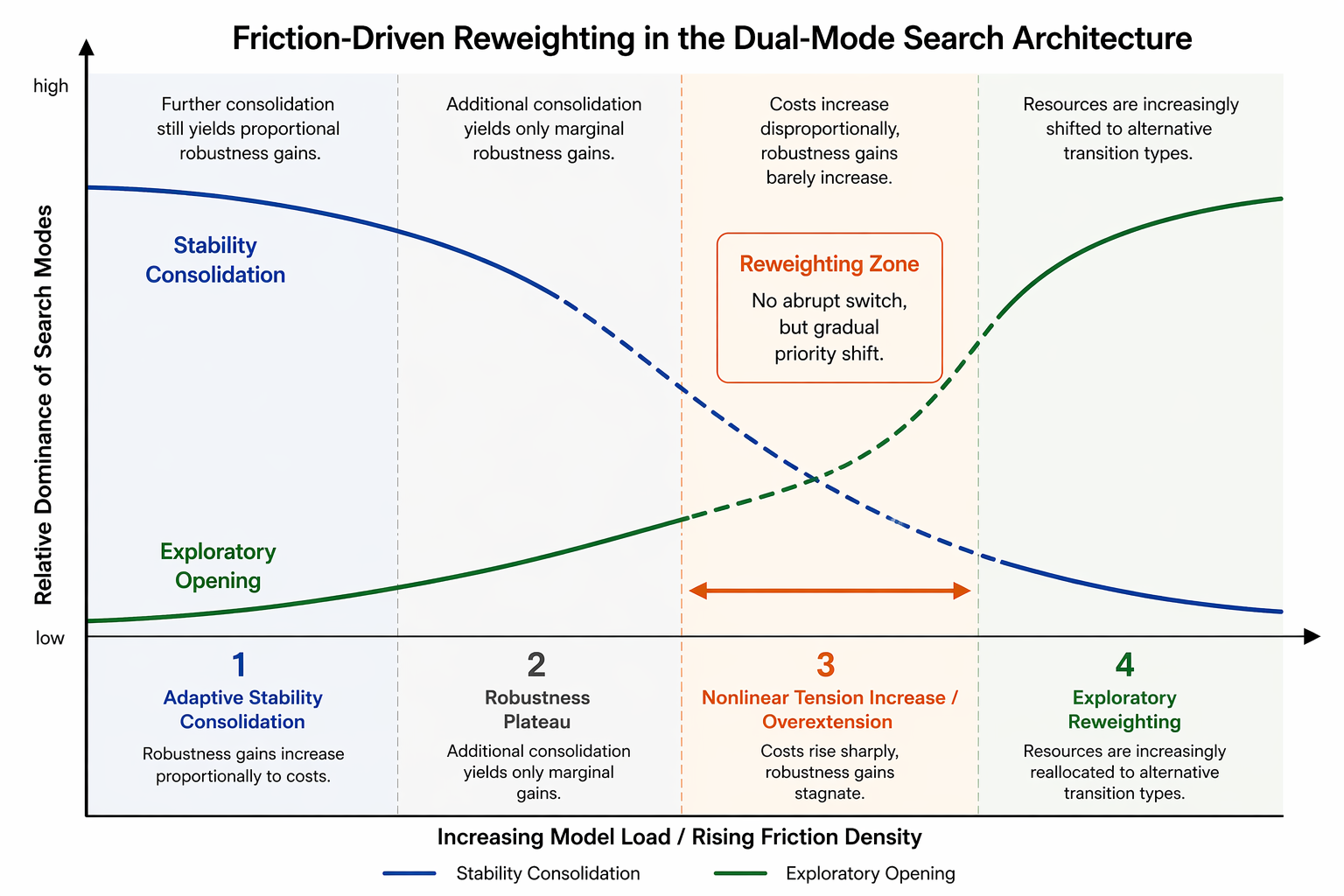
The dual-mode architecture requires criteria for adaptive reweighting between both modes. Since stability consolidation and exploratory opening coexist permanently in real search systems, the question is not one of an abrupt switch but rather of those threshold configurations at which a gradual priority shift becomes plausible. At the architectural level, three indicator groups are particularly relevant for this purpose: rising friction, stagnating robustness gains, and nonlinear tension dynamics. Their more precise operative elaboration follows in the next chapter.
5.4 Structure of the Architecture
The architecture is accordingly not a linear developmental model but a rule structure for governing coexisting search modes under finite conditions. Stability consolidation without exploration leads to rigidity; exploration without consolidation leads to instability. Efficient search processes therefore arise not through the absolute preference for one mode but through relational reweighting guided by structural tension indicators. The innovation of the architecture thus lies not in the mere distinction between two search activities but in their explicit coupling through diagnostic dominance criteria within stabilized model spaces.
6. Selection Mechanism and Relational Dominance Logic
The dual-mode architecture describes two complementary search modes. What is decisive, however, is not their mere coexistence but the question of how their relative dominance shifts under finite conditions. The selection mechanism is neither random nor normatively motivated, but derivable from the internal process dynamics of stabilized model spaces. Search systems continuously reallocate resources between further consolidation and exploratory opening by relating the expected robustness gain, the cost trajectory, and the viability of alternative transition types to one another. The dominance logic is therefore relational and adaptive: it is based not on an absolute evaluation of individual models but on the comparative efficiency profile of competing transition orders under uncertainty.
The relational dominance logic encompasses different structural states. First, a model may maintain stable dominance over extended phases when robustness gains and cost trajectories stand in an adaptive relationship. In such phases, there is no structural occasion for exploratory reweighting; exploration remains possible but is not systemically indicated. Second, under increasing friction, gradual dominance shifts may occur, in which resources are partially redistributed in favor of alternative transition types. Third, borderline cases are conceivable in which a new structure achieves so clearly superior relative efficiency that it amounts to a de facto replacement of the previously dominant model. Such a near-substitutive transition, however, does not represent an abrupt switch but the extreme point of a previously occurring dominance shift.
6.1 Friction as Primary Diagnostic Indicator
Friction functions as the central diagnostic criterion for possible dominance shifts. As long as cost increases are accompanied by proportional robustness gains, stability consolidation remains efficient and structurally dominant. When costs rise faster than ordering performance, however, a relative efficiency differential emerges in favor of alternative transition types.
Not every instance of friction requires exploration. Local tensions can be absorbed through internal adjustment without substantially shifting dominance relations. Only when friction condenses and spreads systemically does a gradual reweighting of resource allocation become structurally plausible. What is decisive is therefore not the mere presence of tensions but their persistence, density, and relational embedding in the cost-robustness ratio.
6.2 Robustness Plateau and Efficiency Boundary
A robustness plateau exists when additional consolidation no longer produces significant stability gains. The model remains functional, but its performance improvement stagnates. If consolidation is continued in this phase, costs rise disproportionately.
The efficiency boundary is reached when further stabilization takes on a primarily defensive character. Protective mechanisms replace structural performance gains. Here the system implicitly signals that internal optimization is no longer sufficient.
6.3 Nonlinearity as an Overextension Marker
Overextension manifests as a nonlinear tension increase. Small extensions, additional safeguards, or further adjustments then generate disproportionate effort without a comparable increase in the robustness of the existing transition type. The model often continues to appear externally functional, but its continuation is internally increasingly burdened and fragile. Nonlinearity therefore functions as a boundary marker indicating that further consolidation is no longer to be read as adaptive stabilization but as the inefficient continuation of an overburdened context. If this marker is recognized early, exploration can be initiated in a controlled manner; if it is bypassed, overextension becomes entrenched under the appearance of continued stability.
6.4 Structured Exploration
Exploration must not be understood as a complete rupture. A search system cannot afford to abandon all stability. Exploration therefore proceeds partially and gradually. At least three intensity levels can be distinguished: parametric exploration, methodological exploration, and structural exploration.
Parametric exploration varies elements within an existing transition type. It involves comparatively low costs but is also limited in its reach. Methodological exploration tests alternative procedures within the same problem or model space. It intervenes more deeply without entirely abandoning the existing ordering space. Structural exploration opens the search space to alternative transition orders. It is the most cost-intensive and risky, but may become necessary where further consolidation only stabilizes overextension.
Exploration therefore does not mean immediate substitution of an existing model. It may take the form of a temporary parallel operation of old and new transition types, a bounded reallocation of resources to alternative structures, and an iterative assessment of new robustness. Only when a new transition type has developed sufficient stability is it itself transferred to the consolidation mode. The old transition type then gradually loses relative dominance.
6.5 Connectivity
This relational dominance logic is in principle transferable to different contexts: research programs, technical development, organizational innovation processes, or algorithmic model adjustment. What is decisive is not the field but the structure of the tension trajectory.
The selection mechanism is therefore based not on a single switching criterion but on a relational interplay of costs, robustness, friction condensation, nonlinearity, and expected alternative viability. It neither replaces evaluation nor creativity, but structures their deployment under finite conditions.
In the next section, the dual-mode architecture is illustrated by means of a minimal structural scenario in order to clarify its operative describability.
6.6 Minimal Diagnostic and Dominance Logic
The dual-mode architecture claims no mathematical formalization, but requires a minimal operative specification of its diagnostic and dominance criteria. Without such concretization, friction would remain a mere interpretive concept. The following sketch therefore does not aim at fixed threshold values but at a structured comparative logic under uncertainty. What is decisive is not a single measurement point but the repeated interplay of robustness development, cost dynamics, friction condensation, and expected alternative viability. Quantification is in principle possible in specific domains but is not constitutive of the architecture. Its claim lies in the explication of a minimally sufficient decision logic, not in the specification of universal metrics.
(1) Robustness
Robustness designates the stability of a transition type under relevant classes of perturbation. Depending on the domain, these may include measurement noise, contextual variation, scaling loads, coordination pressure, or resource fluctuations. Operationally, robustness is evident in the persistence of functional transitions despite varying conditions. Proxies for robustness may include error rates, reproducibility, coordination stability, or prediction accuracy.
(2) Costs
Costs encompass cognitive, social, institutional, or technical expenditures required to maintain a model. They become operationally visible in growing complexity, increasing coordination requirements, rising maintenance loads, parameter inflation, or increased revision resistance. What is decisive is less the absolute cost level than, above all, its dynamics under repeated pressure and its ratio to the robustness gain achieved.
(3) Friction Density
Friction density exists when tension phenomena do not occur in isolation but affect multiple subareas of a model simultaneously. Operative indicators may include the accumulation of exception handling, ad hoc extensions, special rules, or clusters of conflict. If such condensation persists across multiple cycles, the probability of structural inefficiency increases.
(4) Friction Levels
For operative diagnosis, it is decisive not only whether friction occurs but in what degree of condensation it appears. Local friction exists when individual tensions or exceptions arise that remain compensable through internal adjustment. Condensed friction exists when multiple subareas of a model are affected, exception handling recurs cyclically, and internal corrections only reduce tension to a limited degree. Systemic friction exists when friction indicators persist across multiple assessment cycles, generate nonlinear cost increases, and the further consolidation of the dominant transition type itself becomes the problem. Systemic friction is particularly reweighting-relevant; local and condensed friction initially mark observational, verification, and, where applicable, limited reweighting requirements.
(5) Nonlinearity
A threshold indicator is present in particular when additional stabilization generates disproportionate costs. Nonlinearity is evident, for example, in exponential increases in maintenance effort, strongly growing model complexity with stagnating performance improvement, or increasing fragility despite formal stability.
(6) Dominance Criterion
A priority reweighting in favor of exploratory transition types becomes structurally plausible when the following conditions are simultaneously fulfilled:
- The robustness gain of the dominant model stagnates or grows only marginally.
- The costs of further consolidation rise disproportionately.
- Friction density persists across multiple iterations.
- Exploratory alternatives appear sufficiently viable under uncertainty, such that their expected testing and transition costs are below the projected continuation costs of further consolidation.
The dominance criterion is relational and adaptive. What is decisive is not that an alternative model has already been identified as clearly superior. Structurally sufficient, rather, is that the further consolidation of the dominant transition type becomes relatively inefficient while at the same time exploratory alternatives open a sufficient prospect of viable reorganization. The architecture therefore provides no exact threshold values but a structured decision routine for the gradual reallocation of resources within a finite model space.
(7) Operative Decision Routine
The relational dominance logic is not a deterministic mechanism but a structured decision heuristic under uncertainty. Precisely for this reason, it remains susceptible to failure modes. A first failure mode is overreaction: local or temporary friction is prematurely read as systemic inefficiency and leads to premature exploration with unnecessary resource loss. A second failure mode is inertia: persistent friction condensation is tolerated because reweighting costs are overestimated, existing stability gains are overestimated, or short-term functional success is confused with structural viability. A third failure mode is domain confusion: friction in one order is confused with inefficiency in another—for example, when social, subjective, or technical tensions are read under the same diagnostic standard. Finally, self-application is also limited: the architecture can structure its own diagnostic decisions but cannot guarantee that its own reweightings remain free from misinterpretation, success blindness, or overextension. It reduces decision uncertainty but does not eliminate it.
6.7 Operative Application of the Dominance Logic
The present architecture formulates no formal decision procedure in the sense of fixed threshold values, but a structured diagnostic and reweighting logic under uncertainty. Its practical application can be reconstructed as a repeated assessment process that translates the criteria developed in the preceding section into an operative sequence.
The starting point is the observation of the robustness development of a dominant transition type. What is decisive is whether additional stabilization continues to yield proportional robustness gains or whether these increasingly stagnate. In parallel, the cost dynamics are analyzed—in particular, whether additional effort still stands in an adaptive relationship to the ordering performance achieved or has taken on primarily compensatory character.
In the next step, the distribution of friction phenomena is examined. Of particular relevance is not the occurrence of individual tensions but their condensation across multiple partial domains and iterations. Persistent friction density signals a structural load on the existing transition type. Complementarily, it is assessed whether nonlinear tension dynamics are present—for instance in the form of disproportionately increasing complexity or growing fragility under continued stabilization.
On the basis of this diagnosis, no binary decision is made but a gradual reweighting of resource allocation between stability consolidation and exploratory opening. Exploration is typically initially introduced at low intensity—for example in parametric or methodological form—and intensified only when the relative efficiency of alternative transition types increases.
The architecture thereby provides no guarantee of correct decisions but a structured orientation for the adaptation of search processes under finite conditions. Its value lies in the explication of a repeatable assessment and reweighting process that makes it possible to carry out dominance shifts not intuitively but along explicit diagnostic criteria.
7. Minimal Structural Scenario of a Dominance Shift
To illustrate the dual-mode architecture, an abstracted search system is considered. The following scenario, however, serves not only didactic illustration but the brief operative assessment of the dominance logic developed above. It shows in minimal form how robustness plateau, friction condensation, nonlinear tension increase, and exploratory reweighting can be described as interrelated phases within a finite model space. The purpose of the scenario therefore lies not in simulating empirical complexity but in clarifying those structural conditions under which a shift in relative mode dominance becomes plausible.
7.1 Initial State: Stabilized Model M₁
A model M₁ generates robust transitions within a defined domain. Costs and robustness stand in an adaptive relationship. Internal optimization yields efficiency gains. The consolidation mode is dominant. The system invests primarily in refinement, standardization, and expansion within the existing stability space.
In this phase, friction is local and compensable. Corrections occur incrementally. Exploration would be possible but is not structurally necessary.
7.2 Emergence of a Robustness Plateau
With increasing consolidation, robustness gains stagnate. Additional adjustments improve ordering performance only marginally. At the same time, costs continue to rise—for instance through more complex exception rules or protective mechanisms.
The system remains functional, but efficiency gains diminish. Initial friction zones appear not in isolation but across multiple partial domains. Friction density increases.
7.3 Nonlinear Tension Increase
Small extensions of the model now generate disproportionate costs. The attempt to further stabilize the existing transition type leads to growing fragility. Overextension is structurally discernible.
At this point the system signals an efficiency boundary. Internal consolidation alone can no longer compensate for the tensions. The dual-mode architecture therefore structurally suggests a controlled exploratory opening—without asserting it as a mechanical necessity.
7.4 Exploratory Reweighting and Coexistence of M₂
An alternative transition type M₂ is introduced. Initially, its robustness is low and its costs high. Resources are partially redistributed in favor of the new transition type while M₁ continues to be stabilized. Exploration here does not mean immediate substitution but a gradual reallocation within a coexisting model space.
7.5 Formation of Altered Dominance Relations
If M₂ proves increasingly robust under perturbations, the ratio of costs and robustness shifts in favor of the new transition type. The relative dominance of M₂ increases while M₁ loses resources. In borderline cases, this dominance shift may lead to a de facto replacement of the previous model. The model space, however, does not reorganize abruptly but through a successive reweighting of stabilized transition types. The consolidation mode thereby relocates toward the more efficient structure.
7.6 Structural Interpretation
This scenario demonstrates that the dominance shift is based not on external innovation pressure but on internal efficiency diagnosis. Friction functions as a threshold indicator within a finite model space. Exploration is not a creative act in the narrow sense but a functional response to nonlinear tension dynamics.
The dual-mode architecture thus describes not a singular paradigm shift but a repeatable, cyclical reorganization of stability spaces under finite conditions. It replaces neither empirical assessment nor substantive evaluation, but structures their deployment within a bounded resource space.
8. Scope and Limitations
The dual-mode search architecture developed here understands itself as a functional structural model for governing model spaces under finite conditions. Its claim is neither ontological nor truth-theoretical but operative: it describes under which structural conditions search processes can be reweighted between further consolidation and exploratory opening.
The applicability of this architecture, however, presupposes certain minimum conditions. First, the robustness of a transition type must be at least indirectly observable—for instance through reproducibility, error rates, coordination stability, or functional persistence under perturbation. Second, costs must be made sufficiently comparable, even if they are not fully quantifiable. Third, alternative transition types must in principle be testable. Where these conditions are not met—for instance in the case of fully implicit orders, externally fixed decision spaces, or unobservable robustness relations—the architecture cannot be directly employed in a governing capacity. Its claim to validity is therefore structural, not universal in the sense of immediate applicability to every search context.
Clear limitations follow from this. First, the architecture provides no guarantee of truth. A dominance shift may enable adaptive reorganization, but may equally lead to unstable, inefficient, or only locally viable results. Second, it is not an innovation automaton. Exploration may become structurally plausible without new transition types actually developing robust stability. Third, it does not replace disciplinary theories but operates at the level of their model management. It structures search processes but produces no substantive results.
Fourth, its own diagnosis remains fallible. Friction can be misread, short-term success confused with long-term viability, and domain confusion overlooked. Precisely successfully stabilized search orders may temporarily conceal their own overextension, thereby masking reweighting requirements. Fifth, the self-application of the architecture is also limited. It can reflect and order its own decision forms but cannot guarantee that its own reweightings remain free from misinterpretation, success blindness, or overextension.
The architecture thereby increases the transparency of structural search decisions, not their infallibility. Its value lies in the explication of a diagnostic reweighting logic under finite conditions, not in the elimination of contingency from real development.
9. Epistemic Architecture as Management of Search Processes
The dual-mode architecture developed here describes search spaces as relational configurations of stabilized and revisable transition orders under finite conditions. Stability consolidation and exploratory opening appear not as discrete alternatives but as coexisting modes whose relative dominance shifts under changed efficiency conditions. Friction functions in this context as a diagnostic indicator of increasing process tension and marks those threshold condensations at which a gradual reweighting of resource allocation becomes structurally plausible.
The contribution of the architecture lies not in the maximization of novelty or certainty, and not in the replacement of disciplinary theories. It lies in the explication of a search logic with which adaptive priority shifts within finite model spaces become describable. The architecture thereby remains deliberately minimal. It formulates no new ontology of development but an operative structure of model management within the described framework.
Local Operative Concept Definitions of This Paper
The following conceptual ordering serves to stabilize central meanings within this text. It is employed where the argumentation of this paper requires an explicit terminological reference base. It makes no claim to completeness and establishes no independent general canonical lexicon. Concepts not separately listed here are employed in the sense of the Epistemics base canon or are not central to the functional core of this paper.
The following conceptual ordering is to be understood as a locally stabilized reference base of this paper. It serves the operative specification of a search architecture under finite conditions. Modifications, refinements, or extensions are in principle possible but must be explicitly declared, locally bounded, and justified. Implicit meaning shifts, silent extensions, or retroactive reinterpretations are excluded.
Adoption of the Epistemics Base Canon
This paper adopts the conceptual canon defined in the Epistemics base paper as an unaltered reference base. The concepts introduced there are used without reinterpretation and without implicit shifts in their functional meaning. This paper introduces no deviating definitions of the adopted canonical concepts.
Local Operative Specifications in the Context of Search Processes
This paper introduces no independent general canonical extension. It specifies some adopted concepts locally for the special case of search governance under finite conditions. These specifications do not alter the Epistemics base canon but translate parts of its vocabulary into an operative language for the description of model spaces, reweightings, and search dynamics.
Model
Brief definition: A stabilizing structure that orders transitions within a particular context and thereby reduces complexity.
Function: Designates here primarily the organizational form of repeatable transitions within a finite search space.
Demarcation: Not merely a unit of content, not an ontological entity, not necessarily a complete theory.
Validity
Brief definition: Robustness of a model under relevant perturbations within a bounded context.
Function: Designates the operative viability of a transition type under varying conditions.
Demarcation: Not truth in the strong sense, not ultimate justification, not domain-independent applicability.
Stabilization
Brief definition: Temporary reduction of dynamic complexity through repetition, consolidation, or safeguarding.
Function: Describes the condition for search processes becoming connectable, comparable, and governable.
Demarcation: Not a final fixation, not a guarantee of lasting viability.
Costs
Brief definition: Required effort for the stabilization, maintenance, or revision of a model.
Function: Serve the analysis of the relationship between effort and robustness gain.
Demarcation: Not a merely monetary concept, not purely an external evaluation, not an absolute quantity independent of the search context.
Friction
Brief definition: Increase in effort or tension without proportional robustness gain.
Function: Serves as the primary diagnostic indicator of declining search efficiency within stabilized model spaces.
Demarcation: Not a mere isolated problem, not an automatically incorrect model structure, not a sufficient condition for immediate exploration.
Revision
Brief definition: Adaptive modification of a model under pressure from friction.
Function: Designates here the alteration of existing transition types or the reweighting between competing transition orders.
Demarcation: Not a purely external rupture, not necessarily a complete replacement of a model.
Overextension
Brief definition: Continuation of the consolidation of a model beyond its adaptively viable context.
Function: Serves as a boundary marker of inefficient stabilization when costs and ordering performance structurally diverge.
Demarcation: Not a mere application error, not an automatic complete refutation of the model.
Stability Consolidation
Brief definition: Search mode in which an existing transition type is internally optimized, refined, and secured.
Function: Describes the continuation of an already viable context with the aim of relative efficiency gains.
Demarcation: Not a rigid logic of preservation, not unlimited optimizability.
Exploratory Opening
Brief definition: Search mode in which the model space is partially opened to alternative transition types.
Function: Describes the controlled testing of structural alternatives under conditions of increasing friction or declining consolidation efficiency.
Demarcation: Not a mere innovation impulse, not a complete destabilization, not a guarantee of successful reorganization.
Relative Dominance Shift
Brief definition: Gradual change in the priority between stability consolidation and exploratory opening within a finite search space.
Function: Describes the central reweighting logic of this paper, in which resources are adaptively redistributed between coexisting search modes.
Demarcation: Not an abrupt mode switch, not a mechanical switching rule, not a purely normative decision.
Canonical Status and Scope
The specifications made in this paper do not constitute an independent extension of the Epistemics base canon in the strong sense. They serve exclusively the local operative construal of central concepts for the special case of search governance under finite conditions. Their scope is limited to the search architecture of this paper.
No silent extension, reinterpretation, or retroactive modification of the Epistemics base canon takes place. The base canon remains unchanged in meaning, function, and demarcation.
Any future deviation, further refinement, or genuine canonical extension beyond this local operative construal must be explicitly declared, locally bounded, and justified. Implicit meaning shifts or informal canonical extensions are excluded.
References
Auer, Peter, Nicolò Cesa-Bianchi, and Paul Fischer. 2002. "Finite-Time Analysis of the Multiarmed Bandit Problem." Machine Learning 47 (2–3): 235–256.
Cyert, Richard M., and James G. March. 1963. A Behavioral Theory of the Firm. Englewood Cliffs, NJ: Prentice-Hall.
Kuhn, Thomas S. 1962. The Structure of Scientific Revolutions. Chicago: University of Chicago Press.
Lakatos, Imre. 1970. "Falsification and the Methodology of Scientific Research Programmes." In Criticism and the Growth of Knowledge, edited by Imre Lakatos and Alan Musgrave, 91–196. Cambridge: Cambridge University Press.
Levinthal, Daniel A., and James G. March. 1993. "The Myopia of Learning." Strategic Management Journal 14 (Winter Special Issue): 95–112.
March, James G. 1991. "Exploration and Exploitation in Organizational Learning." Organization Science 2 (1): 71–87.
Popper, Karl R. 1959. The Logic of Scientific Discovery. London: Hutchinson.
Rapp, Stefan. 2025. Contextual and Global Falsification of Scientific Models: An Integrated Theory of Epistemic Validity. Zenodo. https://doi.org/10.5281/zenodo.17714966.
Rapp, Stefan. 2026a. Epistemics: Model Management Under Finite Conditions. Zenodo. https://doi.org/10.5281/zenodo.18441326.
Rapp, Stefan. 2026b. Friction: Boundary Signal of Finite Load-Bearing Capacity in Subjective, Intersubjective, and Functional-Empirical Stability Spaces. Zenodo. https://doi.org/10.5281/zenodo.18434699.
Rapp, Stefan. 2026c. Revision under Finite Conditions: A Theory of Model Transformation in Epistemics. Zenodo. https://doi.org/10.5281/zenodo.18935928.
Simon, Herbert A. 1957. Models of Man: Social and Rational. New York: Wiley.
Simon, Herbert A. 1972. "Theories of Bounded Rationality." In Decision and Organization, edited by C. B. McGuire and Roy Radner, 161–176. Amsterdam: North-Holland.
Sutton, Richard S., and Andrew G. Barto. 2018. Reinforcement Learning: An Introduction. 2nd ed. Cambridge, MA: MIT Press.
Appendix A – Didactic Explication of the Dual-Mode Architecture
The dual-mode architecture developed in the main text describes search processes as a relational reweighting between two fundamental search modes: the further development of existing structures and the opening toward alternative approaches. These modes coexist permanently; what is decisive is their relative dominance under varying efficiency conditions. The following didactic explication illustrates these dominance shifts in different contexts.
First: individual search and learning orders (subjective level).
A person addresses complex problems over an extended period using the same well-practiced pattern of thought. As long as this pattern leads to reliable orientation with manageable effort, its further consolidation remains plausible: concepts are refined, distinctions sharpened, routines stabilized. Over time, however, cases accumulate in which additional differentiations yield hardly any further epistemic gain while the effort of maintenance increases. More and more exceptions must be separately processed, and new problems can be fitted into the existing order only with growing internal tension. In such a configuration, it becomes structurally plausible to test alternative modes of thought or search in a controlled manner. The transition therefore does not consist in a spontaneous change of perspective but in a reweighting between further consolidation of the existing pattern and the opening toward new transition orders.
Second: collective or institutional structures (intersubjective level).
A research team works successfully within an established theoretical framework. Initially, more precise measurements and methodological refinements yield clear progress. Later, however, increasingly many subsidiary assumptions become necessary in order to classify new findings. Discussions revolve increasingly around exceptions and borderline cases. When the effort required to defend the existing framework grows faster than its explanatory power, the examination of alternative approaches becomes plausible. This corresponds to the transition from further internal elaboration and consolidation of the existing framework (stability consolidation) to a controlled examination of alternative structural assumptions (exploratory opening).
Third: technical systems.
A software architecture is extended over years. New functions can initially be integrated without difficulty. With increasing complexity, however, even small changes lead to unexpected error cascades, maintenance effort rises, and increasingly many provisional solutions emerge. Rather than making further repairs, a fundamental restructuring may become advisable. The decision arises not from an impulse for innovation but from a changed relationship between effort and performance. Here too the transition becomes evident—from continued elaboration and consolidation of the existing structure (stability consolidation) to a deliberate reorganization of the system architecture (exploratory opening).
Fourth: a critical borderline case.
A research team observes increasing friction within an established model framework. Exceptions accumulate, additional protective assumptions become necessary, and the effort required to maintain the model grows faster than its explanatory performance. An exploratory reweighting therefore appears structurally plausible. The alternative approach that is subsequently tested, however, also proves unstable: it reduces certain costs but generates new friction zones that do not confirm the expected robustness. In this case, the dual-mode architecture did not incorrectly signal that exploration had become plausible; it could not, however, guarantee that the explored alternative is viable. The borderline case illustrates that the architecture can structure reweighting requirements but cannot anticipate the success of a reorganization.
In all four cases, the decisive point is not the occurrence of individual problems but the change in the relationship between effort and effect. As long as additional investment leads to clear improvements, further stabilization remains plausible. When, however, effort grows faster than the gain achieved, a controlled opening of the search space becomes structurally plausible.
The dual-mode architecture provides no fixed timing and no promises of success. It offers an orientation for when it makes sense to further stabilize what exists and when alternatives should be systematically examined. The appendix thus illustrates not mere changes of perspective but the application of the relational decision routine formulated in the main text under different conditions.