Why a Cosmological World Model Is Not Enough
On the Overextension of the Unity Claim in Modern Cosmology
Abstract
Modern cosmology is marked by persistent tensions among different measurement methods, ranges of scale, and cosmological epochs. These tensions are often treated as local inconsistencies within a fundamentally unified theoretical framework. This paper proposes a different methodological reading: persistent tensions, provided they are stably reproducible and arise at transitions between modeling regimes, may indicate an overextension of the cosmological claim to unity.
This paper is not offered as a physical alternative to modern cosmology, but as a philosophy-of-science case analysis of domain-bound model validity. It argues that cosmological practice already operates with different modeling regimes at the operational level, but that this domain dependence is not always consistently translated into an explicit theory of validity, domain boundaries, transition rules, and the level at which falsification applies. Cosmological tensions are thereby not relativized, but made legible at a different level: as possible indications that not only parameters or auxiliary assumptions, but model-domain assignments themselves may become subject to assessment.
What is proposed is therefore not the abandonment of scientific unity, but its reorganization as second-order unity. Unity then no longer resides exclusively in a single model that is supposed to bear all cosmological domains directly, but in explicit rules of domain assignment, controlled transitions, overlapping testing zones, and shared consistency conditions. The level of falsification thereby shifts: not only individual parameters are at stake, but also the question of whether a model is still appropriately assigned to a particular domain. The paper therefore decides no physical hypothesis, but develops a methodological architecture in which model plurality and scientific unity are related to one another in a controlled way.
Keywords
Philosophy of cosmology, cosmological standard model, claim to unity, cosmological tensions, domain-specific models, model architecture, falsification, methodological pluralism, effective theories
1. The Problem Is Not Just Another Tension Phenomenon
Modern cosmology finds itself in a peculiar situation. On the one hand, in the cosmological standard model it possesses a theoretical framework that consistently describes an impressive range of empirical findings. On the other hand, systematic discrepancies among different measurement methods and cosmic epochs have been accumulating for years and cannot easily be integrated into this model. These so-called “tensions” are usually interpreted as local problems: as indications of underestimated systematic errors, inadequate parameterizations, or as motivation for limited extensions of the existing framework.
This paper takes a different starting point. It defends the thesis that the persistence of these tensions is less a matter of isolated empirical or theoretical deficits than of a methodological overextension. What is meant is the implicit claim that a single cosmological model must bear all relevant physical domains of the universe at once. The central thesis is therefore not that cosmology has the wrong equations, but that it adheres to a problematic conception of model validity.
The standard discussion typically treats tensions as temporary inconsistencies within a fundamentally unified world model. This tacitly presupposes that the underlying model architecture is itself not at stake. It is precisely this presupposition that is called into question here. The guiding question of this paper is whether the continued attempt to resolve empirical inconsistencies within a global unified model has not itself become an epistemic obstacle.
It must be emphasized what this paper does not do. It presents no alternative cosmological model, attacks no specific measurement programs, and makes no claim to physical corrections of existing equations. Rather, it offers a methodological analysis of modeling practice in cosmology. Cosmology is particularly suited to such an analysis because it works with indirect inference chains, large-scale model assumptions, and limited possibilities for direct experimental intervention (Ellis 2011). The aim is to make the implicit claim to unity explicit, to reconstruct its epistemic role, and to show why this claim has become problematic under present empirical conditions.
The status of the paper is therefore explicitly exemplary. Cosmology is not used here as an occasion for developing a new foundational theory, but as a particularly illuminating case in which a general problem of modern modeling practice can be displayed: the transition from successful stabilization to possible overextension. The analysis therefore does not ask which concrete cosmological model is physically preferable, but at which level model validity, domain boundaries, and falsification should be methodologically negotiated.
The point of departure is a simple observation: cosmological practice has long recognized different modeling regimes at the operational level. The early universe, late-time expansion, linear perturbation theory, nonlinear structure formation, galaxy physics, and numerical simulations do not simply follow the same modeling logic. The problem is therefore not that cosmology has ignored such differences. The problem is rather that this operational domain dependence is not always translated with equal consistency into an explicit theory of model validity, domain boundaries, and the level at which falsification applies. This gives rise to a tension between practical plurality and theoretical self-description as a unified world model.
This paper argues that many of the current cosmological tensions should more meaningfully be interpreted as signals of a wrongly chosen level of falsification. What is at stake is not individual parameters or equations, but the claim that a single model must cover all cosmological domains at once. Such a reinterpretation shifts the focus from ad hoc repairs toward a reflective model architecture in which different domains may require different effective descriptions.
This objection is not only methodologically relevant; it touches on the very purpose of cosmological foundational research. Cosmological research traditionally claims that the investigation of distant regimes allows inferences about the physical domain in which we ourselves live. This capacity for inference constitutes a central rationale of foundational research and therefore requires explicit methodological grounding. A global world model that tacitly presupposes such transfers without specifying their conditions threatens to obscure rather than fulfill this claim.
The reading proposed here has a limited claim to validity. It decides no physical hypothesis, replaces no data analysis, and offers no alternative cosmological model. Its function is to make visible the conditions under which empirical tensions can be read not only as local deviations but also as indications regarding model architecture, domain assignment, and the level at which falsification applies. The analysis is therefore subject to the same principle it demands of cosmological models: its validity is methodological, not physical.
The perspective proposed here does not rest on a merely pragmatic pluralism. It follows from the insight that cosmological knowledge is essentially obtained through different measurement, inference, and modeling regimes, each of which brings its own epistemic conditions. Where these conditions vary systematically, model validity cannot be unified without hidden assumptions and without a loss of epistemic transparency.
The structure of the paper follows this line of argument. First, the claim to unity in modern cosmology is reconstructed and located in its historical and methodological context. Next, it is shown that actual modeling practice already operates in a domain-dependent manner, without this always issuing in an explicit theory of domain assignment. Building on this, cosmological tensions are interpreted as possible, but not automatic, indications of misplaced claims to validity. Alternative approaches are then read not as full replacement models but as possible indications of domain-specific explanatory power. Finally, a methodological framework is proposed that places model sets, transition rules, and second-order unity at the center, in place of an unreflected global claim to unity.
2. The Ideal of Unity in Modern Cosmology
The claim to a unified cosmological model is not an accidental product but the result of a long and successful development. With the establishment of the ΛCDM model, a theoretical framework emerged that brought together expansion, the cosmic microwave background, large-scale structure formation, and matter distribution in a remarkable way and was empirically supported in particular by precise measurements of the cosmic microwave background (Aghanim et al. 2020). Its success lies not only in empirical fit but also in conceptual closure. A comparatively small set of assumptions makes it possible to describe phenomena coherently across cosmic time scales.
This unification possessed and continues to possess considerable epistemic appeal. Unity is regarded as a scientific virtue because it integrates disparate observations under a common formal framework and thereby appears more explanatorily powerful than a collection of isolated models. In cosmology, this effect was reinforced by the fact that alternative approaches either remained restricted to limited ranges of phenomena or failed central empirical tests. The unified model thus became not only the best available model but a normative reference point against which all alternatives had to measure themselves.
With this normative status, however, came an implicit claim. Discrepancies between data and model were primarily interpreted as deficits in the elaboration of the model, not as indications of possible limits to its validity. The question of whether different cosmological domains might require different theoretical descriptions thereby receded methodologically into the background. Unity was no longer understood merely as a heuristic goal but increasingly as a precondition of good theory.
This claim was plausible under the conditions of the time. The available data could be explained with remarkable precision within a unified framework, and the great cosmological successes of the late twentieth and early twenty-first centuries rest essentially on this unification (Peebles 2020). Precisely for this reason, it is important to acknowledge the historical context of the ideal of unity before questioning its present-day adequacy.
The claim to unity becomes problematic where it no longer functions as a regulative ideal but as a methodological obligation. The very success of a model can be blinding in this respect. When a model integrates very different observations over a long period, there is a growing tendency to exempt its architecture from methodological scrutiny. Discrepancies are then almost automatically treated as local disturbances within the existing framework, not as possible indications of limits to its validity. The epistemic danger therefore arises not despite, but partly because of, the success of the unified model.
This narrowing is becoming increasingly visible today. The empirical precision of cosmology has advanced to the point where differences among distinct measurement domains can no longer be readily covered by statistical uncertainties. Some of the prominently discussed discrepancies now appear stably enough across several independent analytic contexts that they can no longer be treated as merely random marginal phenomena. Under these conditions, the claim to unity, long a driver of progress, can itself become a limiting factor.
At the same time, the strength of the cosmological standard model must not be underestimated. Its epistemic power lies not only in offering an elegant overall description but in the fact that different classes of observations, independent data sources, and various inference paths can be related to one another within a common parameter space. The cosmic microwave background, large-scale structure, supernovae, baryon acoustic oscillations, and gravitational lensing effects function in this framework as mutual constraints. These mutual constraints among different data classes are not merely an expression of an ideal of unity but a genuine methodological control instrument. Domain-responsible modeling must therefore not dissolve this control function but reorganize it on a more explicit architectural level.
The decisive question is therefore not whether the cosmological standard model is wrong, but whether the claim to treat it as a global world model is still justified. This distinction is central to the argument that follows. It allows empirical tensions to be interpreted not prematurely as local defects but as possible indications of an overextension of the ideal of unity. On this basis, the actual modeling practice of cosmology can be brought into view anew.
3. Domain Dependence in Actual Cosmological Practice
Independently of its theoretical self-description, modern cosmology already operates today in clearly distinguishable modeling domains. These domains do not arise from arbitrary partitioning but from different physical regimes, orders of scale, and methodological approaches. What is decisive is that model application is not fully uniform across these areas, even where the rhetoric of unity suggests otherwise. Practice is plural, even where theory claims unity.
A cosmological domain is not understood here as an arbitrarily delimited subject area. A domain is rather a stable interconnection of scale range, physical regime, measurement access, inference chain, and model assumptions, within which a model can claim empirically testable validity. What is decisive is that none of these features by itself already grounds a separate domain. A domain boundary becomes methodologically relevant only where several of these factors interact and where their coupling repeatedly produces tensions that cannot be explained by local error correction, improved calibration, or statistical refinement alone.
One central domain is the early universe. Here, linear perturbation theories are deployed that rest on homogeneous and isotropic initial conditions. These models are mathematically highly formalized and extraordinarily successful as long as they are applied within their intended range of validity. Their performance, however, rests on strong idealizations, in particular the neglect of local structures and nonlinear effects that become dominant in later cosmic epochs.
By contrast, large-scale but already nonlinear structure formation forms a different domain. Here linear approximations increasingly lose their validity, and numerical simulations and effective descriptions move more strongly to the foreground. The transitions between linear theory and nonlinear dynamics are theoretically and numerically controlled, but they cannot be fully captured by a single simple analytic formalism. In practice, therefore, alongside theoretical principles, approximation procedures, numerical stability, computational cost, and empirical calibration play a central role.
A further domain is the scale of individual galaxies and galactic substructures. In this area, phenomena have long appeared whose derivation from large-scale cosmological initial conditions requires additional assumptions about baryonic physics, feedback, nonlinear dynamics, and subgrid modeling. In practice, this is implemented through complex baryonic feedback mechanisms, subgrid models, or empirically motivated correction terms. These elements are functionally necessary, but they do not possess a uniform theoretical status. They are explicitly treated as effective descriptions rather than as fundamental dynamics.
This implicit plurality emerges with particular clarity in numerical simulations. Such simulations combine large-scale initial conditions with locally defined recipes for processes below the numerical resolution. These subgrid models are not derived from the fundamental equations but are calibrated empirically. Their parameters are chosen so as to reproduce observed structures, not because they would follow necessarily from a unified theoretical framework.
This gives rise to a modeling practice in which different components possess different epistemic status. Some parts are treated as fundamental, others as effective approximations, still others as empirical corrections. These differences are clearly present in practical work but are seldom systematically reflected upon. Instead, the overall construction continues to be presented as the expression of a unified world model. The tension between actual working practice and theoretical self-description thereby remains concealed.
This tension also affects the interpretation of cosmological discrepancies. When different measurements systematically lead to different results, these are first read as indications of hidden systematic errors or inadequate parameterizations. The possibility that such discrepancies might point to limits of model application usually remains secondary. The claim to unity functions here as an interpretive filter that constrains alternative readings from the outset.
Domain dependence in itself, however, is by no means problematic. In many other areas of science it is long since recognized. In solid-state physics, fluid mechanics, and climate modeling, it is taken for granted that different scales require different effective theories. Scientific models and laws are often understood not as simple universal images of a unified world structure but as locally and context-dependent forms of order (Cartwright 1983, 1999). The challenge does not lie in avoiding this plurality but in organizing it consistently and making its transitions explicit.
An important point of connection lies in the methodology of effective theories. With Effective Field Theory, physics already has an established way of dealing with scale-dependent domains of validity, controlled approximations, and non-fundamental descriptions, including in cosmological structure formation (Baumann et al. 2012; Carrasco, Hertzberg, and Senatore 2012). The approach proposed here therefore does not claim to introduce domain dependence as a physical practice for the first time. Rather, it shifts the question to the level of cosmological model architecture: if scale-dependent validity is methodologically recognized in individual physical descriptions, the further question arises whether the assignment of cosmological models to epochs, scales, measurement regimes, and inference chains must also be organized more explicitly.
The model-set architecture proposed here is not to be equated with Effective Field Theory. Effective Field Theory regulates scale-dependent validity within formally controlled theoretical frameworks. The question at issue here is set one level higher: it concerns transitions between modeling regimes whose interconnection is not necessarily secured by a common reduction or renormalization structure. The connection to EFT therefore does not show that the approach proposed here is superfluous, but that scale-dependent validity is already physically established and can now be related methodologically to the architecture of cosmological model validity.
In cosmology, by contrast, this plurality is often treated as a provisional state that should ultimately be subsumed under a fully unified description. This expectation shapes the methodological stance of the discipline even where its empirical fulfillment remains uncertain. The result is a continued tension between the claim to unity and the necessity of domain-specific modeling.
The central argument of this chapter is therefore not that cosmology operates inconsistently. On the contrary: its practice is functionally extremely successful. The problem is that this functional plurality is not always consistently reflected upon as a methodological question of model validity, domain assignment, and transition rules. Rather than appearing as a stable feature of modern modeling practice, it often appears as a provisional state that is to be overcome in the long run within a unified world model. As a result, tensions in the data may prematurely appear as defects to be repaired, instead of as possible indications of the limits of a particular claim to model validity.
An explicit acknowledgment of domain dependence would fundamentally change this situation. It would make it possible to treat tensions no longer exclusively as anomalies, but also as markers for transitions between modeling regimes. The focus would shift from the permanent optimization of a global model to the reflective organization of distinct but mutually compatible descriptions. On this basis, the following chapter can explain why many cosmological tensions do not disappear, but remain stable.
4. Why Cosmological Tensions Persist
The persistent tensions of modern cosmology are usually understood as transient inconsistencies that can be resolved through improved data, refined analytic procedures, or moderate model extensions. This expectation is deeply anchored in the discipline’s self-understanding. It presupposes that the observed discrepancies must ultimately be explainable within a unified theoretical framework. It is precisely this presupposition that is called into question in this chapter.
What is striking, first, is that several central tensions arise preferentially where different cosmological domains are coupled to one another: between early and late universe, between linear theory and nonlinear dynamics, between global parameters and local structures. Their persistence is therefore less surprising than it often appears. It is an expected outcome of a model architecture that makes transitions between regimes only insufficiently explicit.
Several prominent tensions illustrate this point. The Hubble tension concerns the difference between early values of the expansion rate inferred, in a model-dependent way, from the cosmic microwave background and late values determined locally through distance ladders. The S₈ or σ₈ tension concerns the relationship among parameters derived from the early universe, structure growth, and weak gravitational lensing measurements (Heymans et al. 2021). More recent discussions of baryon acoustic oscillations, in particular DESI data, and data-dependent indications of possible deviations from the simplest Λ model further show that, under certain combinations, late-time expansion data too can pose new questions for the standard architecture (Adame et al. 2025; Abdul Karim et al. 2025). These cases do not prove the existence of domain boundaries. They do, however, constitute appropriate testing grounds for the question of whether persistent tensions along different measurement, scale, and inference regimes should be read methodologically in a different way.
Tensions are typically interpreted as differences between measured values that nominally concern the same physical quantity. This reading suggests that at least one of the measurements must be erroneous or incomplete. Accordingly, analysis focuses on possible systematic effects, calibration problems, or statistical biases. This approach is justified in many cases, but it falls short where the measurements involved rest on different model assumptions and inference chains.
In such cases it is tacitly presupposed that the underlying theoretical frameworks are fully compatible. The possibility that different measurement domains may require different effective descriptions is hardly considered. Tensions then appear as disturbances of an otherwise coherent model, not as indications of limited domains of validity. The interpretive focus shifts away from model architecture toward ever-finer attempts at repair at the parameter and data level.
A further reason for the persistence of cosmological tensions lies in the asymmetric treatment of agreements and discrepancies. Fits between model and data are interpreted as confirmations of global validity, while discrepancies are classified as local problems. This asymmetry stabilizes the claim to unity even as the number and precision of discrepancies grow. The model is thereby epistemically shielded without being explicitly immunized.
In addition, many tensions are embedded in complex parameter dependencies. Modifications that reduce one specific discrepancy frequently aggravate others. These interactions are usually read as expressions of the model’s complexity, not as indications of an overextension of its claim to validity. The continued attempt to address all tensions simultaneously within a single framework thus leads to mounting overload without calling the underlying model architecture itself into question. From a methodological perspective, this pattern points to a shift in the level of falsification. Instead of asking whether the claim to a global world model is itself still justified, falsification is displaced onto ever smaller structural elements. Parameters, submodels, and correction terms become the primary target of criticism, while the overarching claim to validity remains untouched. Tensions thereby lose part of their heuristic potential.
Viewed from a domain-dependent perspective, the persistence of the tensions appears in a different light. If different measurements effectively address different physical regimes, it is not to be expected that they will integrate seamlessly into a single set of parameters. Tensions are then not anomalies in a strict sense but expressions of insufficiently understood transitions between modeling regimes. Their stability is not a sign of methodological failure but an indication of a misplaced expectation.
This reinterpretation does not relativize the empirical findings. The data retain their full significance. What changes is the way they are read. Tensions are no longer understood primarily as defects to be eliminated but as markers for the boundaries of validity of individual model components. The question shifts from the search for the one correct fit to the clarification of the conditions under which different descriptions are appropriate.
Not every tension, therefore, is already an indication of a domain boundary. A discrepancy may still be due to systematic errors, calibration problems, selection biases, insufficient statistics, or as-yet-unexploited model refinement. It becomes methodologically relevant as a possible domain signal only when it is stably reproducible, remains tied to the coupling of different regimes, scales, or inference chains, and cannot be resolved through local corrections without new auxiliary assumptions or rising repair costs. The domain-related reading therefore does not replace the discipline-specific search for sources of error but begins where this search itself points to a recurring structural limit.
Structurally viewed, this pattern corresponds to an efficiency boundary in the sense of finite search conditions. As long as tensions are framed as local defects, the system remains in the mode of continued compression of a global framework, that is, in further optimization within the same architecture. When discrepancies arise stably along regime boundaries, however, their epistemic status shifts: they become markers of compressed process tension, indicating that further compression is possible only at disproportionate cost. In this situation, a controlled opening of the model space becomes methodologically plausible.
This chapter has shown that persistent cosmological tensions can be read methodologically as indications of a possible overextension of the global claim to unity. As long as this claim is not itself made subject to revision, there is a danger that tensions will be repaired primarily on the local level, even though they may also signal architectural questions of model validity. The next chapter shows that alternative approaches can also be misunderstood at this point: their failure need not always mean a lack of explanatory power but can also follow from the fact that they continue to be measured against the horizon of expectation set by a global replacement model.
5. Partial Successes of Alternative Approaches
Modern cosmology has long been accompanied by alternative approaches, each of which addresses specific weaknesses of the established model. In the disciplinary debate, these approaches are frequently grouped under the common label of failure because they have not been able to establish themselves as full replacements for a global world model. Such an assessment, however, falls short. It overlooks the fact that some of these approaches possess explanatory or heuristic strength in clearly delimited domains, while their alleged failure occurs above all where a global claim to validity is demanded of them.
These approaches are characterized by their domain-specific orientation. They are tailored to particular ranges of phenomena, for example to discrepancies on galactic scales, to problems of structure formation, or to anomalies in the early universe. In these contexts they can offer descriptions that are at times more precise, heuristically fruitful, or conceptually alternative. Their explanatory power then results not from universal reach but from a focus on clearly defined regimes with specifically relevant degrees of freedom.
This becomes visible across several types of alternative approaches. Modified dynamics or theories of gravity often derive their plausibility from contexts in which galactic rotation and acceleration phenomena can be described particularly cogently. They come under markedly stronger pressure of compatibility, however, when they are also expected to explain the cosmic microwave background, large-scale structure formation, and cosmological evolution. Early-dark-energy models specifically address the Hubble tension, but can generate new tensions in other parameter relationships or in structure growth. Models of dynamical dark energy gain relevance where late-time expansion data appear to deviate from the simplest Λ model, but they remain strongly dependent on data combinations, parameterizations, and statistical assessment. Such examples do not show that alternatives would be globally superior. Rather, they show that their epistemic value often lies first in clearly delimited problem and validity domains.
Their reception becomes problematic where they are interpreted exclusively as competing world models. Within this framework they must satisfy the same claim as the established model: the consistent description of all cosmological scales and epochs. This claim, however, is not always motivated by the internal logic of the approaches themselves but is in part imposed by the dominant ideal of unity in the discipline. The failure of many alternatives is therefore not to be understood exclusively as empirical failure. It is in part also co-determined by a methodological horizon of expectation that fully recognizes local or domain-specific explanatory power only when it can be expanded into a complete global replacement model.
This dynamic is particularly evident in the recurring demand for global consistency. Approaches that successfully explain local phenomena come under pressure to justify themselves as soon as they fail to provide a complete cosmological evolution or show difficulties in being embedded into large-scale structure formation. Their partial successes are thereby devalued instead of being taken seriously as indications of domain-specific explanatory power. The discourse narrows into a binary logic of acceptance or rejection.
A different reading is possible and epistemically more fruitful. If the global claim to unity is no longer treated as the sole criterion of evaluation, the successes of alternative approaches can be interpreted as indications of possible domain-specific validity. They then do not necessarily show that an alternative world model would be globally superior, but that certain ranges of phenomena can, under suitable model conditions, be described differently, sometimes more precisely or in heuristically more fruitful ways. The lack of universal compatibility is, in this light, not automatically a deficit but can be an expected consequence of limited domains of validity.
This reinterpretation also changes the status of the alternatives themselves. They no longer appear merely as incomplete or flawed world models but as possible effective models with clearly circumscribed domains of application. This does not, however, automatically legitimize them. Local explanatory power is merely a first indication of possible domain-specific validity. It remains a precondition that their domains of validity be explicitly named, their empirical successes independently verifiable, and their conditions of transition to neighboring domains disclosed. An alternative therefore does not gain epistemic weight simply by describing a local problem better; it does so only when it makes its reach, its costs, and its conditions of compatibility transparent.
From this perspective, alternative approaches become important epistemic instruments. They help to map the structure of cosmological problems by making visible where particular assumptions function and where they reach their limits. Precisely where they come into tension with the standard model, they mark potential transition regions between different modeling regimes.
The central argument of this chapter is therefore that the alleged failure of alternative approaches says less about their quality than about the horizon of expectation in which they are evaluated. As long as the standard remains a global world model, domain-specific theories will inevitably appear inadequate. If, however, this standard is itself called into question, their partial successes acquire a new epistemic significance. They become building blocks of a differentiated landscape of models in which explanatory power is bound to appropriate domain assignment.
This result prepares the methodological proposal of the following chapter. There it is shown that the transition from the search for a unified world model to a systematically organized set of domain-specific models is not only possible but, under certain conditions, methodologically obvious.
6. Model Sets and the Shift in the Level of Falsification
If the previous chapters are correct, a methodological consequence follows that goes beyond individual model adjustments. The problem then lies not only in inadequate parameterizations or missing additional terms, but also in the level at which falsification applies. As long as the claim persists that a single cosmological model must explain all domains at once, empirical discrepancies can be interpreted prematurely as local defects, even though in some cases they could indicate an overextension of the model’s claim.
The change of perspective proposed here does not give up falsification; it shifts the level at which falsification applies. Instead of primarily falsifying individual parameters, submodels, or correction mechanisms, the focus is directed onto the model architecture itself. The central question is then no longer which model is “the right one,” but for which domain which model is valid, and under what conditions transitions between domains are justified.
This approach can be described as work with model sets. It connects to model-theoretic approaches in which models are understood not merely as direct representations of theory or world, but as autonomous epistemic mediators (Morgan and Morrison 1999; Hartmann 1999). A model set is an ordered architecture of several domain-specific models, whose domains of validity are explicitly determined, whose transitions are methodologically controlled, and whose overlaps are disciplined by shared consistency conditions. The models of such a set do not necessarily stand in competition with one another in the sense of exclusive overall interpretations, but can complement each other functionally, provided that their respective domains, points of connection, and limits are openly stated. Their coexistence is then not a sign of theoretical arbitrariness but the expression of an explicit organization of different descriptive regimes under shared testing conditions.
A model set is thereby subject to strict methodological conditions. First, the domains must be unambiguously specified, for example through orders of scale, physical regimes, or characteristic inference chains. Second, the individual models must remain empirically testable within their respective domains. Third, a shared consistency core is required that preserves basic requirements such as causal compatibility, statistical coherence, and local conservation, symmetry, and covariance requirements. Model sets thus do not replace the truth claim of scientific models but make the conditions of its application more precise.
Transition rules in this context do not designate additional laws of nature but methodological conditions under which results, parameters, or inference chains may be transferred from one domain into another. They concern, for instance, the compatibility of scale assumptions, the stability of shared parameters, the control of approximations, and the empirical robustness of overlap zones.
A transition rule becomes problematic when the coupling of two domains can only be maintained through ongoing special assumptions, calibrations, or local repairs, without producing a corresponding gain in robustness. The consistency core of a model set, by contrast, designates those minimal conditions that must not be abandoned even under domain-specific modeling, such as causal compatibility, statistical coherence, and basic conservation or symmetry assumptions.
The decisive change concerns the level at which falsification applies. In a unified model, falsification is primarily understood locally: a measured value contradicts a prediction, so the model must be adjusted or extended. In a model set, falsification can also apply architecturally. If a model in a particular domain can only be maintained through ongoing auxiliary constructions, calibrations, or special assumptions, it is not necessarily the model as such that is wrong, but possibly its assignment to that domain. What is then falsified is the claim that this model remains valid in that domain.
This shift complements the distinction between contextual and global falsification of scientific models. Whereas contextual falsification concerns the validity of a model within a particular domain of application and global falsification calls into question its overarching claim to validity, architectural falsification applies at the level of the model-domain assignment itself. What is then at stake is not only the content of a model but the question of whether a model is still appropriately assigned to a particular domain.
This form of falsification is less dramatic but epistemically more precise. It does not lead to abrupt theoretical breaks but to a stepwise reorganization of the model space. Tensions acquire a new function in this framework. They mark places where transitions between models are insufficiently understood or where domain boundaries have been wrongly drawn.
In this sense, persistent cosmological tensions can, under certain conditions, be interpreted as meta-signals. They then point not directly to faulty data or wrong equations, but to a possibly inconsistent model architecture or to a problematic assignment of model and domain. Their persistence is, on this reading, not a methodological failure but an indication that they may be addressed at the wrong level. Only when the claim to unity itself becomes methodologically testable can their full heuristic potential become visible.
A model set therefore demands a different form of scientific discipline. It requires the willingness to name limits of validity explicitly and to address transition problems openly, instead of concealing them through ad hoc extensions. At the same time, this approach guards against an inflationary expansion of individual models by reducing the structural pressure to integrate every new empirical detail into a global framework. Complexity is not eliminated but methodologically organized.
Unity is thereby not abandoned but shifted to a second order. First-order unity would consist in bringing all relevant cosmological phenomena directly under a single model and a common parameter space. Second-order unity, by contrast, consists in connecting several domain-specific models through explicit transition rules, overlapping testing zones, and shared consistency conditions. The claim to coherence is preserved but is no longer tacitly tied to the universal reach of a single model. What is decisive is therefore not less unity but a different form of unity: architectural, controlled, and domain-aware.
Second-order unity is therefore more than mere pluralism only if at least three conditions are met. First, the domains of validity of the participating models must be explicitly determined. Second, their transitions and overlaps must remain empirically testable. Third, a shared consistency core must be maintained that prevents every tension from being neutralized through arbitrary domain separation. Second-order unity thus consists not in the mere addition of several models but in their controlled, testable, and limited coupling.
This chapter has shown that the transition from a cosmological world model to a domain-responsible organization of models does not represent a capitulation in the face of complexity. Rather, it is a refinement of the practice of falsification that makes it possible to take empirical tensions seriously where they are conducive to insight. In the following chapter, the costs and benefits associated with this approach are explicitly weighed against one another.
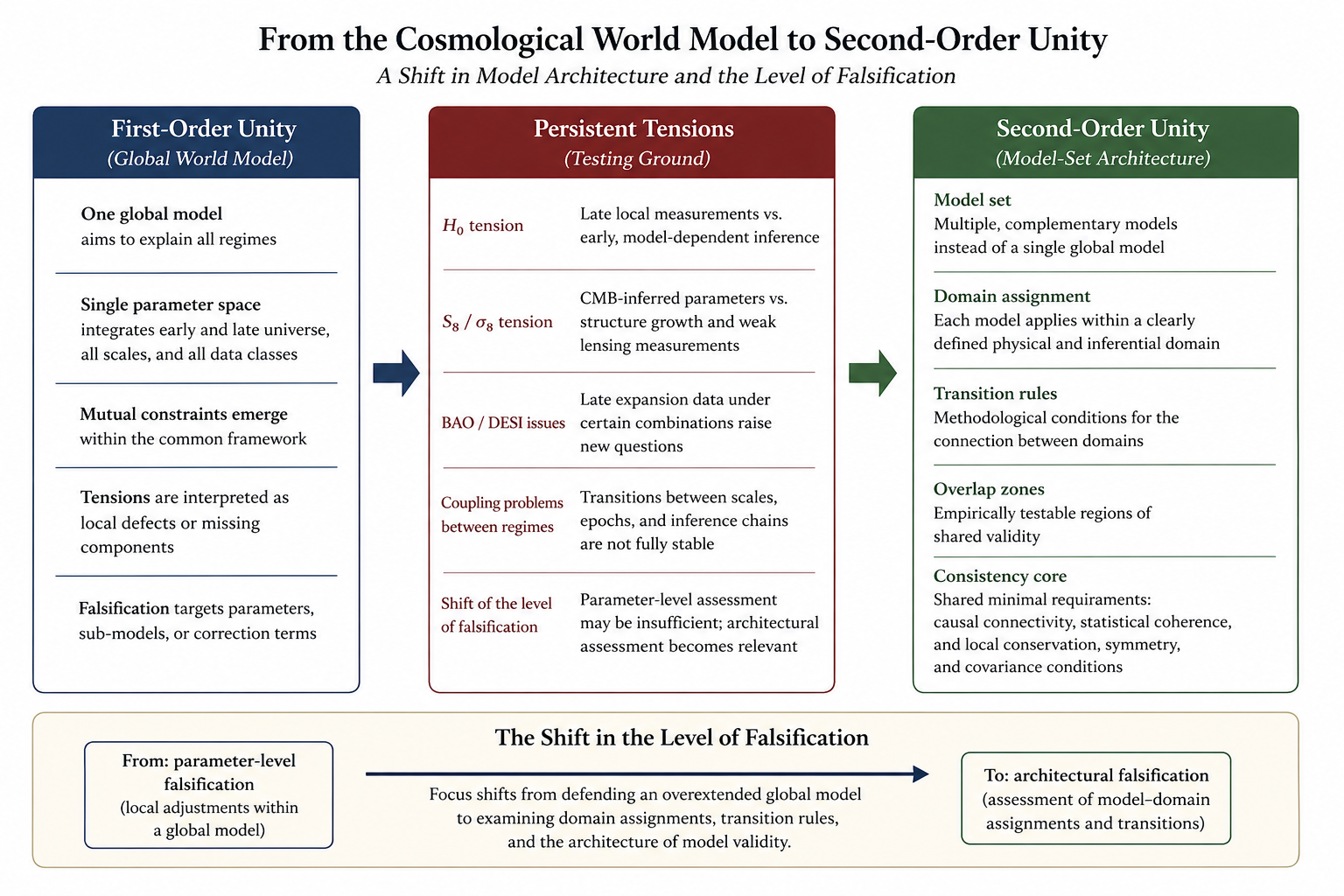
The figure shows the methodological shift from parameter-level falsification within a global model framework to architectural falsification, in which model-domain assignments, transition rules, and consistency conditions themselves become testable.
7. Costs, Benefits, and Epistemic Honesty
The transition from a global cosmological world model to an architecture of domain-specific model sets is not without cost. It demands a deliberate renunciation of theoretical ideals that have long been regarded as self-evident scientific virtues. For precisely this reason, it is necessary to name openly the costs associated with this step and to set them against the epistemic gains. Only thus can it be avoided that the proposed approach be misunderstood as a mere retreat from unsolved problems.
One obvious price is the loss of formal elegance. A unified world model possesses a clear aesthetic and communicative quality. It promises clarity, mathematical closure, and a simple narrative structure. Model sets, by contrast, appear more fragmented. They replace a singular explanation with an ordered diversity of descriptions whose interplay itself requires explanation. This additional meta-level increases the structural complexity of the theory.
A further, weightier point concerns the possible loss of global mutual constraints. A unified model forces different types of data and measurement domains into a common parameter space and thereby prevents local overfitting. If this framework is abandoned, there is a risk that tensions will be neutralized through domain segmentation instead of remaining epistemically effective. Model sets thus run the fundamental risk of encouraging fragmentation if no additional disciplining mechanisms are established.
This objection must be taken seriously. It nevertheless misses the approach proposed here insofar as model sets are not understood as mere pluralism. A domain-responsible model architecture is epistemically legitimate only if it expressly limits fragmentation. This requires overlapping domains of validity in which different models experience competing explanatory pressure, clearly defined transition regimes, shared consistency conditions, and methodological criteria that prevent an unlimited splitting of domains. Model sets therefore do not replace cross-constraints but shift them from an implicit global parameter space to an expressly controlled architectural level. Their claim is not less rigor but a more explicit form of rigor.
The domain-responsible modeling proposed here does not replace established procedures of statistical model evaluation. Bayesian model selection, information criteria, and posterior-predictive checks remain central instruments for assessing competing models within given comparison spaces. The question at issue here, however, lies on a different level: how are the domains, transitions, and comparison spaces determined within which such formal evaluations meaningfully apply in the first place? Model sets therefore understand themselves not as an alternative to statistical model selection but as a methodological architecture in which its conditions of application are made more explicit.
These costs, however, must be weighed against considerable epistemic gains. The most important of these is a more honest treatment of inconsistencies. Instead of smoothing over or marginalizing tensions, they can be read as systematic indications of limits of validity. The theory thereby loses some of its apparent closure but gains in interpretive transparency. Visible transition problems replace concealed inconsistencies. A further gain lies in the reduction of ad hoc extensions. The pressure to explain every new empirical detail within a global model frequently leads to an accumulation of additional parameters and auxiliary constructions of unclear theoretical status. Model sets relieve this pressure by treating new phenomena first as indications of domain-specific effects. Theoretical inflation is thereby limited without sacrificing empirical rigor.
In terms of structural search efficiency, this corresponds to a transition from continued stability compression to a partial opening for exploration: not because novelty as such is sought, but because the costs of further compression within the global framework grow more rapidly than the gain in robustness. The shift therefore primarily concerns not individual parameters but the control logic of the model space.
Particularly significant is the gain in heuristic openness. In a unified model, discrepancies appear primarily as defects to be eliminated. In a model set, they become starting points of new questions. The focus shifts from the defense of an overburdened framework to the investigation of transitions, boundary regimes, and scale effects. This shift expands the space of meaningful research instead of narrowing it.
A frequently raised objection holds that model sets could lead to epistemic arbitrariness. Without an overarching world model, objective standards would be lost. This objection overlooks, however, that model sets demand explicit criteria for domain assignment, empirical corroboration, and consistency. Precisely because these criteria are openly named, the approach is methodologically more rigorous than an implicit claim to unity that conceals its own limits.
Epistemic honesty in this context does not mean dispensing with explanation but precisely limiting its claim. Truth is not relativized but bound to clearly defined domains of validity. This binding increases the testability of theoretical statements rather than weakening it.
In summary, the proposed approach effects a deliberate trade. It partly gives up formal elegance and narrative simplicity in order to gain empirical robustness and methodological transparency. Given the increasing precision of cosmological data, this trade appears not only defensible but, under certain conditions, methodologically required. A model that knows its own limits is epistemically stronger than a model that systematically conceals them.
8. From the Cosmological World Model to Domain-Responsible Modeling
This paper has argued that some of the currently discussed problems of cosmology should not be understood exclusively as faulty data, inadequate equations, or local parameter problems. They can also point to an overextended demand for unity. Against this background, the persistence of cosmological tensions does not necessarily appear as a mere anomaly but as a possible indication of a model architecture whose limits of validity are not sufficiently explicitly reflected upon.
Central to this diagnosis was the distinction between theoretical self-description and actual practice. While cosmology continues to understand itself predominantly as the discipline of a unified world model, the analysis shows that it has long since worked in a domain-dependent manner in fact. Different scales, physical regimes, and methodological approaches are addressed with different modeling strategies. This plurality is functionally successful but remains methodologically underdetermined as long as it is not explicitly reflected upon as a question of domain assignment, transition rules, and model validity.
Against this background, it was proposed to read cosmological tensions epistemically anew. They then no longer appear primarily as disturbances of an otherwise coherent model but as markers for transition problems between modeling regimes. Their stability points less to stubborn errors of detail than to a wrong choice of the level of falsification. What is at stake is not individual parameters or auxiliary assumptions, but the claim that a single model can bear all cosmological domains at once.
The transition from a unified model to a domain-responsible organization of model sets does not signify a turn away from scientific rigor. On the contrary: it shifts the focus from the defense of an overburdened global framework to the precise determination of domains of validity, transitions, and consistency conditions. Models are thereby not relativized but contextualized. Their explanatory power is measured not by universal reach but by their adequacy for clearly defined domains.
At the same time, this perspective allows a reassessment of alternative approaches. Their partial successes no longer appear merely as inadequate approximations to a global ideal but as possible domain-specific descriptions whose epistemic legitimacy remains tied to explicit domains of validity, conditions of compatibility, and empirical tests. The alleged failure of many alternatives thereby does not automatically prove to be an expression of inadequate theoretical quality but can also be a symptom of a wrongly placed horizon of expectation.
Methodologically, this approach demands a heightened form of epistemic honesty. It requires that limits of validity be openly named, transitions explicitly addressed, and tensions not prematurely smoothed over. The price is a partial loss of formal elegance and narrative simplicity. The gain consists in a theoretical architecture that, with growing empirical precision, becomes not more fragile but more robust.
The proposal developed here itself remains domain-bound. It claims validity as a philosophy-of-science methodology of cosmology, not as a physical theory and not as a substitute for discipline-specific model testing. It is therefore subject to the very principle it describes: its tenability depends on the adequacy of its domain, its concepts of transition, and its compatibility with discipline-specific testing.
In conclusion, adherence to a cosmological world model is not problematic because unity would be a wrong scientific goal. It becomes problematic where a single model is supposed to do more than its domains, transitions, and inferential conditions can bear. Domain-responsible modeling therefore does not replace the claim to unity with arbitrariness but with second-order unity: with an explicit architecture of domains of validity, transition rules, overlapping testing zones, and shared consistency requirements. In a cosmology whose data are becoming ever more precise and varied, this would be not a step backward but a more mature form of theoretical self-understanding.
References
Abdul Karim, M., et al. 2025. “DESI DR2 Results II: Measurements of Baryon Acoustic Oscillations and Cosmological Constraints.” arXiv:2503.14738.
Adame, A. G., J. Aguilar, S. Ahlen, S. Alam, D. M. Alexander, M. Alvarez, O. Alves, et al. 2025. “DESI 2024 VI: Cosmological Constraints from the Measurements of Baryon Acoustic Oscillations.” Journal of Cosmology and Astroparticle Physics 2025 (02): 021. https://doi.org/10.1088/1475-7516/2025/02/021.
Aghamousa, Amir, Jessica Aguilar, Steve Ahlen, Shadab Alam, Lori E. Allen, Carlos Allende Prieto, James Annis, et al. 2016. “The DESI Experiment Part I: Science, Targeting, and Survey Design.” arXiv preprint arXiv:1611.00036.
Aghanim, N., Y. Akrami, M. Ashdown, J. Aumont, C. Baccigalupi, M. Ballardini, A. J. Banday, et al. 2020. “Planck 2018 Results. VI. Cosmological Parameters.” Astronomy & Astrophysics 641: A6. https://doi.org/10.1051/0004-6361/201833910.
Baumann, Daniel, Alberto Nicolis, Leonardo Senatore, and Matias Zaldarriaga. 2012. “Cosmological Non-Linearities as an Effective Fluid.” Journal of Cosmology and Astroparticle Physics 2012 (07): 051.
Butterfield, Jeremy, and Christopher Isham. 1999. “On the Emergence of Time in Quantum Gravity.” In The Arguments of Time, edited by Jeremy Butterfield, 111–168. Oxford: Oxford University Press.
Carrasco, John Joseph M., Mark P. Hertzberg, and Leonardo Senatore. 2012. “The Effective Field Theory of Cosmological Large Scale Structures.” Journal of High Energy Physics 2012 (09): 082.
Cartwright, Nancy. 1983. How the Laws of Physics Lie. Oxford: Oxford University Press.
Cartwright, Nancy. 1999. The Dappled World: A Study of the Boundaries of Science. Cambridge: Cambridge University Press.
Di Valentino, Eleonora, Olga Mena, Sunny Vagnozzi, Luis Visinelli, Weiqiang Yang, Alessandro Melchiorri, David F. Mota, Adam G. Riess, and Joseph Silk. 2021. “In the Realm of the Hubble Tension: A Review of Solutions.” Classical and Quantum Gravity 38 (15): 153001. https://doi.org/10.1088/1361-6382/ac086d.
Ellis, George F. R. 2011. “The Epistemology of Cosmology.” Studies in History and Philosophy of Modern Physics 42 (3): 176–189.
Ellis, George F. R., and Joseph Silk. 2014. “Scientific Method: Defend the Integrity of Physics.” Nature 516 (7531): 321–323.
Hacking, Ian. 1983. Representing and Intervening: Introductory Topics in the Philosophy of Natural Science. Cambridge: Cambridge University Press.
Hartmann, Stephan. 1999. “Models and Stories in Hadron Physics.” In Models as Mediators: Perspectives on Natural and Social Science, edited by Mary S. Morgan and Margaret Morrison, 326–346. Cambridge: Cambridge University Press.
Heymans, Catherine, Tilman Tröster, Marika Asgari, Chris Blake, Hendrik Hildebrandt, Benjamin Joachimi, Konrad Kuijken, et al. 2021. “KiDS-1000 Cosmology: Multi-Probe Weak Gravitational Lensing and Spectroscopic Galaxy Clustering Constraints.” Astronomy & Astrophysics 646: A140. https://doi.org/10.1051/0004-6361/202039063.
Kuhn, Thomas S. 1962. The Structure of Scientific Revolutions. Chicago: University of Chicago Press.
Lakatos, Imre. 1978. The Methodology of Scientific Research Programmes. Cambridge: Cambridge University Press.
Morgan, Mary S., and Margaret Morrison, eds. 1999. Models as Mediators: Perspectives on Natural and Social Science. Cambridge: Cambridge University Press.
Peebles, P. J. E. 2020. Cosmology’s Century: An Inside History of Our Modern Understanding of the Universe. Princeton, NJ: Princeton University Press.
Rapp, Stefan. 2026a. Beyond Physics and Metaphysics: Epistemics and the Differentiation of Reality into Subjective, Intersubjective, and Functional-Empirical Physics. Zenodo. https://doi.org/10.5281/zenodo.18317965.
Rapp, Stefan. 2026b. Contextual and Global Falsification of Scientific Models: An Integrated Theory of Epistemic Validity. Zenodo. https://doi.org/10.5281/zenodo.17714966.
Rapp, Stefan. 2026c. Domains, Boundaries, and Transition Functions: On the Domain-Relative Validity, Migration, and Coupling of Models under Finite Conditions. Zenodo. https://doi.org/10.5281/zenodo.19542526.
Rapp, Stefan. 2026d. Efficient Search under Finite Conditions: A Dual-Mode Architecture of Model Management. Zenodo. https://doi.org/10.5281/zenodo.18799473.
Rapp, Stefan. 2026e. Epistemics: Model Management Under Finite Conditions. Zenodo. https://doi.org/10.5281/zenodo.18441326.
Rapp, Stefan. 2026f. Friction: Boundary Signal of Finite Load-Bearing Capacity in Subjective, Intersubjective, and Functional-Empirical Stability Spaces. Zenodo. https://doi.org/10.5281/zenodo.18434699.
Rapp, Stefan. 2026g. The Limits of the Self in Ontological Materialism: On the Indeterminacy of Exclusive Personal Identity. Zenodo. https://doi.org/10.5281/zenodo.18219333.
Rapp, Stefan. 2026h. Ontologization as an Epistemic Basic Operation: Functional Stabilization, Intersubjectivity, and Malfunction. Zenodo. https://doi.org/10.5281/zenodo.18346602.
Rapp, Stefan. 2026i. Relative Reality Theory: Degrees of Reality, Validity, and Stability in Fragmented Knowledge Environments. Zenodo. https://doi.org/10.5281/zenodo.18000510.
Rapp, Stefan. 2026j. Revision under Finite Conditions: A Theory of Model Transformation in Epistemics. Zenodo. https://doi.org/10.5281/zenodo.18935928.
Rapp, Stefan. 2026k. Why a Cosmological World Model Is Not Enough: On the Overextension of the Unity Claim in Modern Cosmology. Zenodo. https://doi.org/10.5281/zenodo.18265886.
Riess, Adam G., Wenlong Yuan, Lucas M. Macri, Dan Scolnic, Dillon Brout, Stefano Casertano, David O. Jones, et al. 2022. “A Comprehensive Measurement of the Local Value of the Hubble Constant with 1 km s⁻¹ Mpc⁻¹ Uncertainty from the Hubble Space Telescope and the SH0ES Team.” The Astrophysical Journal Letters 934 (1): L7.
Smolin, Lee. 2006. The Trouble with Physics: The Rise of String Theory, the Fall of a Science, and What Comes Next. Boston: Houghton Mifflin.
Smolin, Lee. 2013. Time Reborn: From the Crisis in Physics to the Future of the Universe. Boston: Houghton Mifflin Harcourt.
Verde, Licia, Tommaso Treu, and Adam G. Riess. 2019. “Tensions between the Early and Late Universe.” Nature Astronomy 3: 891–895. https://doi.org/10.1038/s41550-019-0902-0.
Weinberg, Steven. 1993. Dreams of a Final Theory. New York: Pantheon Books.
Appendix A – An Exemplary Model-Set Reading of the Hubble Tension
A1. Status of the Case Sketch
This appendix illustrates how the perspective developed in the main text can be applied to a concrete cosmological tension. The Hubble tension serves here neither as proof of a domain boundary nor as the starting point for an alternative cosmological model. Rather, it is treated as a methodological test case: it shows how a tension can be read not merely as a difference between two measured values, but as a problem of the coupling of different modeling and inference regimes.
The case sketch does not replace a discipline-specific cosmological analysis. It does not decide between Planck, SH0ES, early-dark-energy models, modified late-time expansion, or systematic-error hypotheses. Its aim is more limited: it shows how a domain-responsible model-set analysis would ask which assumptions are necessary in order to bring results from different cosmological domains into a common parameter claim.
The status of the analysis thus remains methodological. The Hubble tension is not treated as proof that the cosmological standard model is wrong. It serves as an example of how a persistent tension can, under certain conditions, become an examination of the model-domain assignment and of the level of falsification.
A2. The Hubble Tension as a Coupling Problem
The Hubble tension concerns the difference between model-dependent reconstructions of today’s expansion rate from early cosmological data and locally calibrated late-time determinations of the same quantity. Under the assumption of the ΛCDM model, the cosmic microwave background yields a lower value for H₀, while local distance-ladder measurements, in particular via Cepheids and Type Ia supernovae, suggest higher values. In the literature, this tension has been discussed for years as one of the clearest challenges to the standard architecture of cosmology (Verde, Treu, and Riess 2019; Di Valentino et al. 2021; Riess et al. 2022).
Methodologically, what is decisive is that we do not simply have two direct measurements of the same quantity confronting each other here. The early determination from the cosmic microwave background is model-dependent: it reconstructs today’s value of H₀ from early cosmological conditions, parameters, and evolution equations within a global model. The local determination, by contrast, works through a late, astrophysically anchored distance ladder. Both procedures aim nominally at the same quantity, but they do so via different measurement paths, inference chains, and model assumptions.
A purely local reading treats this difference as a problem of individual measurements, calibrations, or additional parameters. A domain-responsible reading sets in earlier. It asks which transition assumptions are required so that an early cosmological inference and a late local measurement chain can support the same parameter claim. The tension is thereby not relativized but structurally clarified: it concerns not only the value of H₀ but also the stability of the connection between early and late cosmological domains.
A3. Standard Readings as Local Repair Strategies
The established disciplinary discussion rightly treats the Hubble tension first as a problem of possible sources of error and model adjustments. On the observational side, calibrations, Cepheid measurements, supernova samples, dust corrections, metallicity effects, or alternative distance indicators are examined. On the theoretical side, extensions are discussed, for example additional early energy components, modified recombination histories, altered properties of dark energy, additional relativistic degrees of freedom, or modifications of late-time expansion.
These strategies are technically necessary. A domain-responsible reading does not replace them. Likewise, it does not replace statistical model evaluation; Bayes factors, information criteria, and posterior-predictive checks remain necessary, but they evaluate models within previously determined comparison spaces. It does, however, raise an additional question: if the tension remains stable despite repeated local examinations and repair attempts, this might indicate that the problem does not lie only at the level of individual measurement details or parameters. It could then point to a problematic coupling between domains, more precisely between an early, model-reconstructed cosmological domain and a late, local-astrophysical measurement domain.
What is decisive here is not that local repairs would be wrong. What is decisive is whether they generate robustness or merely shift tensions. If an adjustment reduces the H₀ conflict but at the same time produces new problems for baryon acoustic oscillations, supernova data, structure growth, lensing, or other parameters, the tension becomes architecturally relevant. Then what is at stake is not only an individual value but the question of whether the common parameter space still couples the involved domains appropriately.
A4. Model-Set Reading of the Hubble Tension
A model-set reading therefore does not begin with the question of which H₀ value is “correct” in isolation. It first asks which domains, inference chains, and transition rules are at play. At least two domains can be distinguished: an early cosmological domain in which H₀ is inferred from the cosmic microwave background within the framework of a global evolution model, and a late local domain in which H₀ is determined via calibrated astrophysical distance measurements.
In a classical unified model, both domains are connected through a common parameter set. Precisely in this lies the strength of ΛCDM: it makes it possible to integrate early and late data into a common cosmological framework. The Hubble tension becomes methodologically interesting when this connection can only be stabilized through increasing additional assumptions. The question then arises whether the coupling itself must be examined.
A model set would not simply separate the two domains. Rather, it would require that their respective validity, their overlap zones, and their conditions of transition be expressly stated. The early domain must not be arbitrarily decoupled from late data; the late domain must not be arbitrarily shielded from CMB, BAO, or structure-growth data. The methodological gain lies precisely in the fact that the conflict is not concealed but more precisely located: where exactly does the transfer between the domains break down under stress?
A5. Transition Rules and Consistency Core
For the Hubble tension, transition rules would be the conditions under which early and late determinations of H₀ may meaningfully be related to each other. This includes, first, the stability of common parameter assumptions: the parameter reconstructed from early data must not be identified with a locally measured value without explicit additional conditions, when the inference chains involved bear different model loads.
A minimal transition rule could be formulated by way of example as follows: an early, CMB-based reconstruction of H₀ and a late, locally calibrated determination of H₀ may be regarded as stably coupled determinations of the same cosmological quantity only if not only the nominal identity of the parameter but also the model and inference conditions of its determination are stably connected. This connection must support relevant control instances such as BAO, supernovae, lensing, and structure growth without systematic deterioration. If agreement is achieved only through additional assumptions that burden other control areas, then it is not only the parameter value that is problematic but also the transition rule between the early and the late domain.
Second, overlap zones must remain robust. Baryon acoustic oscillations, supernova data, lensing, structure growth, and other cosmological probes function here not merely as additional data but as control instances for the coupling between early and late domains. A model that reduces the Hubble tension but systematically degrades these control instances does not solve the problem architecturally but shifts it.
Third, a model set requires a consistency core. This does not encompass a complete unified dynamics, but it does encompass minimal conditions that must not be abandoned at will: statistical coherence, causal compatibility, controlled approximations, empirical testability, and compatibility with robustly established observational areas. A domain-specific model can therefore not be legitimized simply by hitting a local value better. It must show how its local explanatory power remains connected to the other stable areas of cosmological practice.
A6. Architectural Falsification as an Additional Level of Falsification
From this perspective, the Hubble tension can serve as an example of how architectural falsification can become relevant as an additional level of falsification. What would then be falsified is not directly ΛCDM as a whole, nor automatically a particular measurement method. Rather, what would be at stake is the claim that the same global model framework can connect the early and late domains within a stable parameter set without additional transition problems.
This shift is methodologically important. A parameter conflict asks: which value of H₀ is correct? An architectural question asks: under what conditions may different procedures even raise the same parameter claim? The first question remains necessary, but it may not be complete. The second question makes visible that falsification can also apply to the assignment of models to domains.
On this reading, the Hubble tension would not be a mere defect to be smoothed over as quickly as possible. It would be a diagnostic stress test for the model architecture. Its epistemic value would lie not only in whether one day it disappears through better data, better calibration, or new physics. It would also lie in the fact that it shows which coupling assumptions between early and late cosmological regimes are tacitly presupposed.
A7. Result of the Case Sketch
The model-set reading does not solve the Hubble tension. Nor does it shift the disciplinary decision regarding measurement precision, systematic errors, or physical extensions. Its contribution lies in making the tension legible at a different level. It shows that the Hubble tension need not be understood only as the competition of two numerical values, but as a test case for the conditions under which different domains can be coupled within a common cosmological model space.
The Hubble tension thus exemplifies the function that the main text ascribes to cosmological tensions in general. Provided that its persistence and regime dependence remain technically confirmed, it can be read as an indication of a possible overextension of the claim to unity. This reading remains conditional. It claims no physical decision. It does, however, make visible how a local tension can become an architectural question of model validity.
The methodological yield therefore lies in a refinement of the question. Not only: which H₀ value is correct? Not only: which extension resolves the tension most elegantly? But additionally: which domains, transition rules, and consistency conditions must be satisfied so that a common H₀ claim remains epistemically justified? It is precisely at this point that the usefulness of domain-responsible modeling as second-order unity becomes evident.
Appendix B – An Epistemic Reading for Readers of Epistemics
This appendix is addressed to readers who work with the conceptual framework of Epistemics. It is not required for understanding the cosmological methodology of the main text and introduces no additional physical claim. Its function consists exclusively in translating the argument developed in the main text into the vocabulary of validity, stabilization, friction, overextension, and model architecture, as developed within Epistemics as a theory of model management under finite conditions (Rapp 2026e; Rapp 2026f; Rapp 2026b).
B1. Overextension as Stability Compression
The claim to unity criticized in the main text can be described epistemically as a phase of continued stability compression. A global world model functions in this context as a highly compressed stability space: different types of data, scales, and inference chains are integrated into a common parameter space.
As long as this integration is accompanied by a proportional gain in robustness, it is epistemically meaningful. It becomes problematic where additional integration is possible only at rising structural costs. On this reading, persistent tensions mark not primarily local inconsistencies but a compression that has reached its efficiency boundary. Cosmological tensions thus appear as frictional compressions: as signals that further model adjustments increasingly require disproportionate effort without producing a corresponding gain in robustness.
B2. Persistent Tensions as Reallocation Indicators
The main text showed that many tensions arise preferentially along transitions between physical regimes. Read epistemically, such transitions mark structural thresholds in the model space.
As long as discrepancies are treated as mere parameter problems, the system remains in the mode of continued compression. Only when tensions arise stably along regime boundaries does their status change: they become indicators of a possible misassignment of domains of validity.
On this perspective, the proposed transition to model sets corresponds not to a retreat from complexity but to a controlled opening of the model space. The mode shifts from pure optimization within a global framework to a partial exploration of structured alternatives.
B3. Shift in the Level of Falsification
In the unified model, falsification is primarily local: parameters, submodels, or auxiliary assumptions are at stake. In the architecture developed here, the level of falsification shifts to the assignment of models to domains.
What is falsified is not necessarily a model as such but its claim to be valid in a particular domain. This architectural falsification concerns the organization of the model space, not merely its internal fine-tuning.
Tensions thereby gain a new epistemic function. They are not understood as defects to be smoothed over but as markers for transition problems between regimes.
B4. Model Sets as Structured Exploration
Model sets realize an organized form of exploration while preserving a shared consistency core. Exploration here does not mean theoretical arbitrariness but explicit domain assignment, overlapping domains of validity, and methodologically defined transitions.
In simpler terms: when further repair of a global model produces increasingly more effort without bringing a corresponding gain in robustness, it becomes rational to shift part of the theoretical attention to alternative domain assignments. The stabilizing force is not abandoned but redistributed. Part of it remains directed at preserving shared consistency conditions, another part opens the model space to structured alternatives. Domain-responsible modeling is thus not a turn away from unity but a reorganization of unity at the architectural level.
B5. Limits of the Metatheoretical Reading
This epistemic reconstruction does not replace a physical analysis and yields no decision regarding concrete cosmological hypotheses. It merely translates the dynamic described in the main text into a more general model of finite search and stabilization conditions. Its own validity therefore remains limited to the methodological level. Whether individual cosmological models are empirically tenable can be decided only within the relevant disciplinary testing procedures. The appendix accordingly understands itself as an interface between cosmological methodology and general model architecture, not as a substitute for discipline-specific argumentation.