Contingency Mechanics
Variation, Stabilization Tension, and the Emergence of Viable Order in Finite Systems
Abstract
Finite systems do not operate under complete information, unlimited processing capacity, or stably pre-given decision spaces. They face open possibility spaces in which several continuations are conceivable, without any one of them being fully determined, probabilistically calculable, or formally derivable. This paper develops the concept of contingency mechanics for this situation: the dynamic operational logic through which finite systems transform open possibility into viable continuation.
The core of the model is: variation → e-profile → e₀-proximate stabilization → immanentization → latent e → actualization → friction/reorganization. e-profiles designate the system-relative stabilization tensions of an order; e₀ designates the range in which ordering gain, stabilization costs, revisability, and processing form enter into a viable relation. The paper distinguishes generative, selective, latent, and actualized e and thereby describes stabilization as a life-cycle phenomenon: an order emerges, competes with alternatives, recedes into the background, and can later become processable again through focus, context, or friction.
Contingency mechanics is not an ontology of the world in itself. Its claim to generality rests on the fact that every world accessible to a finite system appears as a reconstructed and stabilized order. Within such orders, e is quasi-real: not as a world-absolute substance, but as real stabilization tension. The paper demonstrates the four states of e through a historically oriented model shift, distinguishes contingency mechanics from Active Inference, free-energy approaches, and Peirce’s abduction, identifies conditions of falsification, and sketches a path of operationalization for LLM systems.
Keywords
contingency mechanics; stabilization; e-profile; e₀; finite systems; immanentization; friction; possibility processing; order; Epistemics; model formation; heuristic; AI; social order; operationalization; Free Energy Principle
1. The Problem of Open Continuation
Finite systems do not simply face a finished world from which their continuation follows unambiguously. They encounter situations in which several reactions, interpretations, search directions, or orders are possible. These possibilities are not always fully calculable. Their consequences are not always known. Their costs are not always visible. Their viability often becomes apparent only in the course of operation.
A human being experiences a situation and does not immediately know whether it is dangerous, harmless, significant, random, or misleading. A researcher sees a pattern in data without already knowing whether it is a measurement error, an anomaly, a boundary condition, or an indication of a new model. An organization faces a problem and must decide whether to apply an existing rule, make an exception, modify a procedure, or introduce a new category. An AI system generates several possible response paths without the best path already being fully determined by the prompt. In all these cases, there is a possibility space, but not yet an unambiguous, fully formalized continuation.
This situation differs from mere uncertainty. Uncertainty means that something is not known or not determined. Contingency means that several continuations are possible and none of them is fully compelled by the given situation. Uncertainty primarily concerns missing information. Contingency concerns open possibility under finite conditions.
Finite systems cannot keep such openness open without limit. They have limited time, limited energy, limited attention, limited memory capacity, limited processing depth, and limited revisability. They must therefore select. But this selection often does not take place within a fully formalized decision space. Options, criteria, probabilities, utility values, and standards of evaluation are often themselves still part of the problem.
This paper develops the concept of contingency mechanics for this purpose. Contingency mechanics investigates how finite systems generate viable continuations from open possibility. It does not primarily ask how a system computes the optimal decision under ideal information. Rather, it asks how a system, before complete formalization, under incomplete determinability, and with limited resources, generates an order that provisionally remains viable.
The central thesis is:
Finite systems generate stable continuations not by calculation, probability, or fixed rules alone, but through contingency-mechanical processing: they generate variation, evaluate possible orders according to system-relative e-profiles, stabilize e₀-proximate forms, immanentize successful orders, and actualize their latent tension when context, focus, or friction changes.
Contingency mechanics is thus understood as a general model of finite possibility processing. It is not restricted to human cognition, but human cognition is a particularly complex case. It is not restricted to scientific model formation, but scientific model formation makes many of its structures explicit. Nor is it identical with Epistemics. Epistemics describes model management under finite conditions (Rapp 2026a). Contingency mechanics is more general: it describes how finite systems arrive at viable continuations at all, before and while models, rules, worldviews, or actions emerge from them.
At the same time, contingency mechanics makes no direct ontological claim about the world in itself. It does not claim that ontological reality itself consists of e-profiles. Its claim to generality is situated differently: every world accessible to a finite system appears as a reconstructed, stabilized order. Within such reconstructed orders, stabilization costs, dissonances, maintenance tensions, frictions, and revision loads are really effective. In this sense, e is quasi-real: not as a world-absolute substance, but as a system-relative tension under which an order remains viable.
2. Limits of Existing Descriptions
Many established approaches describe aspects of what is here called contingency mechanics. Yet a gap remains when the issue is the general structure of open continuation under finite conditions.
Deterministic models explain continuation in terms of complete initial conditions and fixed rules. If all relevant parameters were known and the system were fully calculable, future development could be derived from the present state. Contingency mechanics, however, begins precisely where a finite system lacks complete determinability. Even if a world were ontologically determined, it would not thereby be fully accessible to a finite system in deterministic terms.
Theories of probability describe decisions under uncertainty insofar as a probability space can be meaningfully formulated. They presuppose that options, states, and probabilities can be determined with sufficient stability. Many real situations, however, lie before such stability. The possible options are themselves unclear. The relevant axes of comparison have not yet been determined. The space of possible continuations must first be generated and ordered. Contingency mechanics concerns precisely this prior or accompanying processing of possibility.
Decision theories usually presuppose that options, preferences, and utility relations are at least broadly determinable. Even when they include uncertainty or risk, they typically operate within an already ordered decision space. Contingency mechanics, by contrast, asks how such a decision space emerges in the first place, how strongly it should be stabilized, and when its own presuppositions come into question again.
Theories of heuristics, especially in the context of bounded rationality, show that simple rules can be effective under finite conditions (Simon 1955; Gigerenzer and Selten 2001). This insight is central to contingency mechanics. Yet a heuristic is a particular form of stabilization or search guidance. Contingency mechanics asks more generally when a heuristic is appropriate, when a model is appropriate, when formalization is appropriate, when multi-path examination is appropriate, and when the possibility space must be reopened.
Theories of models investigate how models represent, idealize, simplify, simulate, or enable scientific cognition. Frequently, however, they already presuppose that a model exists as an explicit order. Contingency mechanics begins earlier: it investigates the variation, evaluation, and selection of those orders from which models, heuristics, schemata, or formalizations can emerge.
Cybernetics and systems theory place feedback, self-regulation, and system-environment relations at the center. Here, too, there are clear points of connection. Contingency mechanics, however, does not simply adopt the concept of feedback. It asks how open possibilities are stabilized under system-relative costs. Feedback is a necessary component of more complex contingency mechanics, but it is not the whole mechanism.
Predictive Processing and Active Inference describe cognitive systems as expectation-guided systems that process deviations between prediction and input (Friston 2010; Clark 2016). The Free Energy Principle formalizes model evidence, complexity costs, and error processing in a way that comes close to the relation between ordering performance and stabilization costs developed here. For precisely this reason, the difference must be stated clearly. Active Inference is formally stronger, mathematically more developed, and considerably more precise in neurocognitive contexts than the contingency mechanics developed here. Contingency mechanics, by contrast, is conceptually broader and formally narrower. Its added value does not lie in replacing the mathematics of the Free Energy Principle, but in providing a more general language for order formation, immanentization, social stabilization, epistemic model choice, technical search processes, and not fully formalized possibility spaces.
The relation is therefore asymmetrical: Active Inference may be superior where a system is described as a probabilistically modelable, neurocognitive, or agent-based architecture. Contingency mechanics may be useful where the relevant option spaces, domains, cost profiles, and stabilization forms themselves first emerge, or where social, epistemic, technical, and phenomenal orders are to be described within a shared life-cycle model. It is therefore not the mathematically stronger theory, but the broader framework of order.
Further interlocutors are important for later elaboration. Heidegger’s distinction between readiness-to-hand and presence-at-hand describes a case in which an order functioning in the background becomes explicit only under disturbance (Heidegger 1927). Polanyi’s tacit knowing points to background knowledge that supports orientation without becoming fully thematic (Polanyi 1966). Bourdieu’s habitus describes socially incorporated orders that structure behavior without being continuously reflected upon (Bourdieu 1977). Schön’s reflective practitioner shows how practical competence becomes reflexive in situations of disturbance (Schön 1983). Maturana and Varela provide important systemic points of connection through autopoiesis and enactivism (Maturana and Varela 1980; Varela, Thompson, and Rosch 1991). The present paper does not replace these approaches; it reads them as possible special cases or adjacent spaces within a more general life-cycle mechanics of stable order.
Another central interlocutor is Peirce’s concept of abduction. Abduction describes the formation of an explanatory hypothesis when a surprising phenomenon occurs and a possible explanation is sought (Peirce 1931–1958). Abduction thus touches an important part of what is here called variation and tentative stabilization. Contingency mechanics, however, has a broader scope. It describes not only the emergence of explanatory hypotheses, but the entire life cycle of an order: the variation of possible continuations, their evaluation according to e-profiles, e₀-proximate stabilization, later immanentization, the actualization of latent tension, and possible reorganization under friction. Abduction is therefore an important special case of contingency-mechanical order formation, but it is not identical with contingency mechanics as a whole.
The specific contribution of the present model therefore does not lie in replacing all the approaches mentioned. Contingency mechanics marks an operational logic that lies beneath or across them:
How does open possibility become a stable but revisable continuation when the conditions of decision themselves have not yet been fully determined?
In this question, it also touches pragmatist and finitude-oriented approaches: Dewey’s theory of inquiry describes cognition as the processing of problematic situations, while Wimsatt explicitly thinks cognition under conditions of limited, piecemeal, and error-tolerant stabilization (Dewey 1938; Wimsatt 2007).
3. Minimal Conditions of a Contingency System
Not every system possesses contingency mechanics. A mere causal reaction is not sufficient. A falling stone does not process open possibilities. A fully hardwired mechanism that always performs only one reaction likewise does not treat contingency in the sense intended here.
Contingency mechanics begins where a system can selectively treat several possible continuations and where this selection becomes relevant for later states. Six minimal conditions can be formulated for this.
First, there must be several possible continuations. These continuations may be reactions, search paths, states, interpretations, actions, models, or orders. Without variation, there is no contingency mechanics.
Second, not all continuations may be realized at the same time and with equal strength. A system must select because resources are limited. It cannot fully pursue, stabilize, or test all possibilities at once.
Third, the optimal continuation must not be fully determined in advance. If the continuation were fully calculable or fixed, the system would not need contingency-mechanical processing, but only execution.
Fourth, the possible continuations must have different cost or tension profiles. One continuation may be more stable but more expensive. Another may be faster but riskier. A third may provide short-term relief but be more susceptible to friction in the long term.
Fifth, the selected continuation must have a stabilizing effect. It need not be final, but it must generate a state, reaction, order, or orientation that carries the system forward.
Sixth, feedback must be possible. A system must be able, at least in some way, to alter its later variation, evaluation, or selection on the basis of confirmation, failure, friction, or a changed situation. Without feedback, no dynamic contingency mechanics would remain, but only isolated selection.
These minimal conditions allow a broad, but not arbitrary, use of the concept. A simple adaptive system may possess contingency mechanics in a weak form if it distinguishes between several reactions and changes its future tendency to react through feedback. A human system of cognition possesses a complex form because it can form interpretations, models, background assumptions, focus, and revision. A scientific system possesses an explicit form because it develops models, formalizations, and testing procedures. An AI system possesses a technical form because it generates, evaluates, and stabilizes response or solution paths, even if this evaluation is grounded differently than in humans.
Contingency mechanics is therefore general, but not boundless. It does not begin with causality as such, but with selective possibility processing under finitude.
4. Ontological Status: e in a Reconstructed World
The concept of contingency mechanics must be formulated with ontological caution. The model does not claim that the world in itself consists of contingency mechanics. Nor does it claim that e is an objective natural force in the physical sense. Its status is more relational.
We never operate outside all systems of cognition and processing. Everything that appears to a system as world already appears as a reconstructed, ordered, and stabilized world. Even if there is an ontological reality independent of the system, it is not immediately available to the system as such. It appears only in orders that can be distinguished, weighted, stabilized, immanentized, and revised under friction.
In this reconstructed world, e is quasi-real. This means that e is neither a freely invented metaphor nor a world-absolute substance. e designates the real stabilization tension under which an order remains viable for a system. A model, an interpretation, a social rule, or a worldview has a cost profile within a system. It must be maintained, integrated, applied, defended, adapted, or revised. These costs are really effective for the system.
Three levels can therefore be distinguished.
First: the world in itself. Contingency mechanics makes no direct ultimate claim about it. Whether e exists there in any ontological sense remains open.
Second: the reconstructed world of a system. Here, orders, models, expectations, and relevances are stabilized. Within this order, e is quasi-real because stabilization costs, dissonances, maintenance effort, and friction are really effective.
Third: explicit models within this reconstructed world. Here, e can be partially analyzed, described, and, in perspective, operationalized, for instance through costs, increases in complexity, friction signals, revision effort, or stability behavior.
This position avoids two errors. The first error would be excessive ontologization: e would then be treated as a basic substance or world force. The second error would be excessive subjectivization: e would then be only a feeling, metaphor, or linguistic image. The middle position is:
e is real within the reconstructed world order of a system because every viable order there possesses a stabilization tension.
For a system of cognition, e is therefore as real as the stability of the orders through which its world becomes accessible at all.
5. The Physical Domain as an Open Boundary Question
A particular difficulty arises in the physical domain. There, e seems most likely to be connected with actual energy. Physical systems possess energy, potentials, binding states, free energy, entropy gradients, and equilibrium states. An atom, a molecule, a thermodynamic system, or a star cannot be described through stabilization tension merely metaphorically. In the physical domain, stabilization is closely coupled to energetic quantities.
For precisely this reason, the claim must be limited. The present paper does not claim that e and physical energy are identical. In modern physics, physical energy is determined through precise theoretical relations, for example through conserved quantities, symmetries, invariances, measurement operations, and mathematical formalizations. These determinations cannot simply be translated into a general theory of system-relative stabilization tension.
At the same time, the physical domain, too, is not an immediately given world in itself for a system of cognition, but a reconstructed, highly stable functional-empirical world order (Rapp 2026c). Energy is not a raw datum of experience there. It is a theoretically stabilized concept that emerges from measurements, invariances, mathematical formulations, technical operations, and reproducible effects.
We do not experience energy in itself, but heat, motion, resistance, light, force effects, change, measured values, and technical effects. Within physical reconstruction, these phenomena are stably ordered by the concept of energy. This order is exceptionally resilient, formally precise, and technically effective. For this reason, the physical domain has a special status: it is the most strongly operationalized functional-empirical domain, in which e-like stabilization tension appears especially precisely reconstructible.
For contingency mechanics, this yields not a closed thesis, but an open question of connection:
Can physical energy be read as a highly stabilized domain-specific form of e, or does the physical domain mark a categorical transition at which the general model of contingency mechanics may not be continued without additional formalization?
This question is not decided in the present paper. It is only marked because it shows how far the claim of contingency mechanics could reach and where its boundary could lie. The cautious intermediate formula is:
In the physical domain, e is especially closely coupled to energy, potentials, entropy, free energy, binding states, and stability states; however, no simple identity of e and physical energy follows from this.
This yields a domain-relative reading:
- In the physical domain, e could appear as energy, potential, binding, free energy, entropy, or equilibrium tension, provided that a viable translation succeeds.
- In biological reconstructions, e could be reconstructed through regulation, metabolic effort, or allostatic effort.
- In cognition-related reconstructions, e could be reconstructed through dissonance, attention, load, or control effort.
- In social reconstructions, e could be reconstructed through coordination load, conflict pressure, or institutional maintenance.
- In epistemic reconstructions, e could be reconstructed through auxiliary assumptions, model costs, friction, or revision load.
- In AI systems, e could be reconstructed through computational effort, token costs, loss of consistency, error correction, or quality gain per processing step.
The physical domain is therefore neither excluded from contingency mechanics nor prematurely absorbed by it. It remains a boundary case: particularly attractive because e appears most strongly operationalizable there; particularly risky because identifying it with physical energy would generate a much stronger theoretical commitment than this paper is meant to carry.
6. Variation: The Emergence of Possible Continuations
Contingency mechanics begins with variation. A system can operate in a contingency-mechanical way only if more than one continuation is possible. This variation can take different forms.
In simple biological systems, variation may appear as selection among reaction patterns: approach, withdrawal, stillness, search, attack, or avoidance. In cognitive systems, variation appears as selection among search paths, interpretations, memories, expectations, or actions. In scientific systems, variation appears as competition among hypotheses, models, operationalizations, or formalizations. In social systems, variation appears as possible norms, roles, institutions, interpretations, or procedures. In technical systems, variation appears as possible computational paths, response paths, control strategies, or system states.
Variation is not arbitrary. A system can generate or treat only those possibilities that are accessible within its structure. A simple system cannot form complex theoretical variation. A scientific system can vary only on the basis of existing concepts, instruments, methods, and questions. A human being can generate only those interpretations that are connectable within their biographical, linguistic, cognitive, and cultural structure. Variation is therefore system-relative.
This is important because contingency does not mean that everything would be possible at any time. Contingency means: within the structure of a system, there is a possibility space that is not fully closed by the given situation.
In humans, this becomes especially clear if one does not prematurely consider them as biological objects, but as systems of cognition to which world appears. Raw experience is not already a finished worldview. A situation can be interpreted differently. A glance can appear as friendliness, distance, rejection, fatigue, or coincidence. A bodily signal can be interpreted within the reconstructed world as illness, stress, excitement, hunger, or an insignificant sensation. A scientific finding can appear as an error, exception, anomaly, or model boundary. Experience opens a space of variation that must be ordered.
This variation is the first step of contingency mechanics. Without variation, there would be no selection. Without selection, there would be no contingency-mechanical stabilization.
7. e-Profile: Stabilization Tension of Possible Orders
Every possible continuation has an e-profile. e designates the system-relative stabilization tension of a possible or existing order. This tension cannot be reduced to a single measurable value. It designates the dynamic cost and tension profile that arises when a system generates, maintains, integrates, actualizes, or revises an order.
An e-profile comprises several dimensions:
- cognitive load
- affective dissonance
- logical incoherence
- social costs
- institutional effort
- technical complexity
- maintenance costs
- resistance to revision
- friction pressure
- integrability with existing orders.
Thus e is not simply energy in the physical sense. But it is also not merely a metaphor. e is a theoretical quantity that may, in perspective, be operationalized. e-profiles could be reconstructed, for example, through stabilization costs, error rates, auxiliary assumptions, increases in complexity, reaction times, revision effort, losses of consistency, or robustness behavior. Depending on the type of system, different indicators would be relevant.
It is important that e should not be understood as a fixed single value. An order does not possess an unchanging e. Its e-profile changes over its life cycle. Four states are especially important.
Generative e designates the tension that arises when an order emerges. A new interpretation, a new model, or a new form of reaction must first be generated at all. This requires search energy, comparative performance, and ordering effort.
Selective e designates the cost profile of a variant in comparison with alternative variants. Here it becomes visible which possibility is relatively viable, which is too expensive, which is too weak, which is too rigid, and which is too dissonant.
Latent e designates the background binding of an immanentized order. A successful order need not be actively reflected upon at all times, but it remains effective as a structuring binding.
Actualized e designates the tension that arises when focus, context, or friction lays claim to a latent order again. A previously inconspicuous background order becomes relevant again and shows whether it still remains viable.
This differentiation is decisive. Contingency mechanics describes not only how an order emerges. It also describes how an order continues to operate, runs in the background, becomes burdened, and can be reorganized if necessary.
8. Immanent and Transcendent Costs
The stabilization of an order is never entirely cost-free. Even a well-fitting order requires tension in order to exist as order. It must hold distinctions, form expectations, set relevances, and enable continuations. The decisive question is therefore not whether an order has costs, but what kind of costs it generates.
Immanent costs are necessary stabilization costs that can be viably integrated within the order. They do not generate destructive dissonance, but belong to the functional tension of stable order. A scientific theory must keep certain concepts, assumptions, and methods stable. A social norm must coordinate expectations. A worldview must make basic assumptions available in the background. These costs are not automatically problematic. They are the internal tension through which order exists at all.
Transcendent costs, by contrast, are costs that cannot be integrated into the order without additional tension, dissonance, repression, friction, overextension, or immunization. An interpretation must then be defended against strong counterindications. A model requires more and more auxiliary assumptions. A social rule must be stabilized through increasing coercion or exception management. A personal assumption generates lasting internal tension because it no longer fits experience.
The distinction between immanent and transcendent costs explains why stability alone is not a sufficient criterion. An order may appear stable only because it represses or externalizes high transcendent costs. Another order may appear less fixed but be closer to e₀ because it remains viable with less dissonance, lower auxiliary costs, and higher revisability.
This distinction touches familiar motifs. Lakatos’s concept of degenerating problem shifts describes cases in which a research program continues to be stabilized but increasingly generates ad hoc auxiliary costs (Lakatos 1970). Kuhn’s accumulation of anomalies can likewise be read as an increase in the transcendent costs of a scientific order (Kuhn 1962). Contingency mechanics generalizes this structure: transcendent costs can occur not only in science, but also in everyday cognition, social orders, technical systems, and institutional procedures.
What matters from the standpoint of contingency mechanics, therefore, is not maximal stability, but appropriate stabilization. An order is not better because it is more strongly closed. It is better when its stabilization costs stand in a viable relation to its ordering performance.
9. e₀ Selection Without Circularity
e₀ designates the system- and context-relative minimum point of viable stabilization. This concept is especially susceptible to misunderstanding. If e₀ were simply defined as “fitting stabilization” and fitting stabilization in turn as proximity to e₀, the concept would be circular. The model must therefore provide a more independent determination of e₀.
e₀ is not the lowest effort as such. An order with minimal effort may be too weak. It may generate no orientation, hold no relevant distinctions, and enable no stable continuation. Understabilization is therefore not e₀-proximate.
e₀ is also not maximal stability. An order can be so strongly consolidated that it excludes relevant alternatives, conceals friction, blocks revision, or overextends a possibility space. Overstabilization is likewise not e₀-proximate.
e₀ is not identical with the highest probability. Probability presupposes an already ordered probability space. But e₀ can also be relevant where probabilities are not yet meaningfully determinable.
e₀ is also not the subjectively most pleasant possibility. A pleasant interpretation may generate high later costs. An unpleasant interpretation may be more viable if it reduces friction and enables better orientation.
Positively determined, e₀ means:
e₀ designates the range in which the additional ordering gain of further stabilization no longer increases proportionally to the costs incurred, while lower stabilization would lose relevant orienting performance.
e₀ is thus understood as a boundary range. Below this range, an order is too weak. It generates too little orientation, too little comparability, too little capacity for action, or too little testability. Above this range, an order becomes too strong. It generates disproportionate auxiliary costs, excessive narrowing, pseudo-precision, concealment of friction, or blockage of revision.
In brief:
e₀ lies where ordering gain, stabilization costs, and revisability enter into an optimal relation.
Or more simply:
As much order as necessary, as little tension as possible, as much revisability as required.
This clarification extends the non-circular determination of e₀ to the processing form. An order may be stabilized not only too weakly or too strongly, but may also arise through an unsuitable processing form. Direct stabilization, broad variation, formal testing, heuristic approximation, and revision each have their own e-profiles. More elaborate processing is therefore not automatically more e₀-proximate. It may generate additional costs, redundancies, or error surfaces if its form does not fit the structure of the problem.
This determination permits non-circular examination. A system is not e₀-proximate because it “works.” Rather, one can examine whether additional stabilization still generates proportional orienting gain or whether it merely increases costs, friction, and blockage. Likewise, one can examine whether lower stabilization would still provide sufficient orientation or whether relevant distinctions would be lost.
In empirical or technical contexts, e₀ could therefore be reconstructed as the inflection or plateau range of a cost-benefit curve. In AI systems, for example, processing depth could be measured against quality gain and costs. In scientific models, one could compare the increase in auxiliary assumptions, complexity, and explanatory scope. In social orders, one could analyze maintenance costs and coordination performance. e₀ would then not be an absolute value, but a system- and context-relative optimal range. For technical and cognitive systems, therefore, not only processing depth but also processing form would have to be compared: a direct path, several parallel paths, or a short revision loop can generate different e-profiles given the same total resource.
Contingency-mechanical selection therefore means:
Among several possible continuations, the preferred continuation is the one whose e-profile lies closest to the e₀ range of the system under the given conditions.
10. Stabilization: From Possibility Space to Order
Stabilization means that a possibility does not merely remain possible, but becomes effective as a viable continuation. The system no longer treats a variant merely as an open option, but as a reaction, search direction, interpretation, rule, model, habit, or form of reality.
Stabilization is not an absolute fixation. It can be weak, provisional, practical, tentative, social, model-like, or formal. A heuristic stabilizes a search direction. A schema stabilizes relations. A model stabilizes a domain of objects in an explicitly processable form. A formalization additionally stabilizes rules of derivation. A social norm stabilizes expectation. A habit stabilizes behavior. A worldview stabilizes an understanding of reality.
Stabilization is necessary because otherwise a system would remain stuck in possibility space. It could not act, compare, learn, test, or revise. Every cognition and every orientation requires at least minimal stabilization.
At the same time, stabilization limits. It makes some things visible and others less visible. It privileges certain continuations, excludes others, or shifts them into the background. It generates order, but also selectivity. For this reason, stabilization is not automatically good. What matters is whether it is e₀-proximate.
An e₀-proximate stabilization remains viable and revisable. It creates enough order to continue working, but it does not fully destroy residual contingency. It can prove itself, be immanentized, or be reorganized under friction.
11. Immanentization: Relief Without Loss of Tension
Stabilization is not the end of the process. A successful order need not be constantly reflected upon, tested, or defended. If it repeatedly remains viable, it can pass into the operational background. This process is called immanentization in the present paper.
Immanentization does not mean that the tension of an order disappears. If an order no longer had any tension, binding, or ordering performance, it would also have no effect. Rather, immanentization means:
Explicit stabilization tension is transformed into latent order binding.
Before immanentization, an order must be actively maintained. One tests it, defends it, compares it with alternatives, or applies it consciously. Its e is explicitly visible. After immanentization, it runs in the background. It structures perception, expectation, relevance, action, and interpretation without itself constantly being an object of attention.
This relieves the system. A human being cannot explicitly check every linguistic rule while speaking. An organization cannot renegotiate every basic norm with every decision. A science cannot fully reflect on all methodological presuppositions in every experiment. An AI system cannot reoptimize its entire architecture for every output. Successful orders must be able to recede into the background.
Immanentization is therefore a resource technique. It lowers active processing costs. It accelerates orientation. It enables higher complexity because not every order has to be constantly held explicitly.
Here there is a clear proximity to Heidegger’s analysis of the ready-to-hand: a tool functions in the background as long as it remains usable; only in disturbance does it become thematic as an object (Heidegger 1927). Likewise, an immanentized order can operate inconspicuously for a long time and become explicit only under friction. Polanyi’s tacit knowing also describes orders that are effective without being fully explicit (Polanyi 1966). Bourdieu’s habitus can be read as a social form of immanentized order binding (Bourdieu 1977).
But immanentization carries risks. An immanentized order can continue to operate even though its viability has declined. It can conceal friction because it no longer appears as an order, but as self-evidence. It can be actualized too late. Then defective immanentization arises: an order has a relieving effect even though it is already burdened.
The decisive formula is:
Immanentization does not erase e, but transforms explicit e into latent e.
This, however, describes only one direction of movement. The countermovement in which an immanentized order again becomes visible, testable, and processable is understood in the following section as re-explication.
12. Focus, Context, and Actualized e
Latent e is not constantly active. Complex systems possess many immanentized orders. Most of them are not focal in a concrete situation. They operate as background architecture. They determine which possibilities are close at hand, which distinctions stand out, and which expectations run along, but they do not generate permanently visible tension.
This actualization is at the same time a re-explication of the immanentized order. What previously operated as latent background binding becomes visible again as a processable order. Re-explication therefore designates the countermovement to immanentization: an order is not newly generated, but is brought back from its background position into the explicit space of testing and processing.
Not every re-explication already amounts to transcending the previous order form. Such transcending occurs only where the re-explicated order can no longer be reorganized within its previous form and another or more comprehensive order form becomes necessary.
Only focus and context actualize latent e. Focus determines which order is currently being claimed. Context determines whether this order remains viable, must be adapted, or generates friction.
A simple example is language. Grammatical structures are strongly immanentized. In ordinary speech, they generate hardly any explicit tension. In a difficult sentence, in a translation, or in a grammatical question of doubt, they are focally activated. A previously latent order then appears again as actualized e.
Another example is trust. A person may carry in the background the assumption that other people are basically reliable. As long as everyday life does not burden this assumption, it has an orienting effect but is hardly explicit. In a crisis of trust, it is actualized. Its e then rises: the order must be tested, defended, limited, or revised.
Scientific models also possess latent e. An established model forms the background of research. It is not fully tested in every application. When new data, boundary conditions, or anomalies arise, however, the model is actualized. It then becomes apparent whether its stabilization costs remain viable.
The formula is:
Latent e is actualized through focus and context.
This makes it understandable why an order can operate inconspicuously for a long time and then suddenly generate high tension. The tension had not disappeared. It was latently bound and was actualized by a concrete claim upon it.
13. Friction and Reorganization
Friction arises when an actualized order no longer remains viable within the e₀ range. The concept connects with the analysis of friction in Epistemics, but is here understood in contingency-mechanical terms as the burdening of actualized e (Rapp 2026b). This does not automatically mean that the order is false. Friction first shows that its e-profile is burdened. An order may still be usable but generate higher costs. Or it may be so strongly burdened that reorganization becomes necessary.
Friction can arise internally when assumptions, relations, or concepts of an order no longer fit together. It can arise externally when new experience, new data, or new cases do not fit into the existing order. It can arise in relation to costs when an order demands more and more effort for maintenance. It can arise in relation to domain when an order is transferred into an area in which it no longer remains viable.
From a contingency-mechanical perspective, friction is a signal of actualized e. A latent or explicit order is burdened, and its stabilization cost profile moves away from the e₀ range. The system must respond to this.
Possible responses are:
- local adaptation
- weakening of stabilization
- stronger formalization
- de-formalization
- retreat to a more open heuristic
- pluralization of several orders
- revision
- abandonment of the order.
Reorganization does not always mean complete abandonment. Sometimes it is enough to limit an order. Sometimes it must be differentiated. Sometimes it must be led back from strong formalization to a weaker heuristic. Sometimes it must be pluralized because several stabilizations must coexist.
This reorganization may also concern the processing form itself. A system may shift from direct stabilization to multi-path variation when a situation opens several genuine search axes. But it may also return from broad variation to targeted revision when the plurality of paths generates more costs than orienting gain. Friction then concerns not only the content of an order, but also the form of its processing.
Friction is therefore not merely error. It is a signal of burdened stabilization. It shows that a system must re-examine its order for proximity to e₀.
The dynamic cycle is:
Variation → e-profile → e₀-proximate stabilization → immanentization → latent e → focus/context → re-explication → actualized e → friction or confirmation → reorganization or renewed immanentization.
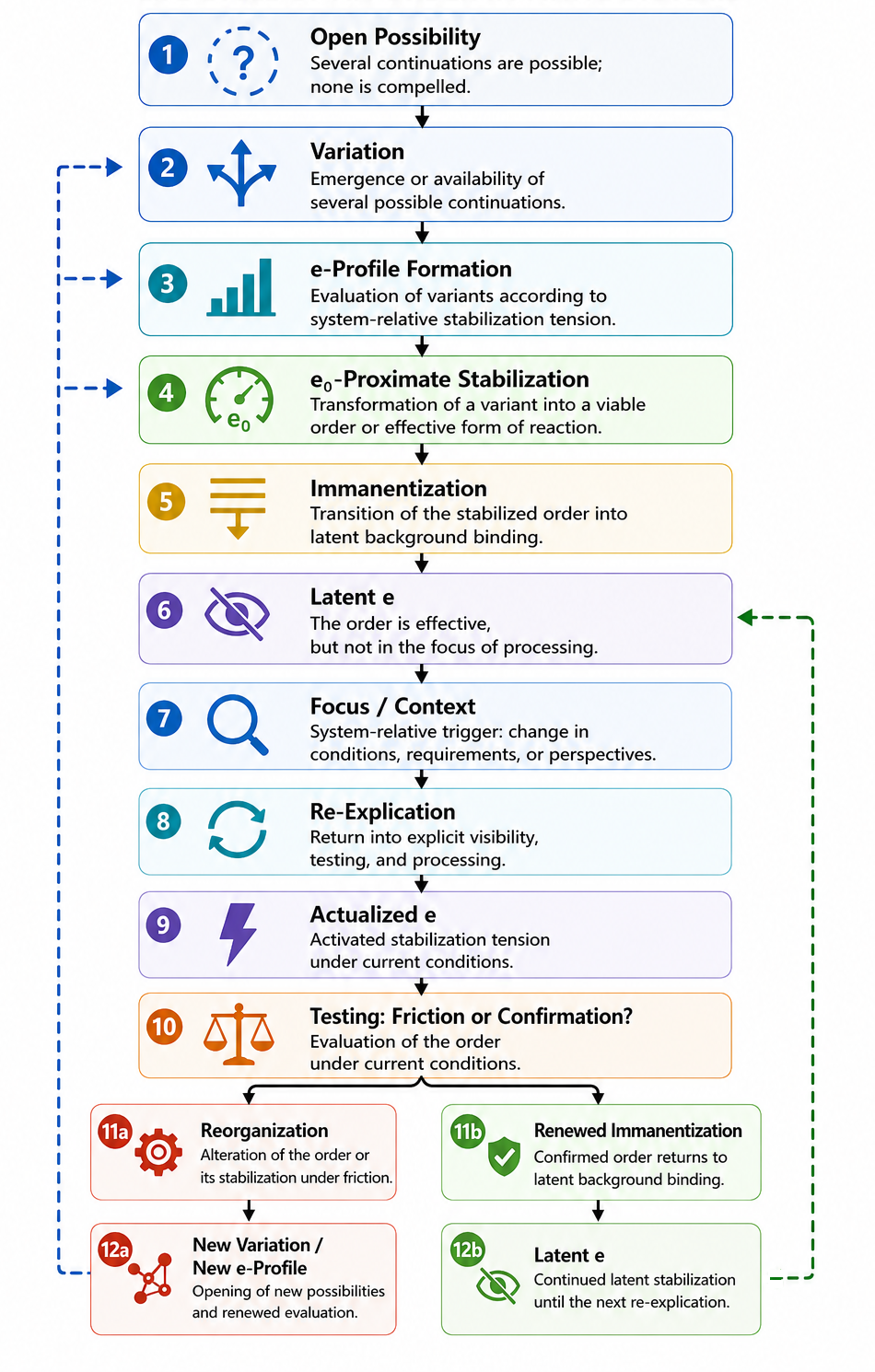
14. Simple and Complex Forms of Contingency Mechanics
Contingency mechanics does not appear everywhere with the same degree of complexity. There are simple and complex forms.
Reactive contingency is present when a system can choose among simple reaction patterns. An organism can approach, withdraw, or remain still. The selection is simple, but not entirely rigid.
Adaptive contingency is present when feedback changes later reaction probabilities. What repeatedly remains viable becomes more likely. What repeatedly causes harm becomes less likely. Learning begins.
Heuristic contingency is present when a system uses simple search or decision rules. A heuristic does not stabilize final truth, but a cost-efficient search direction.
Epistemic contingency is present when a system tentatively forms and tests interpretations, search paths, degrees of stabilization, and models. Here, contingency is explicitly connected with cognition, validity, friction, and revision.
Reflexive contingency is present when a system not only processes possibilities, but also examines its own processing mechanics. It then asks not only: Which order remains viable? But also: Which form of contingency processing is appropriate here?
These levels are not a hierarchy of value. A simple heuristic can be more e₀-proximate in a dangerous situation than extended reflection. A complex multi-path examination may be necessary for a basic scientific question, but would be too expensive in a routine action. Good contingency mechanics does not mean maximal complexity, but fitting complexity.
15. Resource Sensitivity of Contingency Mechanics
Contingency mechanics itself consumes resources. Variation costs. Evaluation costs. Comparison costs. Stabilization costs. Immanentization costs. Actualization costs. Revision costs.
From this follows a contingency of the second order. A system must not only decide which continuation is to be stabilized. It must also determine which form of contingency processing is appropriate: direct stabilization, heuristic search, multi-path variation, formal testing, targeted revision, or reopening of the possibility space. These processing forms have their own e-profiles. They differ not only in depth, but also in costs, error surfaces, revision possibilities, and their relation to the task structure.
An undercomplex mechanics saves resources, but may overlook relevant distinctions. The system then resorts too quickly to a simple rule even though the situation is more complex. This generates defective stabilization.
An overcomplex mechanics may test too much, keep too many possibilities open, or actualize too many background orders. Processing then consumes more resources than it gains in orientation. This generates overload or blockage of action.
The central formula is:
A contingency mechanics is appropriate when its own complexity and concrete processing form are no greater than the expected orienting gain warrants, but also not so slight or narrowly chosen that relevant alternatives are prematurely lost. e₀-proximity therefore designates not only fitting processing depth, but fitting processing form.
This point is especially important for AI systems and organizations and connects with the theory of efficient search under finite conditions. More computing power, more testing, or more reflection is not automatically better. Sometimes several weaker variation runs followed by selection can be more efficient than a single very deep pass. In other cases, a short revision loop is more e₀-proximate than broad variation because it specifically burdens an already stabilized solution without reopening the entire possibility space. Still other tasks require direct stabilization because additional paths generate no new orientation, but only costs and error surfaces. What matters, therefore, is not maximal depth or maximal variation, but the fitting distribution of directness, variation, stabilization, and revision.
Immanentization, too, is resource-sensitive. It lowers active processing costs, but can become dangerous when burdened background orders are actualized too late. A system must therefore not only stabilize, but also decide appropriately when an immanentized order must become explicit again.
16. Example I: Human Everyday Cognition
A human being is considered here not first as a biological life form, but as a system of cognition to which world appears. Biological descriptions are possible models within a reconstructed world, but they do not form the starting point of contingency mechanics.
A system of cognition experiences a situation. This experience is not already fully ordered. It contains impressions, moods, memories, expectations, bodily signals as they appear in experience, and relevance markings. Several interpretations can arise from this.
Suppose a person receives no answer to an important message. Several interpretations are possible: the other person is busy. They did not see the message. They are hurt. They want distance. They are indifferent. The situation has a technical cause. None of these interpretations is immediately fully compelled.
The example is intentionally ordinary because it shows the minimal structure of contingency-mechanical order formation. The situation generates a space of variation. The possible interpretations are not equivalent, but have different e-profiles. One interpretation may be quickly available but generate strong subsequent costs. Another may initially remain open but preserve more revisability. A third may provide short-term relief but immediately become unstable under new indications.
The interpretation “they are busy” may generate low tension if it fits previous experiences. The interpretation “they reject me” may generate stronger emotional tension, but may perhaps connect with earlier experiences. The interpretation “it is a technical problem” may have a relieving effect, but be less viable if other indications speak against it. A strongly fixed interpretation such as “they certainly want nothing more to do with me” may generate order in the short term, but have high transcendent costs if it must be maintained against uncertain or contradictory indications.
An e₀-proximate interpretation is therefore not necessarily the most pleasant one, nor the strongest one. It is the one that provides enough orientation under the given conditions without closing the possibility space too early. A possible e₀-proximate stabilization would be: “I do not know yet; being busy is possible, other possibilities remain open, and further indications will decide.” This order stabilizes enough to avoid panic or rumination, but remains revisable. It preserves residual contingency without becoming incapable of action.
If similar situations occur repeatedly, a background order can emerge: “This person often replies late.” This order is immanentized. Later, it generates hardly any active tension. The system need not reopen the entire interpretive space with every delayed answer. The order operates as latent e: it provides relief because it pre-orders a recurring situation.
Only when a new context burdens this background order, for example because distancing behavior, a changed tone, or repeated avoidance also occur, is its latent e actualized. Friction then arises. The previously relieving order “often replies late” may no longer be sufficient. The system must examine whether the old order must be limited, supplemented, or replaced.
The example thus shows more than mere everyday psychology. It shows the entire small e-cycle: variation of possible interpretations, selective evaluation, e₀-proximate provisional stabilization, immanentization of a recurring order, later actualization through context, and possible reorganization. Human everyday cognition is therefore not merely rational decision or emotional reaction. It is contingency-mechanical order formation under open possibilities.
17. Example II: Scientific Model Change as a Demonstrative Analysis of the e Life Cycle
The four states of e must become distinguishable in a concrete case; otherwise, the idea of a life cycle remains merely terminological. A scientific model change is well suited for this purpose because emergence, competition, background stabilization, and later actualization can be documented. The following section uses the transition from phlogiston theory to oxygen chemistry not as a complete history of science, but as a schematic demonstration of the e life cycle.
17.1 Initial Order and Latent e of the Old Stabilization
Before the model change, phlogiston theory was a stabilized order in certain chemical contexts of interpretation. It provided a language for describing combustion, reduction, and related processes. Its e was largely latent: the theory did not have to be called into question as a theory with every application, but formed a background order for chemical thought.
Latent e here means that the theory structured relevances, expectations, and explanations without constantly being explicitly problematic itself. It sustained an order as long as the observed phenomena remained processable within it.
17.2 Actualized e Through Friction
With new quantitative measurements, especially more precise weight balances in combustion processes, this background order became more strongly burdened. Phenomena that had previously seemed interpretable within the existing framework now generated higher stabilization costs. The theory had to absorb auxiliary assumptions or distort its interpretations more strongly.
Here latent e is actualized. The old order does not simply become false immediately. But its e-profile changes: what previously ran in the background as latent binding becomes focal through new measurement practices and problem formulations. The theory now has to be actively stabilized against friction. Its e rises.
17.3 Generative e of the New Order
Oxygen chemistry does not emerge without costs. A new order must first be formulated, conceptually stabilized, experimentally supported, defended against established interpretations, and integrated into a broader chemical system. This is generative e.
Generative e shows that new orders are not automatically less costly. They can have high emergence costs at the beginning. A new theory must generate concepts, measurement practices, forms of evidence, and capacities for connection. Its advantage does not necessarily appear immediately as lower effort, but in the fact that its e-profile can become more viable over time.
17.4 Selective e: Competition Between Two Orders
In the transitional phase, old and new order compete. Phlogiston theory has low connection costs to existing habits, concepts, and teaching traditions, but rising transcendent costs in relation to certain measurement findings. Oxygen chemistry has high generative costs, but can reduce certain frictions more systematically.
Selective e designates precisely this comparison. It is not enough to say that a theory is “truer” or “falser.” The contingency-mechanical question is: Which order, given the available data, measurement practices, concepts, and explanatory requirements, generates the more viable relation among ordering gain, stabilization costs, and revisability?
If a new order integrates more frictions, requires fewer auxiliary assumptions, and generates greater capacity for connection, it can become more e₀-proximate despite higher initial costs.
17.5 Immanentization of the New Order
As the new order becomes more stable, its e-state changes. What was initially burdened in generative and selective terms increasingly becomes background. Oxygen chemistry is not tested anew as a revolutionary order in every chemical explanation. It enters textbooks, measurement practices, concepts, and experimental routines. Its e becomes latent.
This is immanentization. The new order continues to operate, but no longer constantly as an explicitly contested order. It becomes the presupposition of further chemical research. Its tension is not gone. It is bound into concepts, procedures, measurement regimes, and spaces of expectation.
17.6 Later Actualization and Added Value Compared with Kuhn and Lakatos
An immanentized order can later be actualized again. Modern chemistry, atomic theory, thermodynamics, or quantum chemistry do not simply burden older chemical basic orders in the sense of a return to the old conflict. Rather, they actualize background assumptions under new contexts. It thereby becomes visible that even successful orders are not tension-free. They remain stable as long as their latent e can be viably actualized in new contexts.
Here lies the specific added value of contingency mechanics compared with a purely Kuhnian or Lakatosian reading. Kuhn can describe the transition as a paradigm shift; Lakatos can read the old order as increasingly degenerative and the new order as a more progressive research program. Both perspectives capture important parts of the case. Contingency mechanics, however, adds another question: What happens to a successful order after it has prevailed?
The answer is: it does not disappear as a theory, but changes its state of tension. The new order is immanentized. It becomes the background condition of further research, a silent framework of order in which new questions, measurements, instruments, and concepts become possible in the first place. Its e becomes latent. Precisely in this way, a new possibility of later actualization arises. A theory is therefore not only progressive, degenerative, or paradigmatically stable; it has a life cycle of tension. It can be generatively expensive, selectively superior, latently relieving, and later actualizable again.
This point expands classical theories of science not by replacing them, but by making another timescale visible. Kuhn and Lakatos focus primarily on crisis, competition, and transition. Contingency mechanics additionally considers the background phase after stabilization and the conditions of later reactivation. Model change thereby becomes readable not only as the victory of a better order, but as the transformation of the e-profile of an entire research field.
This demonstration shows the four e-states in one case:
- latent e of the established order,
- actualized e through new friction,
- generative e of the new order,
- selective e in competition,
- renewed latent e after immanentization,
- later actualization through new contexts.
The case also shows why stability must not be confused with e₀-proximity. The old order was stable, but its stabilization costs rose. The new order was initially expensive, but became more e₀-proximate in the long run. Contingency mechanics therefore explains the shift not through mere stability, but through change in the e-profile over the life cycle of the order.
18. Example III: Social Order
Social systems stabilize expectations. A norm, a role, an institution, or a procedure reduces open possibility. It specifies what applies, what is expected, who is responsible, which behavior is appropriate, and which continuations are possible.
A social rule has an e-profile. It can create orientation, reduce conflicts, and enable capacity for connection. These immanent costs can be viable. At the same time, it can generate transcendent costs if it conceals exceptions, excludes groups, requires too much coercion, or no longer supports changed life situations.
When a social order functions, it is immanentized. It then no longer appears as a chosen or historically emerged order, but as self-evident. One acts according to it without constantly reflecting on it. Its tension becomes latent. Here there are clear connections to Bourdieu’s concept of habitus and to systems-theoretical descriptions of social expectation stabilization (Bourdieu 1977; Luhmann 1984).
Changes of context can actualize this latent tension. An institution that functions well in a stable environment can generate high friction in a crisis. A norm that previously created orientation can, under changed social conditions, appear unjust, inefficient, or contradictory. Then its e becomes visible.
From this perspective, social conflicts can often be read as conflicts over e-profiles. An order that is e₀-proximate for one group can generate high transcendent costs for another. An institutional stabilization can relieve the system as a whole but generate overload for certain subsystems. Revision of social order becomes necessary when maintenance costs or frictions rise.
Contingency mechanics thereby explains why social orders can be both relieving and problematic. They stabilize possibility, but their stabilization remains cost- and context-dependent.
19. Example IV: AI and LLM Systems as a Path of Operationalization
AI systems process possibility spaces differently than humans. An LLM generates possible continuations on the basis of learned patterns, context, instructions, and selection mechanisms. Its basic operation is implemented in formal-probabilistic terms; however, higher operational patterns become reconstructible in contingency-mechanical terms where several response paths are possible, different interpretations of the prompt compete, and response depth as well as resources must be adapted.
An LLM has no human raw experience. It has no subjective resonance in the phenomenal sense. Nevertheless, e-profiles can be functionally reconstructed in technical systems: token costs, computation time, consistency across runs, contradiction rate, need for self-correction, quality gain per additional processing step, sensitivity to prompt changes, and stability of a response line.
For AI, the resource sensitivity of contingency mechanics is especially interesting. A single very strong pass is not always optimal. In open tasks, it may be more efficient to generate several weaker variants, select roughly, and deeply test only the best candidates. In clear formal tasks, by contrast, a direct structured process may be more appropriate. In other cases, a short revision loop may be more e₀-proximate than broad multi-path variation because it specifically burdens an already stabilized answer without reopening the entire possibility space.
The contingency-mechanical question is therefore not only: Which processing level generates the best orienting gain in relation to its own costs? More precisely, it is: Which processing form generates, under the given task conditions, the best relation among ordering gain, costs, error reduction, and revisability?
The simple hypothesis that there are task-specific optimal ranges of processing depth is not yet risky enough. It remains close to existing inference-time compute research. A stronger contingency-mechanical prediction would have to be more specific: not only the depth, but the form of processing depends on the type of task. In open theory and model formation tasks, multi-path variation with selective deepening can be superior to a single deep pass, provided that the variation paths map substantively relevant search axes. In clearly formalized tasks, by contrast, direct, structured processing is more often e₀-proximate. In precision-sensitive tasks, a targeted revision loop may be more e₀-proximate than broad variation.
This hypothesis is riskier because it does not merely claim diminishing marginal utility of additional processing. It predicts that different tasks require different processing forms. The decisive issue is therefore not maximal processing, but the fit among task structure, processing form, and e-profile.
A first test would have to classify task types independently in advance so that the hypothesis cannot be adjusted after the fact. A classification by external raters or by established benchmark categories before evaluation begins would be possible. Criteria could include: openness of the solution space, number of plausible solution paths, degree of formal determinacy, evaluability of the answer, need for creative variation, and sensitivity to contextual assumptions. Only then would the processing strategies be compared.
For each task type, several processing strategies would be tested with equal total costs: one deep single pass, several shallower variants followed by selection, self-consistency, structured multi-path examination, deep revision, or tree-like multi-path procedures. Quality, consistency, costs, error type, and quality gain per additional processing step would be measured.
The prediction is not only that there is a cost-benefit plateau. It is that different tasks require different contingency-mechanical forms. Precisely this shift in optimal mechanics would be the empirically relevant point.
AI systems are therefore not the origin case of contingency mechanics, but an important technical test case. They show how variation, selection, and stabilization can be implemented and measured in resource-sensitive ways, even without human consciousness.
20. Relation to Epistemics and Tentative Stabilization
Epistemics describes model management under finite conditions (Rapp 2026a). It investigates how models are stabilized, tested, limited, revised, and used in domains. Contingency mechanics is more general. It describes how finite systems arrive at stable continuations under open possibility and how these continuations are held, immanentized, actualized, or reorganized over their life cycle.
Epistemics is therefore a special case of contingency mechanics: the case in which stabilized orders are explicitly maintained, tested, limited, and revised as models.
The theory of tentative stabilization describes how epistemically ordered fields of experience are stabilized in such a way that uncertainty becomes locatable (Rapp 2026d). This, too, is a special case or area of connection. Tentative stabilization asks:
How is an order tested by being posited?
Contingency mechanics asks more generally:
How is one order selected from among several possible orders so that it can be posited, stabilized, immanentized, or revised?
In its dynamic formulation, it additionally asks:
How does a stabilized order continue to operate, how does its e become latent, when is it actualized, and when does this actualization generate friction?
Contingency mechanics thereby overlaps with Epistemics and stabilization theory, but is not contained by them. It describes a more general transformation and life-cycle mechanics of stable order.
21. Falsifiability and Empirical Risks
A model that can retrospectively classify every observation loses explanatory force. Contingency mechanics must therefore name conditions under which it would be weakened or falsified. The claim of the present paper is not to present an already fully empirically confirmed theory. Its claim is to formulate a model that can, in principle, take risks.
Several findings would speak against contingency mechanics or strongly weaken it.
First: if no reproducible relation between stabilization depth, costs, and orienting performance were visible in a system under investigation, the e/e₀ model would lose explanatory force. e would then not be a meaningfully reconstructible profile, but only a retrospective description.
Second: if maximal stabilization consistently generated better results in open tasks, without relevant auxiliary costs, defective forms, or blockages of revision, the e₀ thesis would be weakened. For the model does not claim that more stabilization is always better. It claims that there are system- and context-relative optimal ranges.
Third: if lower stabilization in complex tasks were just as effective as stronger stabilization, without loss of orientation, part of the model would likewise be weakened. For e₀ presupposes that understabilization generates real costs.
Fourth: if immanentized orders could not be reactivated when context changes, or if they exhibited no distinguishable latent and actualized tension, the life-cycle idea would be weakened. Precisely the distinction between latent and actualized e is one of the original core points of the model.
Fifth: if generative, selective, latent, and actualized e could not be meaningfully distinguished in concrete analyses, the model would fall back into a more general language of costs and lose its specific added value.
Sixth: if different processing forms generated no stably distinguishable e-profiles for comparable task structures and equal total resources, the thesis would be weakened that e₀-proximity also depends on processing form. In that case, only the amount or depth of processing would be relevant, not its concrete operational form.
Seventh: if existing theories such as Active Inference, cognitive dissonance, bounded rationality, habitus theory, or programs in the theory of science explained the same phenomena more precisely without contingency mechanics providing additional distinctions or predictions, its independent theoretical value would be low.
These conditions show that contingency mechanics must not be used merely as a universal descriptive grid. Where it claims theoretical explanation, it must take distinguishable risks.
22. Paths of Operationalization
The operationalization of contingency mechanics is difficult, but not impossible. The central point is that e is not measured as an immediately visible substance. e must be reconstructed as a profile: through costs, tension, friction, maintenance effort, revision load, and stability behavior.
Three paths of operationalization seem especially plausible.
22.1 AI/LLM Systems
This is the methodologically simplest entry point. AI systems allow controlled variation, repeatable tasks, measurable costs, and comparable quality measures. One can systematically manipulate processing depth, breadth of variation, and selection procedures.
Possible indicators:
- token costs,
- computation time,
- response quality,
- consistency across runs,
- rate of self-correction,
- type of error,
- robustness to prompt variation,
- quality gain per additional processing step.
Testable hypothesis:
Different task types have different e₀ ranges not only for processing depth, but also for processing form. In open theory or creative tasks, multi-path variation with selective deepening can be more efficient than a single deep pass at equal total costs, provided that the variation paths map substantively relevant search axes of the task. In clearly formalized tasks, by contrast, direct formalization can be more e₀-proximate. In precision-sensitive tasks, a short revision loop can be more e₀-proximate than broad variation.
22.2 Reconstructions in the History of Science
A second path consists in the analysis of historical model changes. Here, e-profiles cannot be measured exactly, but they can be systematically reconstructed: number and type of auxiliary assumptions, increase in complexity, anomalies, revision costs, restrictions of scope of validity, and institutional stabilization costs.
The added value of contingency mechanics does not lie in repeating Lakatos or Kuhn, but in making the life cycle of order visible: generative costs, selective competition, latent background binding, actualization through friction, and reorganization.
22.3 Human Cognition and Neurofunctional Reconstructions of Connection
The most difficult path concerns human cognition. Here one could use reaction times, error rates, physiological indicators, pupillometry, EEG, stress markers, or behavioral changes. Methodologically, however, there is a danger of prematurely equating contingency-mechanical operations with familiar constructs such as cognitive dissonance, prediction error, or cognitive load.
Human cognition should therefore not be the first empirical test case. Neurofunctional and neuroempirical models can provide points of connection, but they should not be made the foundation of contingency mechanics. The human being is considered here primarily as a system of cognition; biological and neuronal descriptions are functional-empirical special models within a reconstructed world.
A possible added value would arise only if contingency mechanics made predictions that differ from established theories. For example, it would have to show not merely that dissonance or prediction error occurs, but that latent order bindings are actualized in context-dependent ways and that different e-states have distinguishable trajectories.
A further question of connection concerns the neurofunctional translatability of contingency-mechanical operations. What would have to be examined is not whether contingency mechanics can be directly “localized in the brain,” but whether variation, e-profile formation, e₀-proximate stabilization, immanentization, actualization, and reorganization can be connected with measurable neurophysiological profiles of load, stabilization, or reorganization. Such a translation would not provide a neurobiological foundation for contingency mechanics, but would test its functional-empirical capacity for connection.
23. Defective Forms of Contingency Mechanics
If contingency mechanics describes the transformation of variation into stable order and the further life cycle of this order, then defective forms arise wherever variation, evaluation, selection, stabilization, immanentization, or actualization is misdirected.
Poverty of variation is present when a system generates too few possibilities. It stabilizes the first available continuation because alternatives do not become visible at all. This produces premature closure.
Overvariation is present when a system generates too many possibilities and loses its capacity for selection. Openness is no longer productive, but blocking. Orientation disintegrates into unconnected alternatives.
Misevaluation is present when e-profiles are read incorrectly. A dissonant variant appears resonant because transcendent costs are repressed. Or a viable variant is rejected because short-term costs are overestimated.
False e₀ selection is present when the system does not choose the e₀-proximate stabilization point, but an undercomplex or overcomplex form. Undercomplexity generates too little orientation. Overcomplexity generates pseudo-precision, overextension, or unnecessary maintenance costs.
Defective stabilization is present when a variant is treated as a stable form of reality or orientation even though its e-profile is not viable. It appears stable, but must be maintained through auxiliary effort, immunization, repression, or power.
Loss of residual contingency is present when non-selected possibilities are fully erased instead of being preserved as possible revision options. The system loses its capacity to learn.
Permanent reopening is present when a system cannot maintain any stabilization. Every order is immediately reopened. Contingency thereby remains unprocessed, and orientation becomes impossible. This relation touches the theory of revision insofar as revision does not mean permanent reopening, but targeted transformation of burdened stabilization.
Defective immanentization is present when an order is shifted into the background even though it is not yet viable enough or already generates excessive transcendent costs. The concept stands close to questions of immanentization and ontologization, but is here determined as a defective form of contingency mechanics. The order then continues to operate as a seemingly self-evident presupposition, even though its e-profile is burdened.
Blocked actualization is present when an immanentized order is in fact burdened by context or friction, but is not permitted to become explicit. The system prevents latent e from becoming actualized e. Break points thereby remain invisible and revision is blocked.
Actualization overload is present when too many immanentized orders are focally activated at the same time. The system must examine too many background bindings at once and loses operational stability.
Processing-form mismatch is present when it is not primarily the content of an order, but the selected processing form that is far from e₀. A system may, for example, use broad multi-path variation even though direct stabilization would have been sufficient; then unnecessary costs, redundancies, and additional error surfaces arise. Conversely, a system may force direct stabilization even though several substantively relevant search axes exist; then the possibility space is prematurely narrowed. Processing-form mismatch therefore concerns the relation between task structure and processing form.
These defective forms show that good contingency mechanics means neither maximal openness nor maximal stability. It means the appropriate transformation of variation into viable order, the appropriate immanentization of successful orders, and appropriate reactivation under friction.
24. Contingency Mechanics as a Model of Stable Continuation
Contingency mechanics describes the selection and life-cycle mechanics oriented toward e₀-proximity through which a finite system stabilizes a viable order from varying possibilities. This order is the one whose e-profile is most viable and closest to e₀ under the given conditions. It can later be immanentized, contextually actualized, confirmed, or reorganized.
The central formula is:
Variation → e-profile → e₀-proximate stabilization → immanentization → latent e → contextual actualization → friction or confirmation → reorganization or consolidation.
For human cognition this means: raw experience opens possible orders. These orders have e-profiles composed of resonance, dissonance, and stabilization costs. e₀ designates the range of minimally viable tension. The selected order stabilizes itself as worldview, self-relation, model, or general understanding of reality. Successful orders are immanentized and continue to operate as latent order bindings. Through focus, context, or friction, their e is actualized; the order can thereby be confirmed, adapted, or revised.
Contingency mechanics is thus neither mere decision theory nor simple heuristic theory, and it is also not merely a theory of abduction. Abduction describes the formation of possible explanations; contingency mechanics additionally describes how such orders are evaluated, stabilized, immanentized, reactivated, and reorganized. It describes the more general transition from open possibility to stable continuation under finite conditions and the further life cycle of this stabilization.
Its ontological claim remains limited. It does not directly describe the world in itself, but the stabilization of reconstructed world orders for finite systems. Within such reconstructed orders, e is quasi-real because every viable order has costs, tension, binding, friction, and revisability. The physical domain remains a boundary case: it could show the most strongly operationalized functional-empirical form of e-like stabilization, but in this paper it must not be prematurely identified with e.
The central gain of the model lies in treating contingency, stabilization, and revision not separately, but as one dynamic relation. Open possibility is not overcome through pure calculation, but through resonance- and cost-evaluated selection of viable stabilization. Stable orders do not persist without tension; rather, they operate as latent order bindings that can be actualized again through focus, context, and friction.
The methodological claim of the paper is deliberately limited and at the same time formulated in a testable way. Contingency mechanics is not meant merely to provide a vocabulary, but to take risks: e₀ must be determinable as a relation among ordering gain, costs, revisability, and processing form; e-profiles must become distinguishable in concrete cases; latent and actualized e must be analytically or empirically separable; and the model must show its own added value in relation to existing theories.
Conceptual Canon for This Paper
The following conceptual canon serves to stabilize central meanings within this text. It is used where an explicit conceptual reference basis is required for the argument of this paper. It makes no claim to completeness or final systematicity. Concepts not listed here either do not belong to the functional core of this paper or are treated within Epistemics or in separate works.
This paper stands in systematic connection with Epistemics, but does not adopt its basic concepts as a conceptual super-architecture. Contingency mechanics is defined here as a more general model of finite possibility processing. Epistemics appears within this framework as a special case, namely as model management under finite conditions. Concepts such as model, validity, stabilization, costs, friction, revision, and domain are therefore used in a way that remains compatible with Epistemics, but they are not silently reinterpreted.
The concepts introduced in this paper do not constitute a retrospective alteration of the basic canon of Epistemics. They determine the local functional core of contingency mechanics: variation, e-profile, e₀-proximate stabilization, immanentization, actualization, friction, and reorganization. Implicit shifts in meaning, silent extensions, or retrospective reinterpretations of Epistemics are excluded.
The conceptual canon is restricted to those concepts that are necessary for the independence of the model.
Contingency designates the openness of several possible continuations without any one continuation being fully compelled by existing conditions.
Contingency mechanics designates the dynamic operational logic through which finite systems transform open possibility spaces into viable continuations and later maintain, immanentize, actualize, or revise them. It also includes abductive hypothesis formation, but goes beyond it because it describes the entire life cycle of stable order.
Finite system designates a system that operates under limited energy, time, processing capacity, information, error tolerance, and revisability.
Variation designates the emergence or availability of several possible continuations, reactions, search paths, interpretations, orders, or models.
e designates the system-relative stabilization tension of a possible or existing order. e is not a physical energy value in the narrow sense, but a theoretical and, in perspective, operationalizable quantity; in the physical domain, however, e can be reconstructed especially closely through energy, potentials, entropy, and binding states.
e-profile designates the dynamic signature of the stabilization tensions of an order over its life cycle. It comprises generative e, selective e, latent e, and actualized e.
e₀ designates the system- and context-relative range in which ordering gain, stabilization costs, revisability, and processing form enter into a viable relation.
Processing form designates the concrete operational form through which a system transforms open possibility into order. This includes, for example, direct stabilization, heuristic search, multi-path variation, formal testing, targeted revision, or reopening of the possibility space.
Processing-form mismatch designates a possible defective form of contingency mechanics in which it is not primarily the content of an order, but the selected processing form that is far from e₀. It is present when, for example, a system uses broad variation although direct stabilization would have been sufficient, or forces direct stabilization although several substantively relevant search axes exist.
Generative e designates the tension that arises when a possible order emerges.
Selective e designates the cost profile of a variant in comparison with alternative variants.
Latent e designates the background binding of an immanentized order.
Actualization designates the renewed claim placed upon a latent order through focus, context, or friction, through which its e becomes visible and processable as actualized e.
Actualized e designates the tension that arises when focus, context, or friction lays claim to a latent order again.
Stabilization designates the transformation of a possible continuation into a viable order or effective form of reaction.
Immanentization designates the transition of a stabilized order from explicit processing into latent background binding. Immanentization does not erase e, but transforms explicit e into latent e.
Re-explication designates the countermovement to immanentization: the return of a latent background order into explicit visibility, testing, and processing. A re-explicated order can be confirmed, limited, adapted, reorganized, or transcended.
Transcending an order form designates the exceeding of a previous order form when it can no longer be reorganized within its own stabilization and another or more comprehensive order form becomes necessary.
Friction designates the point at which burdened stabilization becomes visible, when actualized e shows that an order no longer remains viable within the e₀ range.
Reorganization designates alteration of an order or of its stabilization under friction.
Defective stabilization designates a stabilization whose degree of consolidation, scope of validity, or claim does not fit its e-profile and its actual viability.
Defective immanentization designates the immanentization of an order although it is not yet viable enough or already generates excessive transcendent costs.
Canonical Status and Scope of Validity
The concepts introduced in this paper are stabilized for the scope of validity of contingency mechanics. They can be used as reference concepts in later works, provided their use is expressly marked. They do not replace the basic canon of Epistemics, but form a more general framework of connection within which Epistemics can be situated as a special case of explicit model management under finite conditions.
Literature
Bourdieu, Pierre. 1977. Outline of a Theory of Practice. Cambridge: Cambridge University Press.
Clark, Andy. 2016. Surfing Uncertainty: Prediction, Action, and the Embodied Mind. Oxford: Oxford University Press.
Dewey, John. 1938. Logic: The Theory of Inquiry. New York: Henry Holt.
Friston, Karl. 2010. “The Free-Energy Principle: A Unified Brain Theory?” Nature Reviews Neuroscience 11 (2): 127–138.
Gigerenzer, Gerd, and Reinhard Selten, eds. 2001. Bounded Rationality: The Adaptive Toolbox. Cambridge, MA: MIT Press.
Heidegger, Martin. 1927. Sein und Zeit. Tübingen: Max Niemeyer.
Kuhn, Thomas S. 1962. The Structure of Scientific Revolutions. Chicago: University of Chicago Press.
Lakatos, Imre. 1970. “Falsification and the Methodology of Scientific Research Programmes.” In Criticism and the Growth of Knowledge, edited by Imre Lakatos and Alan Musgrave, 91–196. Cambridge: Cambridge University Press.
Luhmann, Niklas. 1984. Soziale Systeme: Grundriß einer allgemeinen Theorie. Frankfurt am Main: Suhrkamp.
Maturana, Humberto R., and Francisco J. Varela. 1980. Autopoiesis and Cognition: The Realization of the Living. Dordrecht: Reidel.
Peirce, Charles S. 1931–1958. Collected Papers of Charles Sanders Peirce. Edited by Charles Hartshorne, Paul Weiss, and Arthur W. Burks. Cambridge, MA: Harvard University Press.
Polanyi, Michael. 1966. The Tacit Dimension. Garden City, NY: Doubleday.
Rapp, Stefan. 2026a. Epistemics: Model Management Under Finite Conditions. Zenodo. https://doi.org/10.5281/zenodo.18441326.
Rapp, Stefan. 2026b. Friction: Boundary Signal of Finite Load-Bearing Capacity in Subjective, Intersubjective, and Functional-Empirical Stability Spaces. Zenodo. https://doi.org/10.5281/zenodo.18434699.
Rapp, Stefan. 2026c. Beyond Physics and Metaphysics: Epistemics and the Differentiation of Reality into Subjective, Intersubjective, and Functional-Empirical Physics. Zenodo. https://doi.org/10.5281/zenodo.18317965.
Rapp, Stefan. 2026d. From the Field of Experience to the Model: Epistemic Stabilization and the Localization of Uncertainty under Finite Conditions. Zenodo. https://doi.org/10.5281/zenodo.19917105.
Schön, Donald A. 1983. The Reflective Practitioner: How Professionals Think in Action. New York: Basic Books.
Simon, Herbert A. 1955. “A Behavioral Model of Rational Choice.” The Quarterly Journal of Economics 69 (1): 99–118.
Varela, Francisco J., Evan Thompson, and Eleanor Rosch. 1991. The Embodied Mind: Cognitive Science and Human Experience. Cambridge, MA: MIT Press.
Wimsatt, William C. 2007. Re-Engineering Philosophy for Limited Beings: Piecewise Approximations to Reality. Cambridge, MA: Harvard University Press.
Appendix: Didactic Short Examples of Contingency-Mechanical Processes
The following examples illustrate the contingency mechanics developed in the paper. They do not replace the theoretical argument of the main text, but show in concise form how variation, e-profile, e₀-proximate stabilization, immanentization, actualization, friction, and reorganization can occur in different areas. The examples are deliberately simple so that the sequence of the model becomes visible.
A.1 Everyday Cognition: An Unknown Noise at Night
A person hears an unknown noise in the apartment at night. The situation is not immediately unambiguous. Several interpretations are possible: a window has moved, an object has fallen down, an animal is in the house, another person has gotten up, or there is an indication of danger. The system of cognition therefore does not face a finished meaning, but an open space of variation.
Every possible interpretation has its own e-profile. The assumption “it was only the wind” generates little tension, but may be too weak if the noise was unusually clear. The assumption “someone has broken in” generates high tension, but may be relevant for action if further indications appear. The assumption “I do not know yet, but I will briefly check the likely causes” generates medium tension and keeps several possibilities open.
An e₀-proximate stabilization here would consist neither in maximal reassurance nor in maximal alarm. It would lie in an order that generates enough orientation without closing the possibility space prematurely: “The noise is unclear; I will briefly check windows, doors, and likely causes without immediately fixing the most dangerous interpretation.” This stabilization is viable because it generates capacity for action while remaining revisable.
If a similar experience repeats, a background order can emerge: “This house occasionally makes noises at night.” This order is immanentized. It provides relief because not every noise must immediately be interpreted entirely anew. Its e becomes latent. Only when the context changes, for example through repeated noises, an open door, or additional indications, is this background order actualized. It then becomes apparent whether it still remains viable or whether friction arises and reorganization becomes necessary.
The example shows the simple e-cycle: variation of possible interpretations, evaluation of their tension profiles, e₀-proximate provisional stabilization, later immanentization of a background order, and possible actualization through a change of context.
A.2 Scientific Practice: A Deviating Measurement Value
In an experiment, a measurement value appears that does not fit the expected results. The finding is initially open. It may be a measurement error, an outlier, a calibration problem, an unconsidered boundary condition, or an indication that the model being used is limited. The situation therefore does not generate an immediately unambiguous conclusion, but a contingency-mechanical space of variation.
The possible interpretations have different e-profiles. The interpretation “measurement error” is often cost-efficient because it protects the existing model and requires little reorganization. But it can generate high transcendent costs if similar deviations occur repeatedly. The interpretation “new boundary condition” generates more effort, but can expand the order without abandoning it completely. The interpretation “model problem” has high generative costs because it requires deeper examination or revision, but can be more e₀-proximate in the long term if the deviations are systematic.
An e₀-proximate stabilization would therefore not be an immediate decision in favor of the most convenient or most radical interpretation. It could be: “The measurement value is initially marked as a deviation requiring examination; measurement error and calibration are checked, and at the same time it is recorded whether similar deviations occur again under comparable conditions.” This order reduces uncertainty without erasing the possibility of a model problem too early.
If the deviating finding is not confirmed by further measurements, the provisional order can be relieved again. If, however, it becomes reproducible, the actualized e of the existing model rises. The assumption running in the background that the model sufficiently orders the relevant area becomes focally burdened. Friction then arises. The system must decide whether a local correction is sufficient, whether a boundary condition must be added, or whether a deeper revision is required.
This example shows that scientific practice does not consist only of application and falsification. Between finding and model change lies a contingency-mechanical zone: deviations must be classified, weighted, stabilized, or held open before one can decide whether they are mere error, a relevant boundary condition, or model friction.
A.3 AI/LLM: Translation, Calculation Task, and Theory Development
An LLM can realize different processing forms for different tasks. In a simple calculation task or a clear definition of a concept, the solution space is already strongly limited. There are few plausible continuations, clear evaluation criteria, and usually an unambiguous error check. In such cases, direct structured processing can be e₀-proximate: it generates enough order without producing additional costs through unnecessary variation.
The case is different for a translation. Here the solution space is more open. Several formulations can be correct, but they differ in tone, precision, terminological fidelity, readability, and contextual fit. A single direct pass can produce a usable but not optimal stabilization. A short revision loop or limited variation loop can be more e₀-proximate here: the system tests an already stabilized version or a few alternatives with regard to which formulation best connects terminology, style, and comprehensibility.
This becomes even clearer in theory or paper analysis. There, the relevant orders are often not fully pre-given. The system must first generate possible interpretations, weaknesses, points of connection, and structures. A single deep response path can consolidate a particular reading too early. Multi-path variation with selective deepening can be more viable here because several analytical axes first become visible before an order is stabilized.
The e-profiles differ accordingly. Direct processing saves tokens and time, but in open tasks it can lead to premature stabilization. Broad variation increases costs, but can generate better coverage of the search space. Deep revision increases effort, but can reduce inconsistencies. e₀-proximate AI processing lies where the form of processing fits the openness and evaluability of the task.
The contingency-mechanical hypothesis is therefore: not only processing depth is decisive, but the fitting processing form. Strongly closed tasks tend to require direct stabilization. Precision-sensitive tasks such as translations, condensations, or conceptual checks can benefit especially from a short revision loop because an already stabilized answer is specifically examined without reopening the entire possibility space. Open theory tasks benefit more strongly from multi-path variation with selective deepening only when several substantively relevant search axes actually exist.
A.4 Defective Immanentization: An Outdated Work Routine
A person or organization uses a certain work routine over a long period. This routine was originally useful: it reduced search effort, made procedures predictable, and prevented every task from requiring a new decision. The routine was thereby immanentized. It receded into the background and was no longer perceived as an actively chosen order, but as a self-evident mode of work.
If the context changes, however, the same routine can become burdened. New tasks, different tools, changed expectations, or higher complexity no longer fit well with the old order. Nevertheless, the routine continues because it is familiar and is not explicitly examined. Its e-profile deteriorates: processing times increase, errors become more frequent, detours become more common, and additional corrections become necessary.
Defective immanentization is present here because an order continues to operate in the background even though, under actualized conditions, it no longer remains e₀-proximate in its viability. It does not appear as a problem because it is no longer visible as an order. Precisely for this reason, it can remain stable for a long time even though its maintenance costs rise.
An appropriate reorganization would make the routine explicit again. The system would have to examine which parts still remain viable, which must be adapted, and whether a new form of work would be more e₀-proximate. The decisive issue is not to reject the old routine merely because it is old. The decisive issue is whether its actualized e-profile is still viable under present conditions.
The example shows that stable orders do not fail only when they are openly attacked. They can also become problematic because they remain invisible for too long.
A.5 Overview: Mini-Schema of Contingency Mechanics
A contingency-mechanical process can be read in simplified form as follows:
- Variation: Several continuations are possible.
- e-profile: Every possibility has its own costs, tensions, and revision loads.
- e₀-proximate stabilization: An order is chosen because it provides enough orientation without generating excessive tension.
- Immanentization: Successful order recedes into the background and relieves the system.
- Latent e: The order continues to operate without being constantly explicit.
- Re-explication: Focus, context, or friction make the background order visible and processable again.
- Actualized e: The previously latent stabilization tension is claimed again.
- Reorganization: The order is confirmed, limited, changed, or replaced; transcending an order form is the special case in which the previous order form must be exceeded.
The didactic core is:
Contingency mechanics describes not only how an order emerges, but also how it continues to operate, recedes into the background, remains there as an effective order, becomes visible again, can be placed under strain, and changes under friction.