Domains, Boundaries, and Transition Functions
On the Domain-Relative Validity, Migration, and Coupling of Models under Finite Conditions
Abstract
Models are often treated as though they were generally valid or readily transferable to other contexts. This leads to misapplications, apparent contradictions, and forms of model overextension. By contrast, this paper develops a domain-based perspective within Epistemics as model management under finite conditions. Domains are not presupposed as given regions but are understood as functionally reconstructed spaces of order with their own functional logic, their own conditions of stability, and their own criteria of validity.
Against this background, the paper investigates how models encounter stability problems at domain boundaries, under what conditions they can be transferred between domains, and why such transfers require adaptation. Transition functions are thereby determined as conditions of functional connectivity. Model migration accordingly appears as a process of transformation, and model overextension as a boundary violation.
Moreover, the paper shows that the viability of a model depends not only on its internal structure but also on its domain coupling. A model can be stable within one domain and simultaneously fragile across domains. Falsification therefore appears not only as an intra-domain test of a model but also as an indication of transition problems, unstable domain couplings, or insufficiently specified domain boundaries.
The theoretical contribution of the paper lies in an integrated architecture of domain-relative model validity. Domains, boundaries, transition functions, model migration, model overextension, domain coupling, and falsification are related to one another within a common framework. In this way, model validity becomes determinable not as general or universal, but as domain-relative, boundary-dependent, and transition-bound.
Keywords
Epistemics, domains, model validity, transition functions, model migration, model overextension, falsification, friction, conditions of stability, spaces of order
1. Problem Statement and Theoretical Approach
Models play a central role in scientific, political, and everyday contexts. They structure experience, enable orientation, and serve as a basis for decision and action. At the same time, they are often used as though they were valid independently of their respective field of application. They are transferred from one context to another without systematic reflection on their functional conditions. This leads to misapplications, apparent contradictions, and forms of model overextension.
The question addressed in this paper lies at the intersection of several lines of research. These include work on the function of scientific models and their use in theory and practice, debates on falsification, scientific change, and the limits of validity claims, as well as approaches that investigate social and institutional orders as independently stabilized structures (Morgan and Morrison 1999; Popper 2005; Kuhn 2012; Lakatos 1978; Cartwright 1983; Berger and Luckmann 1966; Luhmann 1984).
These perspectives have yielded important insights, yet they treat either the context-dependence of models, the revision of theoretical programs, or the difference among social orders without systematically linking these problem areas within a common diagnostic model. Thus, in Cartwright the context-dependence of laws and models becomes especially visible, in Lakatos the stabilization and revision of theoretical programs, and in Luhmann the difference among functional social orders.
By contrast, the present approach shifts the emphasis toward the systematic interrelation of domain relativity, boundary structures, transition functions, model migration, model overextension, and distinguishable failure types. What has so far remained less developed is an integrated perspective that asks not only whether a model is viable in itself, but also in which space of order it is valid, where its boundaries lie, under what conditions it can pass into other orders, and how loss of validity is to be diagnosed differently depending on whether the problem lies in the model, the transition, or the domain. It is precisely here that the present contribution begins.
The paper develops a perspective in which model validity is understood not as general or universal, but as domain-relative. The point of departure is the assumption that models are stable and functional only within specific spaces of order. These spaces of order are referred to in what follows as domains. A domain is not simply a field of topics or an object domain, but a relatively stable, modeled, and revisable space of order with its own functional logic, its own conditions of stability, and its own criteria of validity. Domains are thus not treated as given regions, but are understood as functionally reconstructed orders.
This shifts the central question. What is decisive is no longer primarily whether a model is true or false, but rather in which domain it is viable, under what conditions it can be transferred into other domains, and where it encounters structural boundaries.
Domain boundaries are not to be understood merely as lines of separation, but often as threshold zones in which functional logics overlap, shift, or come into tension with one another. Transitions between domains are possible only when specific transition functions are operative. They constitute the condition under which models can become connectable across domains at all. Without such transition functions, ruptures, maladjustments, or failed transfers occur.
Against this background, model migration can be determined as the transfer of a model under altered conditions. It is not a mere transfer, but as a rule requires adaptation to the functional logic of the target domain. If this adaptation does not occur, model overextension arises.
This is not merely a nonspecific error, but the expression of a structural mismatch among model logic, domain logic, and transition structure. At the same time, it becomes clear that models can be not only locally stable or unstable. A model can be viable within one domain and simultaneously fragile across domains if it lacks connectivity to other domains.
The paper aims to work out these interrelations systematically. It understands itself as a contribution within Epistemics as model management under finite conditions. Domains are thereby not treated as antecedent units, but as reconstructible orders that arise from different relations of stability, friction, and coupling. In addition, a distinction is drawn between facticization and ontologization in order to capture different forms of stabilization and reality attribution. Finally, consequences for an expanded understanding of falsification are outlined.
The guiding thesis is this: the viability of a model depends not only on its internal structure, but also on the domain in which it operates, on the structure of its boundaries, and on the transition functions that enable or limit its transferability and coupling. The paper’s theoretical contribution lies in four points.
First, domains are not presupposed as given, but are functionally reconstructed. Second, boundaries are determined as changes in conditions of stability. Third, transition functions are made explicit as conditions of the transferability of models. Fourth, falsification becomes legible not only as a model test, but also as a diagnosis of model, transition, and domain errors.
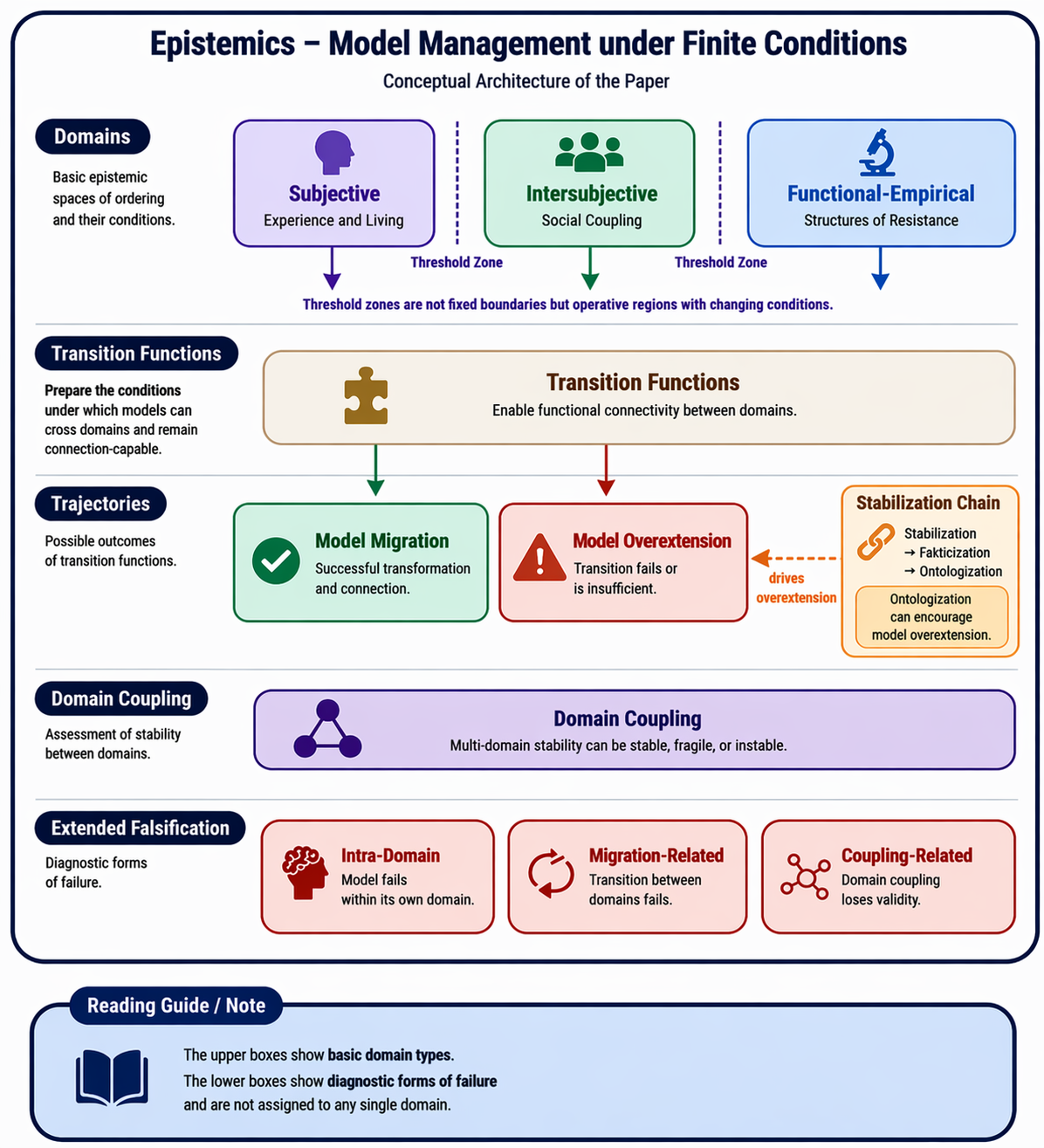
2. Theoretical Framework: Epistemics as Model Management under Finite Conditions
The present analysis is situated within the framework of Epistemics as model management under finite conditions. Epistemics is not understood here as classical epistemology aimed at truth in an absolute sense, but as a perspective on the conditions under which models are formed, stabilized, adapted, and discarded. At the center, therefore, is not the question of how reality in itself can be conclusively known, but under which finite conditions orientation becomes possible at all.
In this respect, the analysis stands close to classical debates in epistemology and philosophy of science, but significantly shifts their focus. Decisive here is neither the question of truth in an absolute sense nor the treatment of models primarily as representations of an independently determined reality.
What is foregrounded instead are the conditions under which models can be formed, stabilized, revised, and maintained as viable in different spaces of order under finite premises. Epistemics thus connects to debates about model use, heuristics, practice, and scientific change, but transforms them into a perspective of functional viability under finitude (Popper 2005; Kuhn 2012; Lakatos 1978; Morgan and Morrison 1999; Rapp 2026a).
The point of departure is the assumption that epistemic systems operate under conditions of structural finitude. Time, attention, computational capacity, and access to information are limited. From this there arises not only the necessity of reducing complexity through models so that orientation becomes possible. Under finite conditions, models are possible at all only because they rely on presuppositions that they cannot fully decide or justify from within themselves.
This structural incompleteness is not a mere weakness, but the condition under which stabilization and orientation become possible at all. Every model therefore contains a functionally necessary surplus beyond its complete justification. This surplus becomes problematic only where its domain-boundedness is concealed and a functional presupposition turns into an unmarked claim to generality or reality. In this context, models are functional structures that bring dynamic processes into a form that remains workable under given conditions.
The stabilization of models is not a one-time act, but an ongoing process. Models must be maintained under changing conditions and, in that process, are continuously confronted with friction. This maintenance is not cost-free, but involves costs of stabilization, which remain low under favorable conditions and can rise under strain. Within Epistemics, friction is understood not primarily as a mere error, but as a diagnostic signal of tensions, boundary problems, rising costs, or the need for adaptation within a model or between a model and its conditions of application.
Epistemic systems respond to friction with revision. Revision denotes the adaptive reconfiguration of a model under conditions of rising tension or loss of validity. It can occur locally, for example through limited refinements or modifications, or structurally, when fundamental assumptions must be changed. Stabilization and revision thus stand in a dynamic relation: stabilization enables orientation, and revision preserves adaptability.
Against this background, validity is understood not as absolute truth, but as functional viability under specific conditions. A model is valid insofar as it enables orientation and can maintain its stability under friction to a sufficient degree. Validity is thus neither universal nor final, but condition-dependent. This is precisely what gives rise to the transition to the question of domains. If validity can be determined only under specific conditions, it must also be clarified in which spaces of order these conditions apply in each case.
Epistemics thereby describes not primarily different regions of the world, but different orders of what can be organized within the epistemic system as stable, connectable, resistant, and capable of validity. When domains are discussed in what follows, this therefore does not immediately mean ontologically independent regions of reality, but rather different forms of epistemic stabilization. The analysis thus does not move outside the epistemic system, but investigates the conditions under which world-relation, model validity, and order formation can arise within this system at all.
At this point, the present extension begins. The paper shows that the conditions of model validity are to be sought not only within individual models, but are determined essentially by the structure of domains, their boundaries, and the transition functions between them. Whereas Epistemics has so far primarily described the internal dynamics of stabilization, friction, and revision, this contribution focuses on the spaces of order in which models operate, on the boundaries of their viability, and on the conditions under which they can be transferred between domains or coupled across domains.
In this way, the analysis of model validity is expanded by a structural dimension. Models are to be evaluated not only internally, but also with respect to the domains in which they are used, the boundaries of their viability, and their capacity to establish stable transitions or resilient couplings between different domains. Epistemics thus remains the overarching framework of the paper, but is supplemented by the present investigation with a domain-relative architecture of model validity.
3. Domains as Spaces of Order
In what follows, the concept of domain is understood not as a thematic or object-related region, but as a relatively stable space of order with its own functional logic, its own conditions of stability, and its own criteria of validity. This determination is central because models are bound not primarily to topics, but to the conditions of their stabilization. Domains therefore differ not first by their object, but by the way in which models can be formed, tested, maintained, and revised within them. Domains are thus functionally reconstructed, not presupposed.
A domain is determined by the manner in which models become viable within it. This includes the mechanisms of stabilization, the typical forms of friction, and the possibilities of revision. A model is viable only insofar as it can be maintained under the respective domain-specific conditions.
Domains therefore do not designate mere classificatory fields, but differences in the conditions of model validity. Methodologically, domains are not directly presupposed, but reconstructively inferred. The point of departure lies in recurring differences in the conditions of stabilization, friction, and revision. It is precisely in friction, boundary phenomena, and forms of failure that it becomes visible that models are not viable everywhere under the same conditions.
In this sense, the difference among domains is not primarily posited, but diagnostically inferred. Only when such differences can be grouped into sufficiently stable and recurring patterns do they become describable as major clusters of order formation. In this sense, domains are not the point of departure, but the result of a provisional and revision-open reconstruction of epistemic orders.
Within the framework of Epistemics, three basic domains can initially be distinguished: the subjective, the intersubjective, and the functional-empirical domain. This tripartite division, however, must not be misunderstood as a mere stipulation. The present approach aims at their functional reconstruction.
The guiding working hypothesis is that the difference among domains does not arise primarily from directly given external regions, but from different patterns of stabilization, friction, and coupling within the epistemic system. Where stabilization depends primarily on individual experiential organization, the subjective domain emerges.
Where stabilization depends primarily on repeated social coupling, the intersubjective domain emerges. Where stabilization depends primarily on repeatable resistance structures, the functional-empirical domain emerges. In this sense, domains are not antecedent units, but reconstructed major forms of order formation.
The subjective domain is characterized by the fact that models serve above all to organize immediate experience. Their primary function is to bring perception, expectation, memory, and orientation into a sufficiently coherent form for a single epistemic system. Friction typically appears here as irritation, incoherence, or disorientation in experience. Revision takes place as a reorganization of individual models, interpretations, or structures of expectation.
The intersubjective domain arises where models not only provide individual orientation, but must also enable repeatable coupling among multiple epistemic systems. Here, expectations, roles, meanings, actions, and normative structures are stabilized in such a way that social connectivity emerges. Stability thereby rests neither solely on individual coherence nor on technical reproducibility, but on successful mutual coordination. Friction accordingly appears as conflict, dissensus, norm violation, or institutional instability. Revision takes place as a process of negotiation, restructuring, or transformation of social orders.
The functional-empirical domain is determined by the fact that models are tested against repeatable resistance structures. Their stability is measured not primarily by whether they are individually plausible or socially accepted, but by whether they yield reliable results under systematically controllable conditions. Friction appears here above all as failed prediction, problems of reproduction, or methodological disturbance. Revision takes place as the adaptation of hypotheses, measurement procedures, theoretical assumptions, or experimental arrangements.
The three domains can, however, be distinguished not only by different leading forms of stabilization, but also by their degree of mediation. The subjective domain lies closer to the organization of immediate experience. The intersubjective domain is already further removed from this, because it presupposes stable coordination, shared meanings, and repeatable social connectivity.
The functional-empirical domain further requires a methodologically condensed stabilization against repeatable resistance structures. The sequence therefore does not designate an ontological hierarchy, but an increasing density of mediation and stabilization in epistemic orders.
At the same time, this reconstruction remains open to revision. It does not claim to have definitively established the only possible articulation of all spaces of order. The claim is weaker and more precise: under the conditions of finite epistemic systems, the subjective, intersubjective, and functional-empirical domains can be determined as especially basic and recurring major clusters of model stabilization.
The triad is thus not asserted as a metaphysically final taxonomy, but as a viable reconstruction of dominant modes of stabilization for the present analysis. None of the three domains functions as an ultimate instance from which the others could be fully derived. The differentiation is therefore to be understood not as a hierarchy, but as a functional analysis of different forms of epistemic stabilization.
Within these basic domains, numerous subdomains exist. They represent more specific configurations of the respective form of stabilization. Thus, within the intersubjective domain, law, politics, morality, or monetary systems can be distinguished; within the functional-empirical domain, scientific disciplines, technical fields of application, or methodological regimes; within the subjective domain, different models of experience, selfhood, or interpretation.
The distinction between domains and subdomains is important because stability can vary at different levels. A model can be stable within a narrow subdomain while already encountering boundaries at the more general level of its basic domain. Conversely, models can migrate between subdomains without requiring a complete transition between the basic domains. Domains are thus neither mere names for thematic fields nor ontologically fixed regions, but functionally reconstructed spaces of order characterized by different patterns of stabilization, friction, and coupling.
4. Boundaries and Threshold Zones
If domains are understood as spaces of order with their own functional logic, the question of their delimitation arises immediately. This delimitation, however, is not to be conceived as a simple line of separation. Domain boundaries are operative regions in which the conditions of model stabilization change. They mark the point at which the mode of stabilization characteristic of a domain can no longer simply be continued.
Boundaries are therefore determined not primarily ontologically, semantically, or disciplinarily, but functionally. A domain boundary is present where a model that was viable under the conditions of a particular domain produces increased friction under altered conditions, loses connectivity, or can be maintained only at additional costs of stabilization. Boundaries thus become visible not first through changing topics, but through shifted conditions of viability. This becomes apparent, for example, where the sentence “I did not mean it that way” has a clarifying effect subjectively, but intersubjectively no longer provides sufficient clarification.
In many cases, such boundaries are not sharply defined. Instead of appearing as a hard cut, they appear as threshold zones. Within them, the dominant functional logic changes gradually. A model can still be partially viable there and at the same time already show initial signs of instability. Such intermediate regions are theoretically important precisely because they make it possible to recognize that validity is not simply present or lost, but comes under tension under changed conditions.
This also yields a distinction among different forms of boundaries. There are relatively sharp boundaries, at which the conditions of stability of two domains diverge so strongly that models are transferable only with considerable transformation or not at all. Alongside these, there are diffuse or gradual boundaries, within which models remain connectable to a limited extent over a certain range. In both cases, however, what is decisive is not the intuitive form of the boundary, but the change in the conditions under which stabilization succeeds.
Boundaries and transitions have already been discussed in different theoretical contexts, for example in connection with limited comparability, changes of language games, institutional difference, or hybrid orders. The present paper, however, understands boundaries not primarily as semantic or disciplinary separations, but as changes in conditions of stability between different logics of order. In this way, boundary cases become visible not merely as problems of understanding, but as sites at which domain differences can be functionally reconstructed (Kuhn 2012; Luhmann 1984; Rapp 2026b).
Boundaries therefore do not merely separate, but also structure. They mark the range of a model by making visible how far its conditions of validity extend. At the same time, they first open up the question of transition and coupling. Without boundaries, there would be neither a systematic determination of transferability nor the possibility of recognizing model overextension as a boundary violation.
Threshold zones are particularly revealing in this context. Within them, different functional logics can overlap or come into tension with one another. This gives rise to hybrid states of stability. Such zones are productive because they enable adaptation and reconfiguration, but also diagnostically delicate, because it is often only gradually decided within them whether a model can be transformed in a viable way or whether a loss of validity is already beginning.
For precisely this reason, boundary cases must not be treated as mere special cases. They are epistemically fruitful because they show wherein domains actually differ. As long as a model functions smoothly within a stable domain, the conditions of its viability often remain invisible. It is only at boundaries and in threshold zones that these conditions come more clearly into view.
It also follows from this that not every instance of friction already indicates a boundary phenomenon. Friction can arise within a domain from model weaknesses, insufficient precision, or local disturbances. A boundary phenomenon is present only where friction points not merely to corrections within the same logic of order, but to the fact that the previous conditions of stability themselves are becoming questionable.
Against this background, model overextension can also be classified more precisely. It often occurs where a threshold zone is mistakenly treated as though it were a stable domain or where a model is applied beyond a boundary without adequately taking the changed conditions of stability into account. In this case, the boundary is not recognized as a functional difference, but is implicitly glossed over.
The analysis of boundaries and threshold zones therefore constitutes a necessary precondition for understanding transition functions. Only when it becomes determinable where and how functional logics change can it be clarified under what conditions models can be transferred between domains, which transformations are required for this, and how such transfers fail.
5. Transition Functions
If domains are determined by different functional logics and their boundaries appear as operative threshold zones, the question arises under what conditions models can cross these boundaries. The central thesis of the present approach is that there is not simply emptiness between domains. Between them, transition functions operate, determining whether connectivity, transformation, or non-transferability is present. Transition functions thus designate the structural conditions under which a model can become viable in another domain at all.
The concept of transition function serves to specify analytically the area between two domains. What is meant by this is neither an additional domain nor a merely technical auxiliary device, but a functional relation of mediation. A transition function is present where a model can be adapted under altered conditions of stability in such a way that it does not immediately collapse within another logic of order.
It thus designates the form of mediated connectivity between model logic and target domain. Not every similarity between two domains already establishes a transition function. Nor is every adoption of a model already model migration. A transition function can be said to exist only where real connectivity is produced under altered conditions of stability.
This yields three basic cases. First, direct connectivity may be present if the functional logics of two domains are closely enough related to permit transfer with low costs of adaptation and stabilization. Second, only partial connectivity may exist. In this case, certain elements of a model remain transferable, whereas others must be transformed, reduced, or abandoned.
Third, non-transferability may be present if no viable transition function exists and the model remains systematically unstable under the conditions of the target domain. Transitions are thus neither self-evident nor uniform, but are themselves an object of functional analysis.
Transition functions do not appear merely in the abstract, but in practice. This can be seen, for example, in the fact that a technically correct number or measurement does not by itself already work in everyday life, but often first has to be explained, contextualized, and translated into an understandable form in order to become connectable in another context. They cannot simply be presupposed, but must prove themselves by whether a model can be stabilized under altered conditions without completely losing its operative core structure. Their absence becomes visible where transfer produces persistent friction that cannot be sufficiently reduced even through revision.
At the same time, transition functions can be described not only retrospectively in terms of the success of a transfer. They can also be prospectively estimated, namely by the degree of structural compatibility between model core and target domain, by the scope and depth of the necessary transformations, by the preservability of a functional model core, as well as by the friction profile of the transition.
The more a model becomes connectable only through profound restructuring, or the more clearly friction points to principled incompatibility rather than manageable need for adaptation, the weaker the transition function to be assumed. In such cases, it is not necessarily the model as such that fails. It may equally be that the target domain requires different forms of stabilization or that the assumed connectivity between the two domains was incorrectly determined.
It is precisely here that an important diagnostic point lies. Transition problems must not be read too hastily as model errors. If a model fails in transfer, at least three sources of error are conceivable: an internal deficiency of the model, the absence or weakness of a transition function, or an insufficient determination of the domains involved. The failure of a transition therefore does not automatically point to the falsity of a model, but can equally indicate that the boundary structure or the domain attribution is in need of revision.
Transition functions are also not necessarily symmetrical. A model can be transferred from domain A to domain B with an acceptable expenditure of adaptation, without the reverse path being possible in the same way. Likewise, transitions can be selective. Certain structural moments of a model can remain connectable, whereas others are non-transferable precisely because of their original embedding. Transitions are therefore not to be understood as the mere exchange of equivalent forms, but as processes under unequal requirements, resistances, and modes of stabilization.
Transition functions thus determine not only whether a model can leave its domain of origin, but also in what form it can do so. They regulate the range, need for transformation, and loss structure of a model in a change of domain. In some cases, the basic structure remains largely intact; in others, only a reduced or restructured model core is transferable. Transition functions are therefore not only conditions of connectivity, but also conditions of selective transformation.
In this way, they simultaneously mark the boundary between productive model migration and model overextension. Productive migration can be said to occur where a model is adapted through viable transition functions in such a way that it remains stable under the conditions of the target domain. Overextension, by contrast, is present where a model is transferred without an adequate transition function being present or without the transformations required by it being carried out. The difference thus lies not simply in whether a model is moved, but in whether its transfer is functionally mediated.
Transition functions are therefore a central component of the domain-relative analysis of model validity. They make visible that the range of a model does not follow from its internal structure alone. Whether a model can become effective beyond its domain of origin depends essentially on whether and in what form transitions between different logics of order are possible at all. Precisely therein lies their systematic significance for the further analysis of model migration, model overextension, and domain coupling.
6. Models, Domain Relativity, and Model Migration
The foregoing analysis has shown that models can be stabilized only within specific domains, that domain boundaries appear as operative threshold zones, and that transition functions constitute the condition for connectivity between different spaces of order. Against this background, the behavior of models can be determined more precisely. Models are not statically bound to a single domain, but can, under certain conditions, migrate between domains. This migration, however, is not a trivial process, but a structured one shaped essentially by transition functions, friction, and adaptation.
First of all, it must be emphasized that local stability must not be equated with cross-domain viability. Local stability denotes the capacity of a model to be maintained within a particular domain under its specific conditions. It does not follow from this, however, that the model is also connectable in other domains. A model can function perfectly within its domain of origin and nevertheless fail systematically outside that domain. It is precisely this difference that makes a domain-relative determination of model validity necessary.
Model migration denotes the attempt to transfer a model from its domain of origin into another domain. This transfer is not a mere relocation of an unchanged model. It takes place by way of transition functions, which determine to what extent and in what form the model must be transformed in order to become viable in the target domain. Migration is therefore not a simple transfer, but a process of functional reconfiguration (Morgan and Morrison 1999; Giere 1999; Cartwright 1983; Rapp 2026e).
A central aspect of this process is adaptation. As a rule, models must be adapted to the functional logic of the target domain. This adaptation can take the form of reduction, expansion, or restructuring. Reduction is present where certain elements are not connectable within the target domain. Expansion is necessary where additional structures are required. Restructuring takes effect where fundamental assumptions or relations must be changed.
What migrates, therefore, is often not the complete model, but a transformed core that must be restabilized under new conditions. Successful model migration can be said to occur only if three conditions are fulfilled: first, friction in the target domain must be reduced to a manageable degree. Second, a sufficiently stable reorganization must succeed there. Third, a functional model core must be preserved that justifies speaking of migration rather than mere complete replacement.
Friction plays a double role in this process. On the one hand, it indicates that a model is not straightforwardly viable under the conditions of the target domain. On the other hand, it is not necessarily already a sign of failure. A moderate degree of friction can be productive because it makes the need for adaptation visible and triggers revision. It is only where friction persists or intensifies despite adaptation that it becomes clear that migration is encountering structural boundaries.
From this perspective, four basic forms can be distinguished. First, there are models that remain stable within their domain of origin without meaningfully migrating. Second, there are models that migrate successfully because viable transition functions are present and the necessary transformations are carried out. Third, there are models that migrate only partially. In such cases, certain structural moments remain connectable, while others must be abandoned or profoundly altered. Fourth, there are models whose migration fails because no sufficient transition function is present or because friction cannot be reduced to a manageable degree.
The possibility of partial migration is theoretically important. In many cases, models are not fully transferred into a new domain, but only in part. This gives rise to hybrid models that combine elements of different domains. Such forms are not necessarily deficient, but are especially prone to misunderstanding because it is easy to overlook which parts of the model have actually migrated and which are merely carried over from the domain of origin.
This also makes clear why model migration must not be equated with model overextension. Migration is a potentially productive process, provided that it is mediated by viable transition functions and the required revision takes place. Model overextension, by contrast, is present where a model is transferred into another domain without these conditions being fulfilled. Overextension is therefore not the movement itself, but its functionally inadequate form.
Finally, it must be taken into account that model migration occurs not only between the basic domains but often between subdomains. In such cases, transitions often appear less abrupt because partial compatibility already exists. Yet this proximity can be deceptive. Significant differences in the conditions of stabilization can exist even between subdomains.
Overall, the analysis of model migration shows that models are determined not by their internal structure alone, but by their capacity to be reconfigured under altered conditions. Viability is therefore not only a question of local stability, but also a question of successful transformation.
7. Model Overextension as a Boundary Problem
Against the background of the foregoing analysis, model overextension can be determined more precisely. It is not to be understood merely as a general error or as an unspecific misapplication, but as a structural boundary problem. Model overextension arises where a model is applied beyond the conditions of its domain of origin without sufficient adaptation to the functional logic of the target domain taking place or without a viable transition function being present.
Overextension thus designates not simply the fact that a model fails, but a particular form of failure: the mismatch among model logic, domain logic, and transition structure. Model overextension therefore does not designate every failure of a transferred model, but the specific case in which domain differences are functionally underestimated and necessary transition performances are not provided.
This is precisely what distinguishes model overextension from model migration. Migration denotes the attempt to transfer a model under altered conditions into another domain, where adaptation, reduction, expansion, or restructuring are possible. Overextension, by contrast, is present where a model is treated as though its conditions of validity were independent of the domain in which it is used.
The decisive difference therefore lies not in whether a model is moved, but in whether its transfer is mediated by viable transition functions and sufficiently adapted through revision. Model overextension is, in this respect, not simply identical with unsuccessful migration as such, but the specific faulty form of a transfer in which the domain difference is functionally underestimated or ignored.
This boundary violation can take different forms. In some cases, a model is transferred completely and without significant adaptation into another domain. In other cases, only individual elements are adopted without their embedding in the original functional logic being taken into account.
In still other cases, the existence of a domain boundary is itself not recognized, so that the application of a model appears unproblematic even though clear tensions are already arising. In all of these cases, the difference in the conditions of stability is not adequately taken into account.
A characteristic mechanism of model overextension is success-blindness. Precisely because a model is successful in its domain of origin, its use easily creates the impression of general viability. Yet this conclusion is illegitimate. Success within one domain does not prove the absence of boundaries, but only that the model is viable under precisely those conditions. Success-blindness consists in inferring universal reach too hastily from local stability. An everyday example would be the assumption that human action can everywhere be treated like a simple weighing of utility, even though friendship, duty, or offense do not readily fit into the same logic.
It must also be added that model overextension often does not immediately become visible as such. Overextended models can initially appear quite stable, especially where the target domain poses similar demands in some respects or where the threshold zone between the two domains is indistinct. It is precisely for this reason that overextension often becomes visible only when friction increases.
This friction then manifests itself as inconsistency, failed prediction, conflict, or loss of connectivity. An important diagnostic point is that such friction is often read incorrectly. Instead of understanding it as an indication of a boundary problem, it is localized within the model itself. This often leads to the introduction of additional auxiliary assumptions or complexity, although what would actually need to be addressed is the boundary violation itself.
Model overextension is therefore not only an application error, but also an error of diagnosis. It often rests on the fact that domain differences are not sufficiently perceived, transition functions are overestimated, or signals of friction are incorrectly classified. It is precisely here that its theoretical significance lies. Overextension makes visible that failure must not always be traced back to the internal structure of a model. It can equally be the result of an incorrectly determined validity claim.
From this perspective, model overextension can be determined as a specific faulty form of domain-related revision. Where successful model migration requires reconfiguration under altered conditions, this reconfiguration is absent or remains insufficient in overextension. The model is shifted, but not functionally transformed. It retains the logic of its domain of origin even though the target domain requires different conditions of stabilization.
This also makes intelligible why model overextension is often linked with facticization or ontologization. Models that have become practically successful and self-evident within one domain tend to conceal their own conditionality. The more strongly a model appears no longer as a model, but as an expression of reality itself, the greater becomes the temptation to extend its validity beyond its original domain.
Overall, it becomes clear that model overextension lies at the intersection of domain analysis, transition function, and model migration. It marks an independent failure type because it designates not merely the failure of a transfer, but the specific misrecognition of the conditions under which transfer would be possible at all. Precisely for this reason, it is of particular importance for Epistemics. It shows that models lose their validity not only through internal weaknesses, but also through their range being incorrectly determined.
8. Facticization and Ontologization
The foregoing analysis has shown that models are stabilized within domains and derive their validity from this stabilization. In order to capture different forms of this consolidation more precisely, a distinction must be made between facticization and ontologization. Both processes concern the stabilization of models, but they do so in different ways and with different consequences for model validity, domain-boundedness, and model overextension.
This distinction is central for the present context because it explains how locally stable models can give rise to an exaggerated validity claim. Without this distinction, it would remain unclear why domain-bound orders tend to overestimate their own range.
Facticization designates the process in which a model, an order, or an interpretation partially loses its hypothetical or constructive character in practical enactment and is treated as a given state of affairs. A model then no longer appears primarily as a model, but as that on which one operatively relies.
This form of stabilization is functionally significant because epistemic systems cannot continuously co-reflect all the conditions of their orientation without becoming incapable of action and connectivity. Facticization therefore reduces uncertainty and relieves ongoing model use.
Ontologization goes beyond this. It is present where an already stabilized or facticized order is treated not only practically as given, but as an expression of reality itself. Whereas facticization thus denotes a stabilization in enactment, ontologization marks consolidation at the level of reality attribution. Not everything that is factually treated as given is thereby already ontologically absolutized.
It is precisely this difference that is important for domain-related analysis. In many cases, models are facticized within a domain without thereby being ascribed universal or ontological validity. Social or institutional orders, for example, can be highly binding in practice while it simultaneously remains known that they arose historically, are open to revision, and depend on continued stabilization. Money is an obvious example. It is treated in enactment as real and action-guiding, without this necessarily entailing an ontologically independent status in the strong sense (Berger and Luckmann 1966; Luhmann 1984; Rapp 2026d).
This makes it possible to describe a graded process of consolidation: stabilization designates the functional establishment of a model, facticization the transition into practical self-evidence, and ontologization the attribution of reality status. This gradation makes it possible to distinguish different intensities of model consolidation without immediately ontologically inflating every stable order.
A central mechanism in this context is entity formation. Models often reduce complexity by converting relational or processual contexts into seemingly fixed units. This is functionally understandable because it facilitates orientation, communication, and coordination of action. At the same time, however, it carries a risk. As soon as such units are no longer perceived as results of model formation, but as given constituents of reality, the probability increases that their conditionality will disappear from view.
Here the connection to the main line of the paper becomes visible. Facticization is initially an aid to intra-domain stabilization. Ontologization, by contrast, alters a model’s validity claim. It favors the tendency to treat an order that is viable within a specific domain as generally or domain-independently valid. In precisely this way, a bridge to model overextension arises.
The distinction between facticization and ontologization is therefore not a mere terminological refinement. It makes visible the point at which functional stabilization can become a problematic surplus of validity claim. Model overextension is often favored not simply because a model is successful, but because its success passes over into a stronger attribution of reality than its domain-boundedness can sustain.
At the same time, this differentiation helps to read friction more precisely. Where an ontologized model inventory encounters boundaries, friction is easily interpreted as a disturbance within reality itself, not as an indication of the limits of the model or its domain. Instead of examining domain-boundedness or transition structure, attempts are then made to preserve the existing model form at any cost.
For the analysis of domains, this means: facticization describes how models become practically binding within a domain. Ontologization describes how this binding force is converted into a stronger validity claim, often crossing domains. Precisely because the present paper determines model validity as domain-relative, this distinction is important. It makes it possible to show that not every form of stability is problematic, but rather that stability which conceals its own conditionality and derives from it an illegitimate claim to generality.
Overall, the distinction between facticization and ontologization refines the analysis of model consolidation within Epistemics. It shows how models can become functionally stable, practically self-evident, and finally ontologically inflated. In this way, it provides an important building block for understanding model overextension, because it explains why domain-bound orders tend to overestimate their own range.
9. Domain Coupling and Stability
The foregoing analysis has shown that models are stabilized in a domain-relative way, that their transferability depends on transition functions, and that model migration requires adaptation. This gives rise to a further question: how is the stability of a model to be determined if it is intended to be effective not only within a single domain, but in several domains? To answer this question, the concept of domain coupling is introduced.
Domain coupling designates the repeatable and resilient connectivity of a model to more than one domain. A model is coupled across domains if it can be stabilized under different functional logics without its operative core structure completely disintegrating at each transition. Domain coupling is therefore more than the mere possibility of a single transfer. It designates not a one-time successful transition, but the capacity to establish viable connections repeatedly under different conditions.
This determination allows a distinction between local and global stability. Local stability designates the viability of a model within a single domain. Global stability, by contrast, does not mean universal validity, but the capacity of a model to serve several domains simultaneously or in stable sequence. A model can therefore be locally stable and at the same time globally fragile. In that case, it functions reliably within a particular space of order, but loses its viability as soon as it has to mediate between different domains or process several functional logics at once.
Domain coupling is not a binary state. Models can be coupled to different degrees. In some cases, the coupling is robust and reproducible, so that a model can repeatedly mediate between domains without falling into systematic instability. In other cases, the coupling remains partial or fragile. The model is then connectable only under narrow conditions or only transferable in certain directions. In still other cases, viable coupling is entirely absent.
A central mechanism that determines the quality of domain coupling is the transition function. Here, transition functions operate not only as one-time mediating performances, but as structural conditions of repeatable connectivity. Precisely herein lies the difference between a single successful transfer and a resilient domain coupling. Coupling can be said to exist only when transitions succeed reproducibly and the model does not immediately lose its connectivity even under variation of conditions.
This also shifts the understanding of robustness. A model is robust not only when it operates stably within one domain, but when it can preserve sufficient operative continuity under different logics of order. This continuity need not mean that all components remain unchanged. Domain coupling may require precisely that a model take on different forms, as long as its functional core remains viable across multiple domains. Robustness thus shows itself not in rigidity, but in resilient transformability.
At the same time, domain coupling is associated with specific risks. Models that are meant to serve several domains simultaneously easily come under tension when the functional logics involved are not fully compatible. A model can then gain stability in one domain and lose viability in another. Such tensions are often not immediately visible. This can be seen, for example, where in schools, medicine, or administration, one must not only count and compare, but also understand, explain, weigh, and legitimate. Precisely for this reason, domain coupling must not be treated too hastily as an advantage. It is not simply a sign of greater reach, but an additional structural requirement.
The friction that arises in this process is diagnostically revealing. It can indicate that a model still appears connectable in several domains, but that its coupling performance is being maintained only at rising costs of stabilization. In such cases, the coupling is still formally present, but functionally already weakened. Domain coupling therefore permits a more precise determination of cases in which a model does not fail abruptly, but gradually loses its cross-domain viability. It thus forms an important bridge to coupling-related falsification.
Overall, the concept of domain coupling expands the analysis of stability by an independent dimension. Stability is not only a matter of internal coherence or local performance, but also a matter of repeatable connectivity among different spaces of order. Models therefore differ not only according to whether they function in one domain, but also according to whether and how resiliently they can connect several domains with one another.
10. Consequences for Falsification
The foregoing analysis has shown that models are stabilized in a domain-relative way, that their transferability depends on transition functions, and that their viability must be determined not only locally, but also with a view to domain coupling. This has consequences for the understanding of falsification.
The present paper does not replace the classical concept of falsification, but expands it by a structural diagnostic dimension. Falsification then designates not only the failure of a model within a single domain, but can also indicate that domain boundaries have been incorrectly determined, transition functions are insufficient, or domain couplings are unstable.
In classical philosophy-of-science contexts, falsification is understood primarily as intra-domain failure. A model loses its validity if it can no longer be stabilized within a particular logic of order, for example because predictions fail, resistances cannot be absorbed, or central assumptions come into enduring conflict with the field of application. This form of falsification is retained in the present approach as well. It concerns the case in which a model loses its functional viability within the domain in which it is tested.
The perspective developed here, however, suggests that this does not capture all forms of failure. A model can remain stable in its domain of origin and nevertheless fail at a domain boundary or in its transfer to another domain. In such a case, an internal model error is not necessarily present. The failure may just as well result from the absence of a viable transition function, from the domains involved having been incorrectly determined, or from a model being only locally viable, but not cross-domain viable.
Against this background, three forms of falsification can be distinguished. First, intra-domain falsification. This is present when a model loses its viability within the domain in which it is valid. Second, migration-related falsification. This occurs when a model fails in the transition into another domain. Third, coupling-related falsification. This is present when a model loses its capacity to connect several domains reliably with one another. This differentiation expands the view of model failure without dissolving the classical form of falsification.
This also changes the diagnosis of failure. Intra-domain falsification points primarily to problems in the structure of the model within a given logic of order. Migration-related falsification points to a failure of transition. Coupling-related falsification makes visible that a model is losing its cross-domain viability even though it may still function in partial areas. Falsification thus no longer appears merely as a negative judgment on a model, but as an indication of the point at which viability collapses in the relation among model, domain, and transition structure.
An important gain of this extension lies in the fact that failure types can be distinguished more cleanly. Where this distinction is lacking, very different problems are easily conflated. A model that fails in its target domain, although it remains stable in its domain of origin, is then too hastily treated as false overall. Conversely, a model that still functions locally can be overestimated even though its domain coupling has already eroded. The domain-related extension of the concept of falsification therefore serves not a conceptual expansion for its own sake, but a more precise localization of loss of validity.
At the same time, it must be noted that falsification under cross-domain conditions does not always appear as a point-like event. Precisely in threshold zones and in unstable domain couplings, loss of validity can develop gradually. A model then does not abruptly lose its viability, but initially produces increased friction, growing connectivity problems, or transitions that are reproducible only to a limited extent. Friction here takes on the character of an early indicator. It does not yet mark completed falsification, but can point to an incipient loss of viability.
This also makes the relation between falsification and revision newly legible. Falsification is not only the endpoint of a failure, but at the same time the point of departure for possible reconfiguration. Precisely when it becomes visible whether a model problem, a transition problem, or a domain problem is present, revision can intervene more specifically. It can change the model itself, work out a new transition function, or correct the determination of the domains involved. Falsification thereby acquires a more strongly diagnostic function within Epistemics.
The present paper does not claim thereby already to provide a fully developed domain-based theory of falsification. It does, however, show that the understanding of model validity remains incomplete if falsification is conceived exclusively in intra-domain terms. As soon as models migrate between domains, fail at boundaries, or are meant to couple several spaces of order simultaneously, forms of loss of validity arise that can be adequately grasped only with an expanded diagnostic perspective.
At the same time, falsification in this context does not function only to indicate failure within already determined domains. It can also help to make domain differences visible in the first place. Where friction, transition failure, or coupling problems can no longer be sufficiently described as mere model weaknesses within a unified space of order, this indicates that different conditions of viability are at work. In this sense, falsification operates not only diagnostically within domains, but also in a domain-disclosing manner.
11. Integration into Epistemics and Points of Connection
The present paper understands itself as a structural extension of Epistemics as model management under finite conditions. Whereas Epistemics has so far primarily analyzed the internal dynamics of stabilization, friction, and revision, this contribution shifts the focus to the question of the spaces of order in which models operate and the structural conditions under which their validity comes about. In this way, the hitherto primarily model-internal perspective is supplemented by a domain-related architectural dimension.
The concept of domain expands Epistemics by a systematic description of spaces of order with their own functional logic, their own conditions of stability, and their own criteria of validity. This makes it clear that models cannot be judged only by their internal coherence or local performance, but also by whether they are viable within a particular space of order at all. Validity thus appears not only as the result of internal stabilization, but as a relational property in the interplay of model structure and domain structure.
This also changes the role of friction. Friction is not to be read only as an internal tension phenomenon of a model, but can point to boundary problems between different functional logics. Especially in threshold zones, it acquires an additional diagnostic function. It can indicate that a model has reached the boundary of its domain, that a transition function is missing, or that the domains involved have been incorrectly determined. In this way, the present analysis expands Epistemics by a more precise distinction between failure and the need for revision.
The introduction of transition functions constitutes a further development. It makes explicit under what conditions models can be transferred between domains. This connects the analysis of friction and revision with the question of connectivity between different spaces of order. Revision now appears no longer only as the internal reconfiguration of a model, but under certain conditions also as a domain-related performance of transformation.
The analysis of model overextension connects directly to this. Within Epistemics, it can be read as a faulty form of domain-related revision. A model is used beyond its viable range without the altered conditions of the target domain being sufficiently taken into account. Overextension is in this sense not simply an ordinary model error, but a boundary error in the relation among model logic, domain logic, and transition structure.
The distinction between facticization and ontologization can likewise be situated within Epistemics. It refines different modes of stabilization. Whereas stabilization designates the functional establishment of a model, facticization describes the transition into practical self-evidence, and ontologization the attribution of reality status. This makes visible how models can become not only stable, but also interpretively consolidated in such a way that their domain-boundedness disappears from view.
In addition, there are points of connection to Relative Reality Theory. Domains can be described as different spaces of reality whose stability is bound to their own respective conditions. The question of a model’s validity can thus also be framed as the question of its stability within a particular space of reality.
The concept of domain developed here provides a functional internal structure for this without prematurely fixing such spaces of reality ontologically. At the same time, it must be noted that the present paper itself does not operate independently of domains. It is itself a second-order theoretical model and moves primarily within an intersubjective-theoretical domain in which concepts, distinctions, and reconstructions aim at argumentative viability.
Its claim does not consist in immediate functional-empirical law formation, but in the structural analysis of conditions of model validity. Its possible connectivity to empirical, institutional, or practical contexts would therefore itself have to be treated as a question of transition performances and domain coupling.
There are likewise direct points of connection to previous work on friction, revision, and model overextension. The concepts developed there are not replaced, but are placed within an expanded framework. Friction appears as a signal of boundary or coupling problems, revision as a possible response to domain change or instability of transitions, and overextension as a structural error of misguided model application.
Overall, the present paper expands Epistemics by a structural dimension of model validity. Models are no longer understood only as entities to be stabilized internally, but as elements whose viability is determined essentially by their embedding in domains, their boundary conditions, and their connectivity to other spaces of order.
The specific contribution of the paper lies in the functional reconstruction of domain differences, the determination of transition functions, the analysis of model migration and model overextension as boundary phenomena, and the expansion of falsification into an indicator of model, transition, and domain problems.
12. Results and Outlook
The present paper has shown that the viability of models cannot be understood as a universal property, but depends essentially on the domains in which they operate. Domains were thereby not presupposed as given regions, but determined as functionally reconstructed spaces of order with their own functional logic, their own conditions of stability, and their own criteria of validity. It follows from this that model validity is fundamentally domain-relative. A model is not valid simpliciter, but only under conditions bound to a specific form of stabilization.
Starting from this determination, it could be shown that domain boundaries are not to be understood as rigid lines of separation. Rather, they often appear as threshold zones in which functional logics overlap, shift, or act against one another. Boundaries thus mark not merely the outside of a domain, but the region in which it becomes visible whether a model retains its viability, can be transformed, or loses its validity.
With the introduction of transition functions, a central mechanism was described that enables or limits the transferability of models between domains. Transition functions were thereby determined as structural conditions of functional connectivity. This made it possible to understand model migration as a regulated process of adaptation. Models do not simply remain bound to their domain of origin, but neither can they be transferred without further ado. Where viable transition functions are lacking or the required transformations do not occur, model overextension arises.
The analysis of model overextension made clear that this is not merely a general error, but a structural boundary problem. Overextension arises where the range of a model is incorrectly determined and a context that is successful in a domain-specific way appears generally viable. This made visible that not every failed transfer is simply a model error. Failure may equally result from insufficient transition functions, incorrectly determined domain boundaries, or misunderstood conditions of stabilization.
With the concept of domain coupling, it was furthermore shown that stability must be determined not only locally within a single domain, but also with a view to cross-domain connectivity. A model can be locally stable and simultaneously globally fragile if it cannot reliably connect several domains with one another. This expands the understanding of robustness. Models differ not only according to their performance within a single space of order, but also according to their capacity to establish viable connections repeatedly under altered conditions.
The distinction between facticization and ontologization added a further differentiation to this analysis. It makes visible how models can become not only functionally stable, but also practically self-evident or ontologically inflated. This interpretive consolidation is especially significant for the analysis of model overextension, because it contributes to domain-bound models being misunderstood as universally valid.
These considerations finally yield consequences for the understanding of falsification. Falsification can no longer be conceived exclusively as intra-domain failure. It also includes migration-related and coupling-related forms of loss of validity. It thus becomes not only an instrument of model testing, but also a diagnostic indicator of problems in domain determination, boundary structure, and transition performance. The classical understanding of falsification is not thereby abolished, but expanded by a structural diagnostic dimension.
The theoretical yield of the paper thus lies in an architecture of domain-relative model validity. The contribution does not consist merely in introducing individual concepts, but in relating domains, boundaries, transition functions, model migration, model overextension, domain coupling, and falsification to one another within a common framework. The guiding point is that models are not determined by their internal structure alone, but by their embedding in spaces of order, by the conditions of their transitions, and by the quality of their connectivity.
This gives rise to several directions for further work. First, an independent elaboration of a domain-based model of falsification would be an obvious next step, one that systematically develops the forms of failure outlined here. Second, the theory of transition functions could be further specified, especially with regard to types of transformation, asymmetries of transitions, and conditions of reproducible domain coupling.
Third, the analysis opens up a further investigation of subdomains, hybrid orders, and multistage migration processes. Fourth, the question arises of how the domain architecture reconstructed here relates to concrete scientific, social, or technical modeling practices. Finally, the present model itself remains open to revision.
It would come under pressure especially where it could be shown that models are systematically viable without recognizable domain-boundedness, that transitions regularly succeed without independent mediating performances, or that the distinction between intra-domain, migration-related, and coupling-related failure yields no diagnostic gain. In this sense, the paper does not claim a domain-free ultimate foundation, but a reconstructive framework whose own viability remains bound to friction, connectivity, and revisability.
The paper thus understands itself as a contribution to the structural expansion of Epistemics as model management under finite conditions. It does not claim to solve all problems of model validity conclusively. It does show, however, that many misapplications, apparent contradictions, and forms of model failure remain insufficiently understood so long as models are treated as though they were valid independently of domain, boundary, and transition structure. Models accordingly fail not only because of internal errors, but often because their domain, their boundary, or their transition conditions are incorrectly determined.
Conceptual Canon of This Paper
The following conceptual canon serves to stabilize central meanings within this text. It is employed wherever the argumentation of this paper requires an explicit conceptual reference basis. It makes no claim to completeness or final systematicity. Concepts not listed here either do not belong to the functional core of this paper or are treated within the Epistemics base canon or in separate works.
The conceptual canon is to be understood as the explicitly stabilized reference basis of this paper. It forms the point of departure for the conceptual work of this text, but is not to be understood as a formally mandatory structure for every Epistemics paper. Changes, refinements, or extensions of the canon are in principle possible, but must be explicitly indicated, locally delimited, and justified. Implicit shifts of meaning, silent extensions, or retroactive reinterpretations are excluded.
Adoption of the Epistemics Base Canon
This paper adopts the conceptual canon defined in the Epistemics base paper as its unchanged reference basis. The concepts introduced there are used without reinterpretation and without any implicit shift in their functional meaning. This paper introduces no divergent definitions of the adopted canonical concepts.
Canonical Deviations or Modifications
This paper introduces no deviations, modifications, or refinements of the Epistemics base canon. All adopted canonical concepts are used strictly in the sense of the base paper.
Domain-Specific Canonical Extensions
- Domain
- Short definition: Functionally reconstructed space of order with its own functional logic, its own conditions of stability, and its own criteria of validity.
Function: Determines the respective context within which models become viable, connectable, or in need of revision.
Delimitation: No ontological region; no presupposed kind of reality. - Boundary / Threshold Zone
- Short definition: Operative region of altered conditions of stability between domains.
Function: Marks those zones in which functional logics overlap, shift, or are only limitedly connectable.
Delimitation: No hard metaphysical cut; no absolutely fixed line of separation. - Transition Function
- Short definition: Structural condition of the connectivity of a model under altered conditions of stability.
Function: Describes the conditions under which a model can be continued or transformed in a viable way within another domain.
Delimitation: Not a mere transfer mechanism; no guarantee of successful transfer. - Model Migration
- Short definition: Transfer of a model between domains, mediated by transition functions and involving necessary transformation.
Function: Describes the process in which models must adapt their form to altered domain conditions in order to remain valid.
Delimitation: Not the identical carrying-over of a model; no domain-independent universality. - Domain Coupling
- Short definition: Repeatable and resilient connectivity of a model to multiple domains.
Function: Permits the analysis of models that functionally connect more than one domain without fully abolishing their respective domain logic.
Delimitation: No fusion of domains; no abolition of domain-specific differences. - Model Overextension
- Short definition: Application of a model beyond its domain without a sufficient transition function or without adequate transformation.
Function: Diagnostic concept for losses of validity, misapplications, and structural transgressions of domain-specific viability.
Delimitation: Not a mere error of use; not an automatically illegitimate crossing of boundaries. - Facticization
- Short definition: Stabilization of a model into practical self-evidence within a domain.
Function: Describes how models within a space of order can acquire a factual status of validity without already being ontologically absolutized.
Delimitation: No ontologization; no proof of ultimate reality. - Ontologization
- Short definition: Consolidation of a model into a cross-domain claim to reality.
Function: Diagnostic concept for the reinterpretation of domain-relative validity into a general or absolute claim to reality.
Delimitation: Not mere stabilization; not a neutral description of factual validity. - Migration-Related Falsification
- Short definition: Loss of the viability of a model in the transition to another domain.
Function: Marks the case in which a model no longer remains connectable under altered conditions of stability.
Delimitation: No complete refutation of the model in its domain of origin; no global invalidity. - Coupling-Related Falsification
- Short definition: Loss of a model’s capacity to connect multiple domains stably with one another.
Function: Describes the failure of a model under the requirement of maintaining cross-domain connectivity in a resilient way.
Delimitation: No single-domain falsification; no necessary refutation of all partial functions of the model.
Canonical Status and Scope of Validity
The domain-specific concepts introduced in this paper constitute an explicit canonical extension of the Epistemics framework. They are stabilized for the scope of validity of this paper and may be used as reference concepts in subsequent works, provided that their use is expressly identified as such.
No silent extension, reinterpretation, or retroactive modification of the Epistemics base canon takes place. The core canon remains unchanged in meaning, function, and delimitation.
Any future deviation, refinement, or further extension of the canon is subject to the metarule of canonical development established in the Epistemics base paper. It must be explicitly indicated, locally delimited, and justified. Implicit shifts of meaning or informal extensions of the canon are excluded.
Bibliography
Berger, Peter L., and Thomas Luckmann. 1966. The Social Construction of Reality: A Treatise in the Sociology of Knowledge. Frankfurt am Main: Fischer.
Cartwright, Nancy. 1983. How the Laws of Physics Lie. Oxford: Clarendon Press; New York: Oxford University Press.
Giere, Ronald N. 1999. Science without Laws. Chicago: University of Chicago Press.
Kuhn, Thomas S. 2012. The Structure of Scientific Revolutions. 23rd ed. Frankfurt am Main: Suhrkamp.
Lakatos, Imre. 1978. The Methodology of Scientific Research Programmes. Cambridge: Cambridge University Press.
Luhmann, Niklas. 1984. Social Systems: Outline of a General Theory. Frankfurt am Main: Suhrkamp.
Morgan, Mary S., and Margaret Morrison, eds. 1999. Models as Mediators: Perspectives on Natural and Social Science. Cambridge: Cambridge University Press.
Popper, Karl R. 2005. The Logic of Scientific Discovery. 11th ed. Tübingen: Mohr Siebeck.
Rapp, Stefan. 2025. Contextual and Global Falsification of Scientific Models: An Integrated Theory of Epistemic Validity. Zenodo. https://doi.org/10.5281/zenodo.17714966.
Rapp, Stefan. 2025. Relative Reality Theory: Degrees of Reality, Validity, and Stability in Fragmented Knowledge Environments. Zenodo. https://doi.org/10.5281/zenodo.18000510.
Rapp, Stefan. 2026a. Epistemics: Model Management Under Finite Conditions. Zenodo. https://doi.org/10.5281/zenodo.18441326.
Rapp, Stefan. 2026b. Friction: Boundary Signal of Finite Load-Bearing Capacity in Subjective, Intersubjective, and Functional-Empirical Stability Spaces. Zenodo. https://doi.org/10.5281/zenodo.18434699.
Rapp, Stefan. 2026c. Beyond Physics and Metaphysics: Epistemics and the Differentiation of Reality into Subjective, Intersubjective, and Functional-Empirical Physics. Zenodo. https://doi.org/10.5281/zenodo.18317965.
Rapp, Stefan. 2026d. Ontologization as an Epistemic Basic Operation: Functional Stabilization, Intersubjectivity, and Malfunction. Zenodo. https://doi.org/10.5281/zenodo.18346602.
Rapp, Stefan. 2026e. Revision under Finite Conditions: A Theory of Model Transformation in Epistemics. Zenodo. Last revised March 10, 2026. https://doi.org/10.5281/zenodo.18935928.
Rapp, Stefan. 2026f. Why a Cosmological World Model Is Not Enough: On the Overextension of the Unity Claim in Modern Cosmology. Zenodo. https://doi.org/10.5281/zenodo.18265886.
Appendix A: Didactic Illustration of Domain-Relative Model Validity
Note on the Status of This Appendix
The following section serves exclusively as a didactic illustration of the concepts and interrelations developed in the main text. It introduces no new concepts, grounds no additional theses, and has no independent argumentative function. Its aim is to make the structural logic of domains, boundaries, transition functions, model migration, model overextension, and domain coupling intuitively accessible. It can be used especially in teaching and communication contexts.
A1. Epidemiological Models in Political Governance: A Case of Successful Model Migration
An easily comprehensible case of successful model migration can be seen where epidemiological or statistical models pass from the functional-empirical domain into processes of political governance. In their domain of origin, such models rest on definable variables, methodological standardization, repeatable data collection, and controlled evaluation procedures. Their stability depends on their ability, under clear assumptions, to describe developments, calculate probabilities, or forecast expected burdens on a system.
As soon as such models enter political decision-making, however, the domain changes. The issue is then no longer solely the functional-empirical question of which dynamics are to be expected under certain conditions, but additionally one of acceptance, communicative mediation, legal proportionality, normative priorities, and institutional responsibility. A model that is viable in its domain of origin therefore cannot simply be adopted unchanged into the political domain.
It is precisely here that the necessity of a transition function becomes visible. The political use of epidemiological models requires a translation into institutionally and socially viable forms. Numbers and scenarios must be communicatively prepared, weighed against competing goods, and embedded in procedures that secure not only predictive power but also legitimacy. What migrates into the new domain is therefore not the model in its original purity, but a transformed core that must be restabilized under altered conditions.
Successful model migration can in such a case be said to occur when three conditions are fulfilled. First, friction in the target domain must be reduced to a manageable degree. Second, a sufficiently stable reorganization must succeed, so that the model becomes politically and institutionally connectable. Third, a functional core must be preserved that justifies speaking of migration rather than mere complete replacement. This is precisely what makes the case didactically revealing: it shows that models can leave their domain of origin, but only through transformation, not through mere displacement.
A2. The Rational Actor Model: A Case of Model Overextension
A particularly well-known example of model overextension lies in the use of the rational actor model, as it appears in sharpened form, for example, in the homo oeconomicus model. Within certain economic contexts, this model can be very useful. It allows decisions under scarcity, utility calculation, and strategic behavior to be analyzed in simplified form. Its strength lies in reducing complex situations of action to consistent orders of preference and selectable options. In such contexts, the model can be functionally highly viable.
The case becomes problematic where a general validity claim is inferred from this local viability. This occurs when the model is no longer used merely as a heuristic instrument in certain contexts, but is read as a comprehensive description of human action. Moral decisions, friendship, self-sacrifice, conflicts of identity, or political convictions are then treated as though they could, at bottom, be reduced to the same logic of preference, utility, and choice.
The overextension lies precisely here. The model is extended from a domain in which it is effective under certain conditions into other domains whose conditions of stabilization are differently constituted. In social, normative, or subjective contexts, it is not sufficient to model action as preference choice among given options. There, ascriptions of meaning, social bonds, moral self-relations, historical embeddedness, and conflictual self-interpretations play a role that cannot readily be dissolved into the same model logic.
The resulting friction often appears not as immediate failure, but as a growing impoverishment of explanation. The model still seems to capture something, yet misses precisely those aspects that are constitutive for the target domain. It is typical in such cases that this friction is not read as an indication of a boundary violation, but as a reason to continue expanding the model by means of auxiliary assumptions. In this way, the range of the model is not corrected, but its overextension is continued.
Didactically, this case makes visible that model overextension does not mean that a model is simply false. The rational actor model can remain quite viable within its domain of origin. What becomes faulty is not necessarily the model itself, but its extension beyond the conditions under which its stability was originally secured. This is precisely the difference between local success and general validity.
A3. Governance by Metrics in Schools, Medicine, or Administration: A Case of Coupling-Related Failure
A particularly vivid case of coupling-related failure can be seen in the governance of institutions through metrics. Such models possess considerable practical appeal. They promise comparability, transparency, efficiency, and improved governability. In schools, these may be test scores, graduation rates, or attendance data. In hospitals, they may include occupancy, length of stay, case numbers, or economic indicators. In administrations, processing times, target attainment rates, or standardized performance metrics can play a corresponding role.
Within a functional-empirical or management-related logic, such a model can initially be stable. It provides measurable quantities, enables comparison, and appears to offer a rational basis for governance. Locally, then, it functions quite well. It creates orientation within a regime based on countability, comparability, and standardized observation.
The problem arises where this model is meant not only to generate internal measurability, but simultaneously to sustain other domains as well. School is not only a space of standardized performance assessment, but also a social and pedagogical context. Medicine is not only a field of optimizable processes, but also an area of care, trust, individual situation, and professional judgment. Administration is not only an efficiency machine, but also a legal form, a relation to citizens, and an order of legitimacy. A metric-based model must therefore accomplish more than merely ordering data. It must couple multiple functional logics with one another.
It is precisely here that the coupling problem lies. The model can continue to appear stable in one domain while losing viability in its enduring connection to other domains. What counts as success in a logic of measurement produces tensions in a pedagogical, medical, or legitimatory logic. Teachers begin to teach to the test. Medical practice is distorted by economic pacing. Administrative decisions orient themselves more strongly toward indicators than toward materially appropriate handling. The model remains locally effective, but globally erodes in its capacity to connect different logics of order with one another in a resilient way.
The friction that arises here is particularly revealing because it is often misunderstood as a mere side effect of what is in itself a good governance instrument. In fact, it can indicate that the domain coupling itself has become unstable. The model then fails not primarily in its internal logic, but in its function of mediating several domains at once in a viable way. This is exactly what makes the case so didactically valuable: it shows the difference between local stability and global fragility.
A4. “I Didn’t Mean It That Way”: An Everyday Case of Domain Difference and Transition Problem
A particularly everyday and easily understandable case can be seen in conflicts in which someone responds to a hurtful or irritating reaction with the sentence, “I didn’t mean it that way.” Within the subjective domain, this statement can be completely stable. One’s own intention appears clear, the speaker’s self-model remains coherent, and from the perspective of one’s own experience the matter may already be settled. The model then reads roughly as follows: I had no bad intention, so my statement was basically harmless or misunderstood.
As soon as the situation moves into the intersubjective domain, however, the conditions of stabilization change. There, a mere appeal to one’s own intention is not sufficient. What now becomes decisive is also how the statement was received by the other person, in which social context it was made, what relation exists between those involved, and what meaning the words used possess within a shared order. The subjective stability of one’s own self-model therefore does not yet guarantee intersubjective viability.
It is precisely here that a domain difference becomes visible. What appears settled subjectively can remain highly friction-laden intersubjectively. The sentence “I didn’t mean it that way” then often marks the point at which a subjectively stable model of one’s own intention is to be transferred into a social order without sufficient transition performance. The friction arises because two different modes of stabilization encounter one another: the subjective self-relation on the one hand, and social effect, interpretation, and relation on the other.
A successful transition here would require that one’s own intention model not simply be defended, but transformed. This includes, for example, the insight that one’s own intention is not the only relevant factor, that social effect possesses its own conditions of stability, and that intersubjective clarification cannot be replaced by mere self-assurance. If this transition performance is absent, the friction is often intensified. The speaker holds fast to subjective stability, while the intersubjective order remains unstable.
Didactically, this case is particularly important because it shows that the logic of domains, boundaries, and transitions is not limited to science or theoretical practice. It permeates everyday processes of understanding. It is precisely here that it becomes visible that Epistemics concerns not only models of scientific knowledge, but general forms of orientation, self-interpretation, and social connectivity.
A5. The Concept of Measurement: A Demonstrative Productive Migration into Other Domains
The following case is not intended to reproduce an already established standard use of the concept of “measurement.” Rather, it serves to put the architecture developed in the main text to productive use. The point of departure is a concept of measurement that is initially clearly stabilized within the functional-empirical domain. There, measurement designates the rule-governed determination of magnitudes, differences, or states under conditions that permit comparability, repeatability, and methodological control. In this form, measurement is bound to defined units, standardized procedures, and reproducible resistance structures.
If such a concept of measurement is now shifted into other domains, a boundary problem first arises. The previous conditions of stability do not simply carry over. In intersubjective orders, too, comparison, grading, and assignment are continuously carried out, but not primarily in the form of standardized numerical magnitudes. Competence, reliability, belonging, rank, normality, or deviance are socially distinguished, weighted, and stabilized on an ongoing basis without thereby already constituting measurement in the narrow technical-empirical sense. If one were to retain the original concept unchanged, the intersubjective domain would easily appear as merely an imprecise preliminary stage of measurement proper. This would be the overextension of a functionally empirically stabilized concept form onto a domain with different conditions of stabilization.
Migration becomes productive only when the functional core of the concept is isolated and redetermined under altered conditions. What can be preserved is the basic idea of a rule-governed comparative operation through which differences are not merely perceived, but brought into a stable order. What must be changed, by contrast, is the form of this order. In the intersubjective domain, measurement then means not primarily numerical quantification, but socially stabilized comparative and evaluative operation. What is measured here is not measured in centimeters, degrees, or seconds, but, for example, in the sense of more credible or less credible, appropriate or inappropriate, competent or incompetent, closer or more distant within a social order. The result is not an exact scale in the natural-scientific sense, but nevertheless a viable order of differences.
The concept can be shifted even further into the subjective domain. Here too, an unchanged adoption of the functional-empirical concept of measurement would be untenable. Nonetheless, the functional core can once again be transformed. Subjective measurement would then not mean that the epistemic system assigns objective units to inner states, but that it continuously places intensities, relevancies, threats, proximities, fittingness, or urgency into relational orders. A pain is experienced as stronger or weaker, a thought as more pressing or more peripheral, a situation as more threatening or more harmless. Here too, measurement in the narrow instrumental sense is not present. And yet more is taking place than merely diffuse sensation. The subjective order rests on internal performances of comparison and weighting that play for orientation the same functional role as measurement in a more condensed form.
It is precisely thereby that what productive conceptual migration means in the sense of the main text becomes visible. The source concept is neither discarded nor adopted unchanged. Its core, rule-governed comparison and order formation, remains identifiable, while its concrete stabilization is adapted to the conditions of the target domain. The result is neither mere metaphor nor silent generalization, but a controlled transformation. The case thus shows that the domain-relative model can not only criticize misapplications, but can also productively generate new conceptions that are viable in a domain-specific way.
Didactically, this case is especially fruitful because it allows a familiar concept, apparently narrowly bound to technical contexts, to appear in a new light. Measurement then becomes not only a procedure of science, but a more generally reconstructible form of stabilized comparative formation that takes on different shapes depending on the domain. It is precisely in this shift of perspective that the heuristic yield of the main text becomes visible: not every concept must remain confined to its domain of origin, but every viable displacement requires explicit work of transformation.
A6. Didactic Summary
The preceding examples serve exclusively to make the architecture developed in the main text visible in familiar cases. First, they show that models can migrate between domains when transition functions are viably developed and necessary transformations are carried out. Second, they make clear that local success must not be confused with general validity. Third, they show that stability must be determined not only within individual domains, but also in the resilient connection of multiple domains. Fourth, they make visible that domain differences and transition problems arise not only in science and theoretical practice, but also in everyday self-interpretation, social understanding, and institutionally consolidated orders.
Especially in teaching and communication contexts, this can help the range of the approach developed in the main text stand out more clearly. The examples are not to be read as a supplementary grounding of the theory, but as a simplified illustration of its concepts. Their purpose is to convey a more precise sense of how domains, boundaries, transition functions, model migration, model overextension, domain coupling, and facticization become visible in cases familiar from real life.